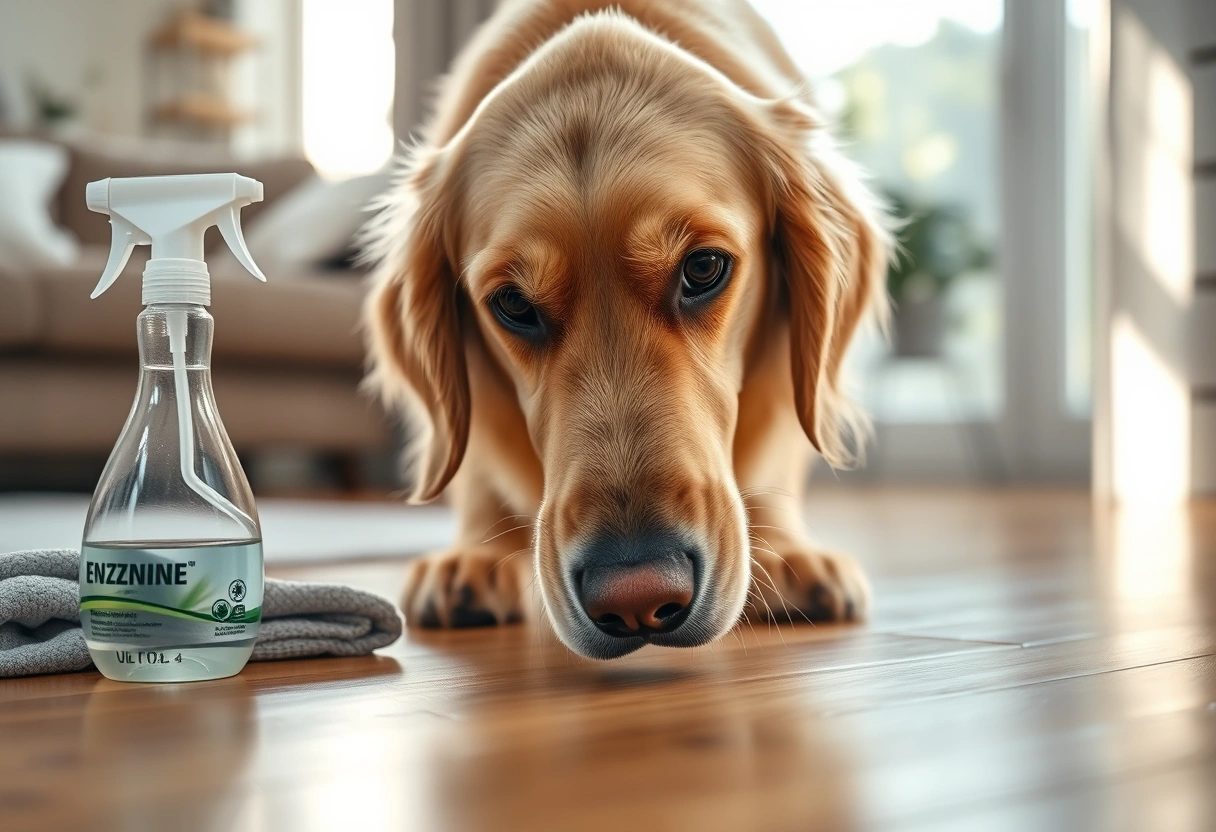
The 5 best enzyme cleaners to stop an older dog from peeing in the same spot work by breaking down uric acid crystals that ordinary cleaning products leave behind, crystals your dog’s nose can detect long after the stain looks and smells clean to you. If you’ve scrubbed a corner of the living room a dozen times and your senior dog still squats there, the problem isn’t your effort. It’s your chemistry. Standard cleaners mask odor for human noses while leaving a biochemical signature that tells your dog’s brain, “this is the bathroom now.” Fixing that requires an enzymatic approach paired with a behavioral plan, and that’s exactly what we’re covering here.
Key Takeaways
- Senior dogs relapse into the same urination spot because of residual uric acid crystals, not defiance or spite.
- Cognitive dysfunction syndrome affects an estimated 28% of dogs aged 11-12 and 68% of dogs aged 15-16, according to a study published in the Journal of the American Veterinary Medical Association, and it directly complicates house soiling behavior.
- Enzyme cleaners to stop an older dog from peeing in the same spot must have adequate dwell time and correct enzyme concentration to fully digest the odor-causing compounds.
- The best enzyme cleaners to stop an older dog from peeing in the same spot differ by surface type, with hardwood requiring lower moisture saturation than carpet.
- Cleaning alone rarely solves the problem. It needs to be paired with antecedent management and a veterinary check for incontinence or cognitive decline.
Why Older Dogs Fixate on the Same Spot
Older dogs return to the same urination spot because of olfactory memory formation combined with age-related changes in bladder control and cognition, not because they’re being stubborn. A dog’s relationship with a soiled substrate is functionally different from ours. We see a stain. A dog detects a chemical map. Uric acid salts embed into porous materials like carpet fiber, grout, and wood subflooring, and those crystals remain detectable to a dog’s nose for months, sometimes longer, even after the visible mark is gone and the smell has faded for you.
This matters more in senior dogs for a specific reason: cognitive dysfunction syndrome. CCD is the canine analog to Alzheimer’s disease in humans, and it disrupts the hippocampal and prefrontal circuitry involved in learned inhibition, spatial memory, and impulse control. A dog with CCD doesn’t necessarily forget house training. What breaks down is the ability to override the strong instinctual pull toward a location that already smells like urine. According to a study published in the Journal of the American Veterinary Medical Association, CCD affects an estimated 28% of dogs aged 11 to 12 and climbs to 68% of dogs aged 15 to 16. That’s not a minor subset. That’s the majority of dogs in the oldest cohort.
Here’s the mechanism in plain terms. Urine-soaked substrate creates a self-reinforcing olfactory cue. The dog smells the spot, the smell triggers an innate elimination response (this is functionally similar to how a puppy is drawn to a designated potty pad, except now it’s happening in your hallway), and the behavior repeats regardless of whether the original medical or situational trigger has resolved. You could fully treat a urinary tract infection, restore perfect bladder function, and the dog may still return to that spot out of pure stimulus-response conditioning. The lingering scent is doing the work, not the bladder.
The Behavioral Science of Enzymatic Cleaning
Standard soap, vinegar, and ammonia-based cleaners fail to stop repeat marking because they don’t break the molecular structure of uric acid, they just mask the smell for the human nose while leaving the crystals fully intact for the canine one. Vinegar is acidic and can actually react with ammonia byproducts in a way that intensifies odor at the microscopic level detectable to dogs. Soap and water lift surface debris but don’t touch the crystallized salts that have bonded to fibers or wood grain below the surface.
The sensory gap here is enormous, and it’s worth sitting with the actual numbers. Canine noses have up to 300 million scent receptors, compared to roughly 6 million in humans, according to research from the Monell Chemical Senses Center. Dogs also have a specialized organ, the vomeronasal organ, dedicated to processing chemical signals that we don’t perceive at all. When you say a spot “smells clean,” you are reporting on a sensory apparatus that is, quite literally, thousands of times less sensitive than your dog’s. That gap is the entire reason enzyme cleaners to stop an older dog from peeing in the same spot exist as a distinct product category rather than just being marketed as another air freshener.
Bio-enzymatic formulas work through a different mechanism entirely. They contain live bacterial cultures that produce enzymes (typically proteases and amylases) which metabolize the uric acid crystals into carbon dioxide and water. This is a biological digestion process, not a masking process. It takes time, which is why dwell time matters so much and why a quick spray-and-wipe often fails even with a high-quality product. Incomplete removal doesn’t just leave odor behind, it perpetuates what behaviorists call the antecedent-response cycle: the residual scent is the antecedent stimulus, and the elimination behavior is the response. Until the antecedent is fully removed, the behavior has no reason to stop, regardless of how well-trained the dog was for the preceding ten years.
The data is fairly consistent on this point: partial enzymatic cleaning is functionally similar to no cleaning at all from the dog’s perspective. A 90% reduction in scent concentration still leaves a detectable, location-specific cue for an olfactory system built to notice parts-per-trillion differences. If you’re going to use enzyme cleaners to stop an older dog from peeing in the same spot, treat the dwell time instructions as a clinical protocol, not a suggestion.
5 Best Enzyme Cleaners to Stop an Older Dog from Peeing in the Same Spot
The best enzyme cleaners to stop an older dog from peeing in the same spot vary in enzyme concentration, dwell time, and surface compatibility, and matching the product to your specific flooring and odor severity matters more than brand loyalty. Below is a comparative breakdown based on formulation type and functional performance criteria rather than marketing claims.
| Product Type | Enzyme Concentration | Recommended Dwell Time | Best Surface Match | Scent Profile |
|---|---|---|---|---|
| Rocco & Roxie Professional Strength | High | 24 hours for set-in stains | Carpet, upholstery | Light citrus, low-intensity |
| Angry Orange Pet Odor Eliminator | Moderate to high | 10-15 minutes, reapply for old stains | Hardwood, tile, sealed grout | Strong citrus (avoid for scent-reactive dogs) |
| Nature’s Miracle Advanced Formula | Moderate | 5-10 minutes, longer for deep-set odor | Carpet, carpet pad | Mild fragranced or unscented option |
| Simple Solution Extreme Pet Stain & Odor Remover | High | Air dry fully, no blotting | Carpet, subfloor penetration | Fragrance-free available |
| OUT! Pet Stain & Odor Remover | Moderate | 3-5 minutes for fresh stains | Hardwood, laminate, tile | Fresh scent or unscented |
A few clinical observations worth flagging before you pick one. First, fragranced formulas like Angry Orange are effective at consumer-grade odor masking, but for a senior dog with heightened olfactory sensitivity or existing anxiety, a strong citrus additive can itself become a new aversive stimulus in the environment, so evaluate your dog’s individual scent tolerance before committing to a heavily fragranced product. Second, hardwood and sealed surfaces need lower liquid volume than carpet, because oversaturating wood risks warping and finish damage, and the enzymatic solution needs to sit on the surface rather than soak deep into a subfloor that carpet backing would otherwise absorb. Third, for carpet with padding, a single application is rarely sufficient. Urine wicks downward into the pad, and if you only treat the visible carpet fiber, the crystallized layer in the pad remains fully intact and continues emitting a detectable signal upward through the carpet over time.
Whichever of these enzyme cleaners to stop an older dog from peeing in the same spot you choose, the application principle stays consistent: saturate to match the depth of the original accident, respect the full dwell time listed by the manufacturer, and avoid steam cleaning treated areas for at least a few weeks, since heat can permanently set residual protein stains and destroy the enzymatic culture before it finishes digesting the uric acid.
Pairing Cleaning Protocols with Behavioral Management
Enzymatic cleaning alone rarely resolves repeat elimination in senior dogs, and pairing it with a structured behavioral protocol produces significantly better outcomes than cleaning in isolation. Here’s a step-by-step approach based on standard antecedent management principles used in applied animal behavior work.
- Treat the site thoroughly first. Apply your chosen enzyme cleaner with correct dwell time before attempting any behavioral intervention. Skipping this step undermines everything that follows.
- Recalibrate potty break scheduling to age. Senior dogs experience measurable bladder capacity decline. A dog who comfortably held it for 8 hours at age 4 may need a break every 4 to 5 hours at age 12. Set a schedule based on your dog’s actual demonstrated capacity, not their capacity from five years ago.
- Restrict physical access to the site during the extinction window. Use a baby gate, closed door, or furniture placement to block the specific spot for at least 2 to 4 weeks while the new scheduling and reinforcement pattern takes hold. This isn’t punishment, it’s antecedent control, removing the trigger before the behavior has a chance to occur.
- Reinforce successful outdoor elimination immediately. Reward within 1 to 2 seconds of the dog finishing outside, using high-value treats and calm verbal praise. Timing matters more than the reward itself. A competing positive association needs to form quickly and consistently to outweigh the old habit strength.
- Track patterns in a simple log. Note time of day, water intake, and any accidents for two weeks. This data becomes useful both for adjusting the schedule and for a veterinary visit if the pattern doesn’t improve.
None of this requires punishment or scolding, and there’s good reason to avoid both. Punishing a senior dog for house soiling, particularly one with underlying cognitive decline, tends to increase stress hormone output and can worsen the anxiety-related component of the behavior without addressing the biological driver at all.
When Cleaning Isn’t Enough: Ruling Out Medical Drivers
Persistent spot-marking that continues despite thorough enzymatic cleaning and consistent behavioral management usually signals an underlying medical issue rather than a purely behavioral one. Urinary incontinence and cognitive decline frequently co-occur in geriatric dogs, and treating the situation as a pure training problem when there’s an undiagnosed medical component wastes time and prolongs the dog’s discomfort.
Conditions to rule out with a veterinarian include urinary tract infections, bladder stones, kidney disease, diabetes mellitus, Cushing’s disease, and age-related urinary sphincter incontinence, which is especially common in spayed female dogs. Don’t count on behavioral fixes alone to work miracles if one of these is present and untreated. A dog leaking urine involuntarily during sleep, for example, isn’t making a choice at all, and no amount of scheduling adjustment or enzyme cleaning will change a physiological leak.
Bring this simple observational checklist to your next veterinary appointment:
- Is the urination a full-volume squat-and-void, or a small leak/dribble, particularly during rest or sleep?
- Has water intake increased noticeably in recent weeks?
- Does the dog seem aware of the accident afterward, or show no reaction at all?
- Are there other CCD indicators present, such as disorientation, altered sleep-wake cycles, or reduced interaction with family members?
- Has the frequency increased gradually over months, or did it start suddenly within days?
A sudden onset points more toward an acute medical cause like infection. A gradual increase paired with disorientation or altered sleep patterns points more toward cognitive decline. Both deserve a veterinary workup, and both benefit from enzymatic cleaning as a supporting measure, but neither will fully resolve through cleaning and training alone if the underlying driver is medical.
FAQ
Why do enzyme cleaners work better than vinegar or soap for dog urine?
Enzyme cleaners contain live bacterial cultures that produce enzymes capable of biologically digesting uric acid crystals, breaking them down into carbon dioxide and water. Vinegar and soap only mask odor for the human nose and can leave the crystallized compounds fully intact, which remain fully detectable to a dog’s far more sensitive olfactory receptors.
How long should enzyme cleaner sit before wiping it up?
Dwell time varies by product and stain age, typically ranging from 5 minutes for fresh accidents up to a full 24 hours for older, deeply set stains. Always follow the manufacturer’s specific instructions, and avoid blotting or rinsing before the recommended time has passed, since doing so interrupts the enzymatic digestion process before it’s complete.
Can cognitive dysfunction syndrome alone cause repeat urination in the same spot?
Yes. Cognitive dysfunction syndrome disrupts the brain circuitry responsible for learned inhibition and spatial memory, which can cause a fully house-trained senior dog to lose the ability to override the instinctual pull toward a previously soiled location, even without any change in bladder health.
Is it safe to use enzyme cleaners on hardwood floors?
Most enzyme cleaners are safe for sealed hardwood when applied with lower liquid volume than you’d use on carpet, since oversaturation risks warping or damaging the wood finish. Always test a small, inconspicuous area first and avoid steam cleaning treated hardwood for several weeks afterward.