
An anxiety wrap for dogs and a calming donut bed target the same problem through completely different biological pathways, and that distinction matters more than most product listings let on. If your senior dog erupts into barking the moment you pick up your car keys, you’re not dealing with a training failure or a stubborn streak. You’re watching a distress vocalization driven by activation of the hypothalamic-pituitary-adrenal axis, the same stress response system that governs panic in every mammal. Understanding which tool actually calms that system, rather than just muffling the symptom, is the difference between a senior dog who settles within minutes of your departure and one who barks through the entire duration of your absence.
Separation Barking Is a Stress Response, Not a Behavior Problem
Owners frequently describe departure barking as “acting out” or assume their dog is punishing them for leaving. That framing doesn’t hold up against the physiology. When a senior dog with an established attachment bond loses visual and olfactory contact with their person, the amygdala flags the separation as a potential threat, and the HPA axis responds by releasing cortisol and adrenaline. Barking, pacing, and destructive chewing are downstream symptoms of that arousal cascade, not deliberate protest. This is a critical distinction for owners of aging dogs, because cognitive decline and sensory loss (reduced hearing, dimming vision) often amplify baseline anxiety, making a previously independent dog suddenly intolerant of alone time. If your dog’s vocalizing extends beyond departures into general noise-reactivity, it’s worth reading our breakdown of senior dog barking causes and fixes, since sensory decline and separation distress frequently overlap and get misdiagnosed as one another.
The practical takeaway here is that any intervention, whether it’s a calming dog bed or an anxiety wrap for dogs, has to work by lowering physiological arousal, not by suppressing the bark itself. A tool that stops the sound without addressing the underlying stress state isn’t solving the problem. It’s masking a welfare issue.
Cortisol elevation during isolation distress isn’t a personality trait, it’s a measurable physiological event. Any management tool worth recommending should show a corresponding drop in that marker, not just a quieter room.
How a Calming Bed Actually Works on the Nervous System
A calming donut bed operates on three overlapping mechanisms: thermoregulation, proprioceptive input, and nesting behavior. The raised bolster walls provide a sensation similar to denning, which taps into an evolutionarily conserved preference for enclosed, defensible resting spaces. Dogs, particularly aging dogs with reduced mobility or diminished confidence, tend to select tighter, warmer resting sites when given the choice, and that preference correlates with lower resting heart rate in several kenneled-dog studies. A 2022 study published in Applied Animal Behaviour Science measured cortisol markers in kenneled dogs provided with enclosed, deep-pressure bedding versus standard flat bedding, and found a statistically measurable reduction in cortisol output in the enclosed-bed group. The mechanism appears to be a combination of thermal retention and the deep-pressure contact of the bolster against the dog’s back and flank, which mimics the sensory input of being pressed against a littermate or a person during rest. For a senior dog, this matters because aging joints and thinning body fat make thermoregulation harder, and a dog that’s physically cold is a dog with an already-elevated stress baseline before the departure cue even happens. The NOYAL Calming Donut Dog Bed, Hooded Cave with Blanket is a reasonable example of this design category, combining the bolstered walls with a hooded cave section and a weighted blanket that adds a second layer of deep-pressure input. Dogs who are noise-sensitive, meaning they startle at sirens, thunder, or street traffic, tend to respond best to this style of enclosed, sound-dampened bedding because it reduces auditory input alongside the tactile calming effect.

- 【Blanket Cave Design for Anxious Dogs & Curious Cats】:Is your pet a cozy cave-seeker or a dedicated burrower? This innov…
- 【Optimal Size & Raised Edge for Joint & Neck Support】:Choose the perfect fit! Available in 3 sizes (19.6”, 25.5”, 31.5”)…
- 【Plush & Supportive Fill for Superior Comfort】:Made with premium, high-loft PP cotton filling, this bed offers exception…
It’s also worth noting that a calming bed is a passive, always-available management tool. It requires no application, no fitting, and no habituation period, which makes it a low-friction first step for owners who haven’t yet identified their dog’s specific sensory triggers.

How an Anxiety Wrap Works, and Why the Evidence Is Split
The dog anxiety wrap category, which includes Thundershirt-style garments and swaddling wraps, works on the principle of sustained gentle pressure applied across the torso. The theoretical basis draws from swaddling research in human infants and from deep-pressure therapy used in autism intervention, where constant, even pressure is thought to reduce sympathetic nervous system activity. In dogs, the proposed mechanism is similar: the wrap compresses the trunk in a way that may lower heart rate and reduce the startle threshold. The problem is that the evidence base for this mechanism in dogs is genuinely mixed, and pet owners deserve to hear that plainly rather than have it glossed over by marketing copy. A 2020 University of British Columbia veterinary behavior review examined wrap efficacy across a sample of anxious dogs and found that the results varied significantly by individual, with roughly half the sampled cases showing no statistically significant difference from a placebo garment. Some dogs showed clear reductions in cortisol and behavioral distress scores. Others showed no measurable change at all, and a smaller subset actually showed increased agitation, likely due to a negative association with the physical sensation of being restrained. This is a case where individual variation matters more than the average effect size. A wrap is far more likely to help a touch-sensitive dog who already seeks out physical contact and pressure (leaning against your leg, burrowing under blankets) than a novelty-averse dog who resists any unfamiliar object touching their body. For dogs in that second category, introducing a wrap without a gradual desensitization period can add a second stressor on top of the separation distress you’re trying to treat.
If you’re testing wrap-style garments, a snug, well-fitted XS Dog Pjs for Small Dogs – Warm 4-Leg Long Sleeve Onesie can serve as a useful low-stakes introduction to sustained body contact for small-breed seniors, since the full-coverage fabric provides some of the same even pressure distribution as a purpose-built anxiety wrap, while also addressing thermoregulation for thin-coated or arthritic dogs who get cold easily during long alone periods.

- 【Size Note】L size dog pajamas for small breeds only.Please check the size chart (measure chest, neck & back length). Pri…
- 【Tip】 For short-legged breeds like Dachshunds: If the sleeves are too long when chest/back fit well, simply roll or trim…
- 【Soft & Breathable Fabric】 Pajamas for dogs made of stretchy lightweight fabric for easy wear. Keeps pets warm in AC/col…
Don’t count on a wrap to work miracles on its own. Pressure garments are best positioned as a component of a broader management plan rather than a standalone fix for separation anxiety barking, particularly for senior dogs whose distress is compounded by cognitive decline or sensory loss rather than pure attachment anxiety.
Calming Bed vs Anxiety Wrap: Side-by-Side Comparison
The table below breaks down the practical differences between these two tools across onset speed, cost tier, training effort, and which dog profile tends to respond best. Use it as a starting reference, not a guarantee, since as established above, individual response varies considerably, especially with wraps.

| Feature | Calming Donut Bed | Anxiety Wrap |
|---|---|---|
| Primary mechanism | Thermoregulation, nesting behavior, passive deep-pressure contact | Sustained active pressure across torso (swaddle effect) |
| Onset speed | Gradual; effect builds over repeated use as bed becomes associated with safety | Can be immediate in responsive dogs; negligible in non-responsive dogs |
| Training/habituation effort | Low; most dogs self-select the bed with minimal shaping | Moderate to high; requires desensitization before departures |
| Best-fit dog profile | Noise-sensitive seniors, cold-intolerant dogs, dogs with joint pain | Touch-seeking dogs who already enjoy contact and leaning |
| Evidence strength | Supported by measurable cortisol reduction in controlled studies | Mixed; roughly half of studied cases show no advantage over placebo |
| Price Tier | $$ | $$$ |
A Structured Observational Exercise: A/B Testing Both Tools
Rather than guessing which tool fits your dog, run a short, structured test. This mirrors the functional behavioral assessment approach used in clinical practice, adapted for a home setting.
- Baseline log (days 1-3): Set up a phone or pet camera on your dog’s usual resting spot before any departure. Record duration until the first bark, total barks per 10-minute interval, and whether the dog lies down, paces, or stays fixated on the door.
- Calming bed phase (days 4-9): Introduce the bed at least two days before testing so the dog has time to build a neutral or positive association. Use the same departure routine and camera setup. Score using the same bark-frequency rubric.
- Anxiety wrap phase (days 10-15): Fit the wrap during calm, low-stakes moments first (during a nap, during a meal) for several sessions before using it during an actual departure. Never introduce a wrap for the first time immediately before leaving, since novel sensations paired with departure can create a negative association rather than a calming one.
- Combined phase (days 16-18, optional): If neither tool alone produces a meaningful drop in bark frequency, test both together. Some dogs, particularly those with mixed noise-sensitivity and touch-seeking profiles, respond better to the combination than to either tool in isolation.
- Score and compare: Tally total barks per session across each phase. A reduction of 50% or more from baseline is a reasonable threshold to call a tool “working.” Anything less suggests you’re dealing with a more complex distress pattern that likely needs a veterinary behaviorist consult rather than a product-based fix.
Weather and outdoor conditions can complicate this testing window too. If your dog needs to be let out during the test period and it’s raining, a properly fitted Waterproof Corgi Raincoat, Breathable Dog Belly & Chest Coverage keeps short-coated or arthritic seniors dry and warm without disrupting the observational protocol, since an uncomfortable, wet dog introduces a confounding stress variable into your bark-frequency data.
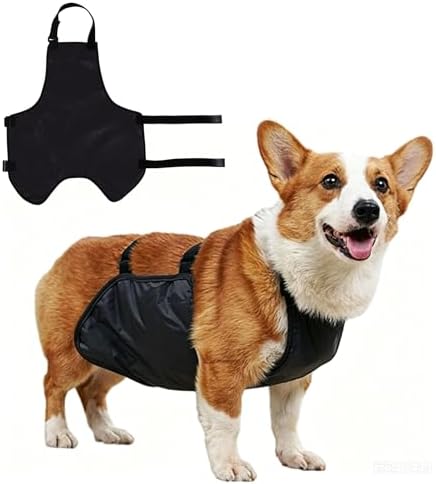
- Waterproof & Breathable Fabric:Crafted from premium waterproof polyester material with good air permeability. It won’t m…
- Targeted Chest & Belly Protection:Specially designed for short-legged dogs like Corgis. It focuses on shielding the ches…
- Convenient for Free Movement & Excretion:The reasonable cut won’t restrict your dog’s daily activities. It features a pr…
What the Data Actually Supports for Senior Dogs
For an aging dog, the calming dog bed generally has the stronger evidence base as a first intervention, largely because it addresses two problems at once: physiological comfort (thermoregulation, joint support) and a stable, low-arousal resting environment. The anxiety wrap for dogs category can still be a useful secondary tool, particularly layered onto a bed-based routine, but owners should go in with realistic expectations given the placebo-level performance found in a meaningful portion of studied dogs. According to the ASPCA’s guidance on separation-related behavior, a combination of environmental management and gradual desensitization to departure cues tends to outperform any single product intervention, which lines up with what the A/B testing protocol above is designed to reveal. If your senior dog’s distress extends into nighttime accidents alongside daytime barking, it’s also worth reviewing our comparison of crate versus belly band options for nighttime accidents, since overlapping anxiety and bladder control issues in older dogs often need to be addressed as a combined protocol rather than treated separately.
Building a Happiness Plan Around Your Findings
Once you’ve identified which tool (or combination) produces a measurable drop in bark frequency, formalize it into a written plan. Note the specific departure cues that trigger the strongest response (keys, shoes, garage door), the tool or combination that reduced barking, and a target bark-count threshold you’re working toward. Revisit the log monthly, since a senior dog’s sensory and cognitive status can shift over a matter of weeks, and a tool that worked in spring may need to be paired with something new by fall as hearing or vision continues to decline. This ongoing reassessment, rather than a one-time purchase decision, is what actually keeps the separation anxiety barking pattern from resurfacing.
Is an anxiety wrap for dogs safe to leave on all day?
No. Most manufacturers and veterinary behaviorists recommend removing a wrap after a few hours to allow normal skin airflow and to prevent the dog from habituating to constant pressure, which can reduce the wrap’s effectiveness over time. Reserve it for specific high-stress windows like departures rather than all-day wear.
Can a calming dog bed alone stop separation anxiety barking?
A calming dog bed can meaningfully reduce arousal in noise-sensitive or cold-sensitive dogs, but it rarely resolves severe separation anxiety barking on its own. It works best as one piece of a broader plan that includes departure desensitization and, in more severe cases, veterinary consultation.
How long does it take to know if an anxiety wrap is working?
Give it at least five to six separate departure sessions after a proper desensitization introduction before drawing conclusions. Some dogs show a response within the first use, while others need repeated low-stakes exposure before any calming effect becomes measurable, if it appears at all.
Should I try the calming bed or the anxiety wrap first?
Start with the calming bed. It requires no habituation period, carries a stronger controlled-study evidence base, and addresses physical comfort factors that compound anxiety in senior dogs. Introduce the wrap afterward as a secondary tool if bark frequency hasn’t dropped to an acceptable level.