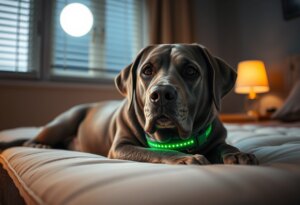
Calming aids for dogs work best when they are treated as one part of a behavior modification plan, not a standalone fix for a dog who erupts into barking every time you hug another person. If your senior dog loses composure the moment arms wrap around another body, you are watching a stress response, not a jealous outburst. The distinction matters clinically, because how you interpret the behavior determines whether your intervention actually reduces the dog’s arousal or just suppresses the noise while the underlying stress stays fully intact.
Why Dogs Bark When You Hug Someone: The Actual Behavioral Function
Owners frequently describe this behavior as jealousy, but that label assigns a human social-cognitive process to a dog that is more plausibly running on a much simpler behavioral script. Two mechanisms show up most often in clinical case review. The first is resource guarding, where the owner is functioning as a high-value resource and the hug represents another individual gaining access to that resource. The second is an alarm response to a sudden, rapid proximity change between two large bodies, which for a dog with reduced visual acuity or hearing (common in aging dogs) can register as a startling, ambiguous event rather than an affectionate gesture.
Neither explanation requires attributing complex emotional reasoning to the dog. Both are testable, both respond to environmental modification, and both are far more consistent with what we know about canine sensory processing and arousal thresholds. Senior dogs in particular are working with a narrower margin for coping. Age-related sensory decline, joint discomfort, and mild cognitive changes all lower the threshold at which a novel or sudden stimulus tips into a stress reaction.
Stress Physiology: What the Research Actually Shows
A 2020 study published in Applied Animal Behaviour Science observed dogs during owner-to-stranger and owner-to-familiar-person embraces and recorded a marked increase in stress signaling, including lip licking, freezing, ear pinning, and whale eye, in the seconds surrounding the hug. These are classic displacement and appeasement signals, not indicators of possessive triumph. The data supports a trigger-stacking interpretation: the hug is rarely the sole stressor. It is typically the final input layered on top of an already elevated baseline caused by things like a full bladder, an unfamiliar visitor’s scent, background noise, or simple end-of-day fatigue.
This is a critical point for owners to sit with, because it changes the entire treatment approach. If you only address the hug itself, you’re managing one slice of a much larger arousal curve. The more useful question is not “how do I stop the barking” but “what is this dog’s cumulative stress load in the ten minutes leading up to the greeting.”

The barking is rarely about the hug in isolation. It is almost always the last domino in a chain of stacked stressors the dog has been absorbing quietly, often without any outward sign, until arousal crosses threshold.
Comparative Breakdown of Calming Aids for Dogs
Calming aids for dogs fall into a few clinically distinct categories, and they are not interchangeable. Pheromone diffusers, such as ADAPTIL, are synthetic analogs of the dog-appeasing pheromone released by lactating females. A 2018 peer-reviewed trial recorded roughly a 30 percent reduction in observable stress signaling among dogs exposed to the pheromone during known trigger events. That is a meaningful effect size, but it is an adjunct, not a cure. Supplements built around L-theanine or alpha-casozepine work through a different pathway, supporting GABAergic activity to gently lower baseline arousal rather than blocking a specific trigger response. Compression wraps and pressure vests apply the same deep-pressure principle used in some human anxiety interventions, and they tend to help most with dogs whose stress presentation includes trembling or pacing rather than pure vocalization.
None of these tools teach the dog an alternative behavior. That is the piece owners consistently underestimate. A calming aid can lower the physiological ceiling enough that training actually has room to work, but it will not, by itself, teach your dog what to do instead of barking.
Comfort during recovery periods matters too. A dog managing chronic stress alongside joint pain benefits from a genuinely supportive resting space, which is where a product like the FurHaven Orthopedic Dog Bed for Large Dogs, Sofa-Style earns its place in a senior dog’s environment, not as a calming aid per se, but as a decompression zone that supports the “go to mat” protocol described below.

- Give Your Pet Deep, Restful Sleep: Our cooling gel sofa bed is engineered to deliver true comfort and joint relief for l…
- A Perfect Fit For Every Sleep Style: Don’t settle for a rigid, one-size-fits-all bed. Our sofa-style design is made for …
- Wash It, Dry It, Done: A dirty pet bed can fill your home with odors and allergens. Our XL washable dog bed makes cleanu…
Comparison Table: Calming Aids for Dogs at a Glance
| Calming Aid Type | Primary Mechanism | Best Suited For | Onset Time | Price Tier |
|---|---|---|---|---|
| Pheromone Diffuser (e.g., ADAPTIL) | Mimics dog-appeasing pheromone, lowers ambient arousal | General household stress, multi-dog homes | 7 to 14 days for full effect | $$ |
| L-theanine / Alpha-casozepine Supplement | Supports GABAergic calming pathways | Dogs with chronic baseline anxiety | 1 to 2 hours (acute), weeks (baseline) | $$ |
| Compression Wrap / Pressure Vest | Deep touch pressure, sensory calming | Trembling, pacing, situational triggers | Minutes | $$ |
| Calming Lickable Treats | Behavioral redirection plus mild calming ingredients | Fast, low-effort greeting redirection | 10 to 20 minutes | $ |
| Orthopedic Decompression Bed | Physical comfort, supports “go to mat” cue | Senior dogs with joint pain and stress overlap | Immediate physical relief | $$$ |
Redirection Tools: A Practical Aside on Lickable Calming Treats
One low-friction tool worth adding to a greeting protocol is a calming lickable treat, which gives the dog a competing behavior (licking, which is inherently self-soothing) at the exact moment the trigger occurs. While formulated for feline anxiety, the Cat Calming Lickable Treats for Anxiety Relief illustrates the mechanism well: a slow, repetitive licking motion activates a parasympathetic response that is difficult to sustain alongside a barking display. If you’re building a redirection kit, look for a dog-specific version with the same lickable format and confirm ingredients are appropriate for your dog’s age and any existing medical conditions with your veterinarian first.

- CREATURE COMFORTS: Even the coolest cat can experience stress. That’s why our Cat Squeezables Calming Support is specifi…
- THE INSIDE STORY: We’ve got other calming lickables licked, because ours are made with clean ingredients that help sooth…
- FILLER-FREE: Unlike other pet purees that contain by-products and fillers like cellulose, corn, soy, wheat and palm oil,…
A long-lasting chew serves a similar functional purpose during planned greeting rehearsals. Chewing is another behavior that competes directly with barking, and it extends the redirection window well beyond a quick lick. The Dogsee Mint Flavor Himalayan Yak Chews for Dogs works well for this because the mint flavor adds a novel sensory input that can help interrupt an escalating arousal spiral before it reaches a full bark response. Reserve it for structured practice sessions rather than every greeting, so it retains its value as a high-interest reinforcer.

- FIGHT BAD BREATH: Mint present in these Himalayan Yak Chews helps freshen your dog’s breath, making close cuddles more p…
- AID DIGESTION: Mint is known for its soothing properties, which can help support your dog’s digestive health.
- NATURAL INGREDIENTS: These Mint-flavored Yak cheese chews are hand-crafted in the Himalayas using only natural ingredien…
Antecedent Management Protocol: Desensitization and Counterconditioning
Calming aids for dogs create the physiological window in which training can succeed, but the actual behavior change comes from a structured antecedent management protocol. This is a step-by-step desensitization and counterconditioning sequence, and it should be run below the dog’s bark threshold at every stage.
- Establish a default “go to mat” behavior in a low-arousal context first, using a comfortable resting surface the dog already associates with calm, such as an orthopedic bed placed away from the main greeting zone.
- Identify the dog’s current trigger distance. Have two people simulate a slow, brief hug at a distance far enough that the dog stays relaxed. Mark that baseline distance.
- Pair the early stages of the hug with a high-value calming aid (a lickable treat or chew) delivered the instant the two people begin to embrace, not after the dog reacts.
- Gradually reduce distance across sessions, only advancing when the dog remains under threshold for three consecutive repetitions.
- Shorten hug duration progressively rather than jumping straight to full-length embraces, since duration is often as arousing as proximity.
- Reinforce the mat behavior independently of the hug exercise, so the dog has a clear, well-rehearsed alternative response it can offer voluntarily.
- Track trigger stacking by avoiding practice sessions immediately after exercise, feeding time, or visitor arrivals, when baseline arousal is already elevated.
This protocol gives the dog agency. Rather than being physically restrained or verbally corrected mid-bark, the dog learns it has a reliable, reinforced option that produces a better outcome than vocalizing. That distinction, between suppression and taught alternative behavior, is the difference between a dog who stops barking because it is shut down and a dog who stops barking because it has a better plan.
If nighttime vocalization is compounding daytime greeting stress, it is worth addressing both simultaneously, since sleep disruption raises baseline cortisol and lowers bark threshold across the board. Our guide on stopping senior dog barking at night covers a parallel protocol that pairs well with this one.

Case-Profile Evaluation: Building a Two-Week Happiness Plan
Clinical tracking turns a vague impression (“he’s getting better”) into measurable data. A simple Happiness Plan template, logged daily for two weeks, should include the following fields:
- Date and time of greeting event
- Trigger intensity (1 to 5): distance, duration, and number of unfamiliar people involved
- Baseline arousal before the event: was the dog already stressed from another source
- Calming aid used: which tool, dosage or application, and timing relative to the trigger
- Observed stress signals: lip licking, freezing, whale eye, barking latency, or full vocalization
- Recovery time: minutes until the dog returns to baseline calm behavior
Review the log every third or fourth day rather than daily, since day-to-day noise can obscure the real trend. Look specifically at whether recovery time is shortening and whether trigger intensity thresholds are climbing. If two weeks of consistent data show no measurable improvement, that is a legitimate signal to consult a veterinary behaviorist rather than escalating the same approach indefinitely. According to the ASPCA, persistent anxiety-driven behaviors that don’t respond to consistent behavioral intervention often warrant a professional evaluation to rule out pain or medical contributors, which is especially relevant in senior dogs.
Owners choosing among calming aids for dogs at this stage should also compare the safety profile of any deterrent-based tools they may already own, since some households mistakenly reach for aversive corrections when a dog barks during greetings. If you’re weighing options, our comparison of an ultrasonic bark deterrent versus a bark collar breaks down which is genuinely safer for a senior dog’s sensory system.
Putting It Together: Choosing the Right Calming Aids for Dogs Who Bark During Hugs
There is no single calming aid for dogs that resolves this behavior in isolation. The dogs who improve fastest are the ones whose owners treat calming aids as scaffolding around a real training protocol, not a replacement for one. A pheromone diffuser running in the background, a lickable treat timed precisely to the trigger, a decompression bed that supports the “go to mat” alternative, and a two-week tracking log will outperform any single product used alone. Senior dogs especially benefit from this layered approach, since their coping capacity is already narrower and their physical comfort directly affects behavioral resilience. Choosing calming aids for dogs with intention, and pairing them with consistent, below-threshold training, gives your dog a genuine path to calmer greetings rather than a quieter version of the same underlying stress.
Are dogs actually jealous when they bark during hugs?
The available research does not support true jealousy as the mechanism. Stress signaling studies point instead to resource guarding or an alarm response to sudden proximity change, both of which are simpler and more consistent with canine cognitive processing than a complex emotion like jealousy.
Do calming aids for dogs work on their own without training?
Calming aids for dogs lower baseline arousal and create a physiological window for learning, but they do not teach an alternative behavior by themselves. Pairing a calming aid with a structured desensitization protocol produces far more durable results than using the aid in isolation.
How long does it take to see results from calming aids for dogs?
Pheromone diffusers typically need seven to fourteen days of continuous use to reach full effect, while supplements built on L-theanine or alpha-casozepine may show acute effects within one to two hours but require several weeks for a meaningful baseline shift. Behavioral training results usually emerge over two to four weeks of consistent, below-threshold practice.
When should I involve a veterinary behaviorist instead of managing this myself?
If two consistent weeks of tracked data show no reduction in trigger intensity or recovery time, or if the barking is accompanied by signs of pain, sudden onset, or aggression, a veterinary behaviorist should evaluate the dog. This is particularly important in senior dogs, where undiagnosed pain often presents as a behavioral change rather than an obvious physical symptom.