
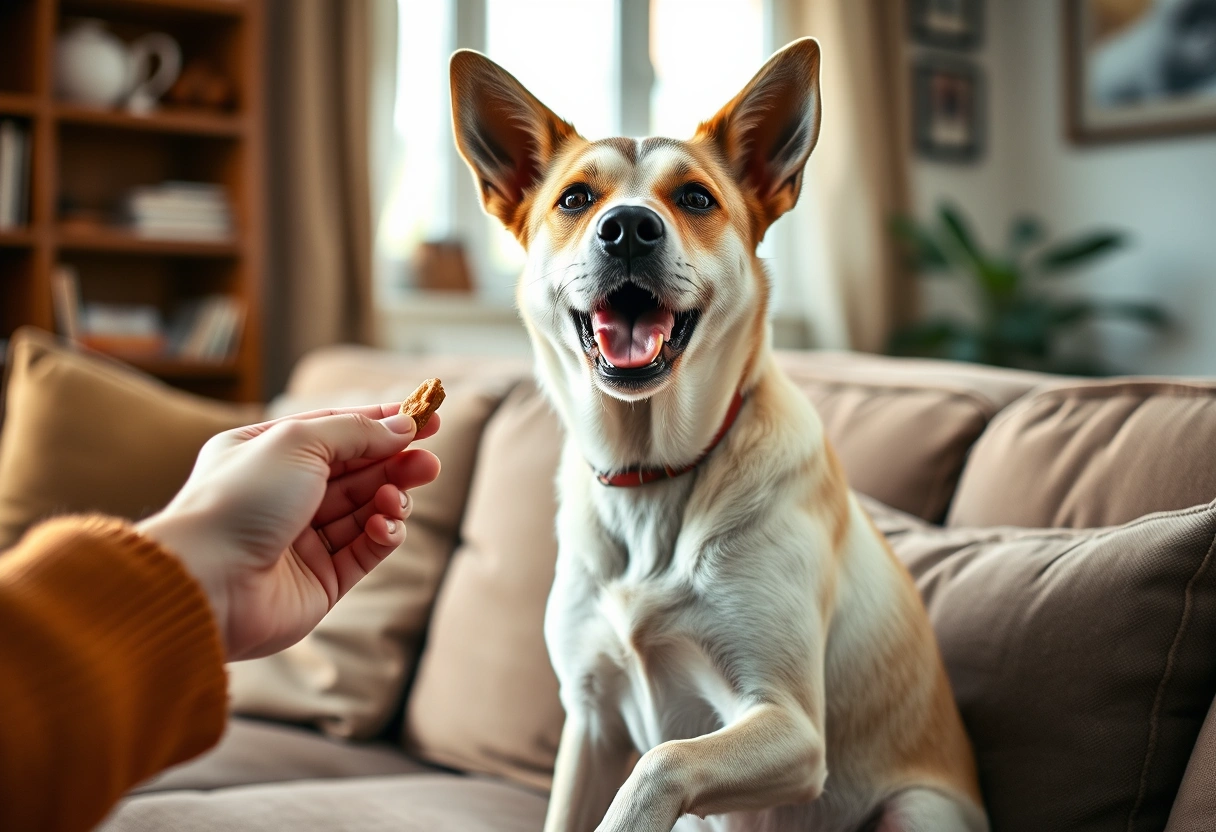

Couch barking dog behavior is rarely about defiance. When a dog erupts into barking the moment you sit down on the sofa, most owners assume the dog is being possessive of “their” spot or trying to boss you around. The actual mechanism is usually simpler and more mechanical than that: either the couch has become a defended resource, or the barking itself has been accidentally reinforced by your own reactions over dozens of repetitions. Sorting out which pattern you’re dealing with is the first diagnostic step, and it changes everything about how you fix it.
Two Very Different Root Causes Behind Couch Barking Dog Behavior
Resource guarding and attention-seeking barking look almost identical from the outside, but they run on different behavioral engines. Resource guarding is a defensive response tied to perceived value of a space or object; the dog barks (or growls, stiffens, lip-curls) because your approach predicts loss of access to something it has learned to value highly. Attention-seeking barking runs on a completely different circuit: operant conditioning. If a dog barks and you look at it, talk to it, push it off the cushion, or even scold it, you have just delivered a consequence. If that consequence increases the future frequency of the barking, by definition it was reinforcing, regardless of how unpleasant it felt to you in the moment. Owners often tell me “he knows it annoys me,” but annoyance directed at the dog is still attention, and attention is often the single most powerful reinforcer available in a household. Couch barking dog behavior that ramps up specifically when you sit down, rather than when you simply walk past, is a strong clue that the couch itself, not your presence generally, has acquired value.
Dogs don’t bark to be dominant over furniture. They bark because a specific antecedent (you approaching or sitting on the couch) has reliably predicted a specific consequence (you leaving, you engaging, or you losing access to the space) enough times that the behavior has been shaped and maintained by that pattern.
What the Research Actually Says About Resource Guarding
A 2020 study published in Applied Animal Behaviour Science estimated that resource guarding behaviors are present in roughly 15 to 20 percent of pet dogs, a figure the researchers noted is likely underreported because owners frequently mislabel the behavior as “grumpiness,” “moodiness,” or a personality quirk rather than recognizing it as a functional guarding response. This matters clinically because mislabeling delays intervention. A dog who is grumpy is treated as an inconvenience to be tolerated; a dog who is guarding a resource is treated as an animal communicating a threat assessment that can be systematically changed through desensitization and counterconditioning. The couch, functionally, is no different from a food bowl or a favorite toy. It is a high-value resource with a soft, warm surface, an elevated vantage point, and proximity to the owner, three things that reliably increase perceived value in domestic dogs according to ASPCA behavioral resources on resource guarding and territorial behavior.

Antecedent Management: Teaching a Reliable Place Cue
Punishing the bark does not address the antecedent, the thing that happened right before the bark that set the behavior in motion. Differential reinforcement of an alternative behavior (DRA) works by making a different, incompatible behavior more valuable than the barking. A “place” or mat cue is the standard tool here because it gives the dog a job to do instead of guarding or vocalizing. Here is the protocol I walk clients through:
- Select a dedicated mat or platform and place it near, but not on, the couch. Distance from the trigger matters early on; start far enough away that the dog is calm.
- Load the mat with value by tossing high-value treats onto it several times a day, unrelated to any couch context, so the mat itself becomes a conditioned positive stimulus.
- Add the verbal or gestural cue once the dog is reliably moving to the mat on its own, pairing the word “place” with the movement, then reinforcing generously.
- Introduce the couch context gradually. Approach the couch yourself, cue “place,” and reinforce heavily when the dog chooses the mat over guarding or barking.
- Reinforce calm duration on the mat, not just arrival. Use a slow-release chew or a stationing platform designed for extended settle behavior to build duration without the dog needing to disengage and re-escalate.
- Fade the food lure once the behavior is reliable across at least 20 successful repetitions, shifting to intermittent reinforcement to build durability.
This process is slow by design. Rushing step four before the mat has strong reinforcement history is the most common reason owners tell me the “place” command “doesn’t work” for their dog.
The 3-Day Baseline Log: Finding Your Dog’s Reinforcement Cycle
Before changing anything, I ask owners to run a structured observational exercise for three days. This isn’t busywork, it’s functional assessment. Grab a notebook or your phone and log four columns every time the barking occurs: the trigger (you approaching, sitting, shifting position, reaching for a blanket), the latency (how many seconds between the trigger and the first bark), your response (verbal, physical, ignoring), and the outcome (did the dog stop, escalate, or get what it wanted). After three days, patterns tend to jump off the page. Most owners discover their own response, not the dog’s temperament, is the variable holding the cycle in place. If you consistently get up, speak to the dog, or move it off the cushion, you’ve been delivering a consequence on a fairly predictable schedule, and predictable schedules of reinforcement are extremely resistant to extinction once removed abruptly. This is also useful context if barking behavior extends beyond the couch into other rooms or toward visitors; if that’s the case, a broader look at the issue through resources like Dog Barking and Biting at You? Vet Behaviorist Help can help you rule out generalized reactivity rather than a couch-specific pattern.

Comparative Breakdown: Training Aids That Work vs. Outdated Tools
The tool market for barking is crowded, and a lot of it is built on outdated punishment models. The American Veterinary Society of Animal Behavior has published position statements explicitly cautioning against punishment-based tools like shock collars and citronella spray collars for behaviors with an anxiety or resource-guarding component, since suppressing the bark without addressing the underlying emotional driver frequently redirects the behavior into growling, snapping, or generalized anxiety elsewhere in the household. The data on aversive tools is genuinely contradictory in the literature; some studies show short-term suppression, but longitudinal data tends to show higher rates of fear-related behaviors in dogs trained primarily with punishment. Don’t count on a shock collar to work miracles here, because it doesn’t teach the dog what to do instead, it only teaches what to avoid, and avoidance learning under stress is a poor foundation for a dog that’s already anxious about resource access.
| Training Aid | Best For | Behavioral Mechanism | Price Tier |
|---|---|---|---|
| Interactive stationing mat | Teaching “place” cue, DRA protocols | Positive reinforcement, differential reinforcement of alternative behavior | $$ |
| Pressure-activated platform | Dogs that need a distinct tactile cue to settle | Antecedent management, clear stimulus discrimination | $$$ |
| Treat-dispensing puzzle toy | Redirecting arousal during owner transitions | Counterconditioning, alternative outlet for arousal | $$ |
| Citronella/shock collar (not recommended) | Not recommended for anxiety-linked barking | Positive punishment; AVSAB advises against use | $$$ |
Recovery Gear and Redirecting Arousal During Training Sessions
Training sessions for couch barking dog behavior are physically active for the dog, lots of movement to and from the mat, repeated approach-and-retreat drills, and sometimes a dog that’s recovering from an unrelated minor procedure still needs to participate in daily management without aggravating a healing site. If your dog is wearing a recovery collar during this period, a softer option like the MIDOG Inflatable Dog Cone After Surgery, Donut Collar allows the dog to still move to the mat, lie down comfortably, and take treats without the rigid cone interfering with normal stationing behavior.
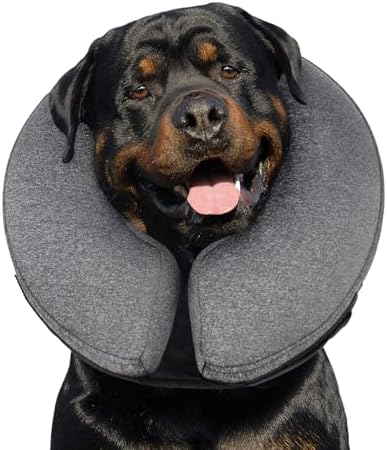
- STRESS-FREE RECOVERY: See, Eat & Sleep in Comfort! Our inflatable donut design provides a full range of vision, allowing…
- EFFECTIVE BARRIER: Designed for post-surgery healing. Creates a protective shield that prevents biting and licking of st…
- WON’T SLIP OFF: Thread your pet’s own collar through the inner loops for a secure fit. Adjustable strap provides a custo…
Outdoor Reinforcement Walks Support Indoor Behavior Change
Behavior change generalizes faster when a dog gets adequate physical outlet outside the training context itself. A dog who is under-exercised tends to show higher baseline arousal, which lowers the threshold for reactive barking around any perceived resource, couch included. Regular structured walks, especially in cold or wet climates where paw discomfort might otherwise shorten outdoor time, help keep total daily activity consistent. For dogs with sensitive paws or senior joints, something like Dog Shoes for Small Dogs, Waterproof Dog Boots can keep walk frequency consistent through winter months instead of skipping outings, which indirectly supports the DRA protocol by keeping arousal levels manageable at home.

- Choosing the right size dog boots for your puppy: Please refer to the picture size chart, choose the right size for your…
- Anti-slip dog booties: Dog booties are soft and breathable to paws, doggy shoes effectively protect dog claws from heat,…
- Adjustable dog hiking shoes: Easy to put on / off, Jzxoiva dog shoes are fastened firmly by reflective straps, which enh…
Tracking Progress Without Losing the Data
Once your baseline log is complete and you start the place command training protocol, keep tracking. Behavior change is easiest to trust when you can see the numbers, latency to settle, number of barks per session, duration on the mat, trending in the right direction over two to three weeks. Some owners like keeping a simple paper log clipped near the couch rather than relying on a phone app that gets forgotten. If you enjoy a tactile system for that, a set of Kaciola Acrylic Bookmark Blanks can double as page markers in a dedicated training journal or behavior log, making it easy to flip back to baseline data when you want to compare week one against week three.

- 【120PCS DIY Bookmark Making Kit】: You will receive 24pcs blank bookmarks with 24pcs tassels,24pcs different patterns uv …
- 【Double Sided Film】: Kaciola acrylic bookmarks are made of high quality acrylic with protective film attached on both si…
- 【UV DTF sticker】: The UV DTF transfer sticker made of UV material with 3D effect. It’s lightweight, durable don’t fall o…
When Couch Barking Dog Behavior Signals Something Bigger
Not every case resolves with a mat and a treat pouch. If the barking is accompanied by stiffening, growling, whale eye (showing the whites of the eyes), or any snapping when you approach the couch, that’s resource guarding with a bite risk attached, and it warrants a session with a certified professional rather than a self-directed protocol. Similarly, if the barking pattern seems to have started alongside a new puppy in the home, competition over the couch as a resource can be amplified by the presence of a second dog; our guide on Puppy With an Older Dog: Pros, Cons and Health Risks covers how multi-dog households change resource dynamics and what to watch for. Couch barking dog behavior in a multi-dog home often needs separate management plans for each dog rather than a single blanket fix.
Frequently Asked Questions
Is couch barking dog behavior a sign of dominance?
No. Modern behavioral science has largely moved away from dominance-based explanations for household behavior. Couch barking dog behavior is better explained by resource guarding or learned attention-seeking through operant conditioning, both of which respond to management and reinforcement-based training rather than dominance corrections.
Should I ignore the barking completely?
Ignoring works only if attention was the reinforcer maintaining the behavior, and only if you can be fully consistent, since intermittent reinforcement (occasionally giving in) actually strengthens behavior more than never reinforcing it at all. If resource guarding is present, ignoring alone won’t address the defensive component, and a structured place command protocol is more effective.
How long does place command training take to fix couch barking?
Most dogs show measurable improvement in couch barking dog behavior within two to four weeks of consistent daily practice, though dogs with a stronger resource guarding history may need six to eight weeks of gradual exposure before the couch context is fully reliable.
Are shock collars or citronella collars effective for this behavior?
The AVSAB advises against punishment-based tools for barking with an anxiety or resource-guarding component, since they suppress the visible bark without resolving the underlying emotional driver, which can lead to escalation into growling or snapping instead. Reinforcement-based training aids are the recommended first-line approach.