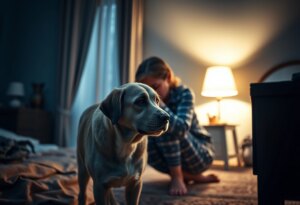
Dog barking at night for no reason you can see? If you’ve been jolted awake at 3AM to your old dog barking at a wall, a corner, or seemingly nothing at all, you’re not imagining it and you’re definitely not alone. I’ve sat on the floor of the sanctuary more nights than I can count, arm around a confused senior, whispering “I’m here, I’m here” while they barked at shadows only they could see. This isn’t just old age being cranky. It’s real, it’s often medical, and it deserves your full attention, not a sigh and a closed bedroom door.
Dog barking at night in a senior dog is frequently a sign of something bigger happening in their aging brain, and treating it like a nuisance instead of a symptom does them a disservice. Let’s talk about what’s actually going on, and what genuinely helps.
The 3AM Reality: Why Senior Dogs Bark at Shadows, Walls, or Nothing
Here’s the thing nobody tells new senior dog parents: aging canine brains change, physically and chemically, in ways that mimic what happens in aging human brains. When your gray-muzzled companion starts staring at an empty corner and barking like it personally offended them, that’s not stubbornness or a bad dream. It’s often disorientation, confusion, or a startled response to shadows and sounds their declining senses can no longer sort out correctly.
Dog barking at night tends to spike for a few honest reasons:
- Vision and hearing loss that make familiar rooms suddenly feel unfamiliar
- Joint pain flaring once they lie still for hours (arthritis doesn’t clock out at bedtime)
- Bladder changes that create restlessness and pacing
- Cognitive decline that scrambles their sense of time, place, and safety
I want to be direct here: dismissing this as “just old age” is one of the most common mistakes I see, and *honestly, who thinks like that??* Old age isn’t a diagnosis. It’s a stage of life that comes with specific, nameable, often treatable conditions. Your dog deserves the dignity of an actual answer, not a shrug.
Canine Cognitive Dysfunction: The Leading Cause Nobody Warns You About
Canine Cognitive Dysfunction, or CCD, is essentially the canine version of Alzheimer’s disease. It’s a real, progressive, diagnosable condition, and it is one of the most common reasons behind senior dog anxiety and nighttime vocalizing.
Research out of the University of California, Davis and the American Kennel Club Canine Health Foundation has found that roughly 28% of dogs aged 11 to 12 show signs of CCD, and that number jumps to about 68% in dogs aged 15 to 16. Read that again. That’s not a rare fluke condition. That’s the majority of our oldest dogs experiencing some level of cognitive fog in their final years.
Signs of CCD that show up specifically at night include:
- Barking at walls, corners, or furniture with no visible trigger
- Pacing in circles or getting “stuck” staring at nothing
- Getting lost in familiar rooms or behind doors they’ve passed through thousands of times
- Disrupted sleep-wake cycles, where daytime naps replace nighttime rest
- Reduced recognition of family members, especially in dim lighting
If any of this sounds familiar, please don’t white-knuckle it alone. A geriatric wellness exam with your veterinarian can rule out pain, infection, or vision loss, and confirm whether CCD is truly the driver. According to the American Kennel Club, early identification genuinely does improve quality of life outcomes for cognitively declining dogs.
Sundowning Syndrome: The Compassionate Human Parallel
If you’ve ever cared for a family member with dementia, the term “sundowning” might already break your heart a little. It’s the exact same phenomenon in dogs. As daylight fades, confusion, agitation, and restlessness spike. The dimming light seems to strip away whatever cognitive scaffolding was holding their sense of orientation together during the day.
Sundowning isn’t your dog being difficult. It’s your dog being scared in a world that suddenly makes less sense than it used to. Meeting that fear with patience instead of frustration is one of the most sacred things you can offer an aging animal.
The American Animal Hospital Association estimates that roughly 1 in 3 senior dogs will show some level of age-related cognitive decline in their lifetime. That statistic sits heavy with me every single time I share it, because I’ve lived it, over and over, with dogs who came to the sanctuary confused, restless, and barking into the dark. It gets better with the right support. It really does.
If your dog’s nighttime barking feels tied specifically to dreaming, twitching, or vocalizing during actual sleep rather than while awake, this piece on senior dog sleep barking and whether it’s dementia or just dreaming walks through how to tell the difference, and it’s worth a read before you assume the worst.
A Vet-Backed Buyer’s Guide: Night Lights and Anti-Anxiety Tools
Once your vet has ruled out pain or a medical trigger, environmental support becomes your best friend. This is where thoughtful, low-stress additions to your dog’s nighttime setup make a real, visible difference. Here’s what actually helps, and what to skip.
Night Lights: Soft Amber Over Bright White
Blue-spectrum light (the harsh white-blue glow of most standard nightlights) actually suppresses melatonin production and can worsen disorientation in cognitively declining dogs. What you want instead:
- Soft amber or red-toned bulbs that don’t disrupt natural melatonin cycles
- Motion-sensor activation so the light only triggers when your dog actually gets up, reducing startle response
- Low, floor-level placement near their bed and along hallway paths to the door or water bowl
- Consistent, unchanging placement, since senior dogs rely heavily on spatial memory
Skip anything with a bright white LED, a timer that shuts off mid-night, or a flickering or color-changing setting. Consistency is everything for a confused senior brain.
Calming Pheromone Diffusers and White Noise
Synthetic dog-appeasing pheromone diffusers mimic the calming chemical signals a mother dog releases to soothe her puppies. In senior dogs, they can meaningfully reduce nighttime pacing and vocalizing, especially when paired with a consistent bedtime routine. White noise machines work on a similar principle: they mask sudden household sounds (pipes settling, a car outside, a housemate stirring) that might otherwise jolt an anxious senior awake.

If your dog’s barking pattern seems tied more to external noise triggers than pure disorientation, this guide on senior dog barking at night causes and real solutions digs deeper into sound-based triggers specifically.
Weighted Wraps and Gentle Pressure Tools
Weighted wraps, similar in concept to a weighted blanket for humans, apply gentle, even pressure that can lower cortisol and ease anxious pacing in some dogs. They’re not a fix for every senior, but for dogs whose anxiety shows up as trembling or restless circling, it’s worth a trial run. Look for breathable, machine-washable fabric and an adjustable fit that won’t restrict arthritic joints or shoulders.
Sound and Distraction Tools Worth a Second Look
Some pet parents have found that calming audio content, like Short Takes on Long Stories, played at low volume can offer a gentle, familiar soundscape that helps ease a restless senior back toward sleep. It’s not a clinical treatment, but a steady, soothing voice in the background has genuinely calmed a few of my own sanctuary dogs during rough nights.

On the flip side, if your dog’s nighttime barking is more reactive than anxious (barking hard at real or perceived intruders, other pets, or their own reflection), a tool like the Anti Barking Device for Dogs Automatic Bark Box Ultrasonic Dog Deterrent can interrupt the cycle with a gentle ultrasonic cue rather than punishment. I’ll say this clearly though: this is a tool for reactive barking, not for cognitive confusion. Using it on a dog who is genuinely disoriented from CCD would only add fear on top of fear, and that’s the last thing an aging brain needs.
There are also newer AI-supported calming devices, such as While You Dream Artificial Intelligence sleep companion, designed to respond to a dog’s movement and sound patterns with soothing audio cues throughout the night. These are still an emerging category, so treat them as a supplement to good vet care, not a replacement for it.

Comparing Your Options at a Glance
| Product/Tool | Best For | Key Feature | Price Tier |
|---|---|---|---|
| Amber Motion-Sensor Night Light | Disorientation, sundowning, CCD confusion | Non-blue spectrum, motion activated | $ |
| Calming Pheromone Diffuser | General nighttime anxiety, pacing | Mimics natural calming maternal pheromones | $$ |
| Weighted Anxiety Wrap | Trembling, restless circling | Even gentle pressure, breathable fabric | $$ |
| Short Takes on Long Stories | Soothing background audio distraction | Calm, low-volume narrated content | $ |
| Ultrasonic Anti-Barking Device | Reactive barking (not cognitive confusion) | Ultrasonic interruption, no shock | $$ |
| AI Sleep Companion Device | Tech-forward pet parents wanting responsive support | Movement/sound-responsive calming audio | $$$$ |
Patience, Dignity, and Knowing When to Call Your Vet
Here’s what I need you to sit with for a moment: your senior dog isn’t barking at 3AM to punish you or ruin your sleep. They are scared, disoriented, or in pain, and you are the only one who can help them make sense of it. *That is a sacred trust*, and it deserves more patience than most of us think we have left in us at 3AM.
That said, patience doesn’t mean silent suffering on either end of the leash. Loop in your veterinarian if you notice:
- Sudden onset barking with no prior history of nighttime restlessness
- Signs of pain, like limping, stiffness, or reluctance to lie down
- Barking paired with disorientation, house soiling, or getting “stuck” in corners
- Any behavior change that feels rapid rather than gradual
Your vet may discuss melatonin, prescription anti-anxiety medication, or CCD-specific supplements like SAMe or omega-3 fatty acids. None of these are something to start on your own without guidance. Dosing matters, especially in dogs with liver or kidney changes common in old age.
And if crate rest or a lower, easier sleeping setup is part of your dog’s arthritis management alongside their nighttime anxiety plan, this roundup of low-entry dog crates for senior dogs with arthritis might be a genuinely useful next stop.
Dog barking at night won’t disappear overnight, and I won’t pretend otherwise. But with the right night lights, the right calming tools, and a vet who takes senior dog anxiety seriously, most families see real, measurable improvement within a few weeks. Give it time. Give your dog grace. This chapter of their life deserves your steadiest self, even at 3AM.
Why is my senior dog barking at night for no reason?
Dog barking at night in senior dogs is often tied to Canine Cognitive Dysfunction, vision or hearing loss, arthritis pain, or sundowning syndrome. It rarely happens “for no reason,” even when the trigger isn’t visible to us. A veterinary exam can help identify the underlying cause.
What color night light is best for a senior dog with cognitive decline?
Soft amber or red-toned night lights are best, since they don’t suppress melatonin production the way bright white or blue-spectrum lights do. Motion-sensor amber lights placed low near your dog’s bed and hallway path tend to work best for reducing nighttime disorientation.
Can calming aids really reduce senior dog anxiety at night?
Yes, in many cases. Pheromone diffusers, weighted wraps, and white noise machines have been shown to meaningfully reduce pacing, trembling, and nighttime vocalizing in anxious senior dogs, especially when combined with a consistent bedtime routine and veterinary guidance for more severe cases.
When should I take my dog’s nighttime barking to the vet?
Contact your vet if the barking is sudden, paired with signs of pain or disorientation, or has gotten noticeably worse over a short period. Sudden changes are more concerning than gradual ones, and your vet can rule out treatable medical causes before assuming it’s purely age-related cognitive decline.
Tell your pup I said Hi! — Dawn