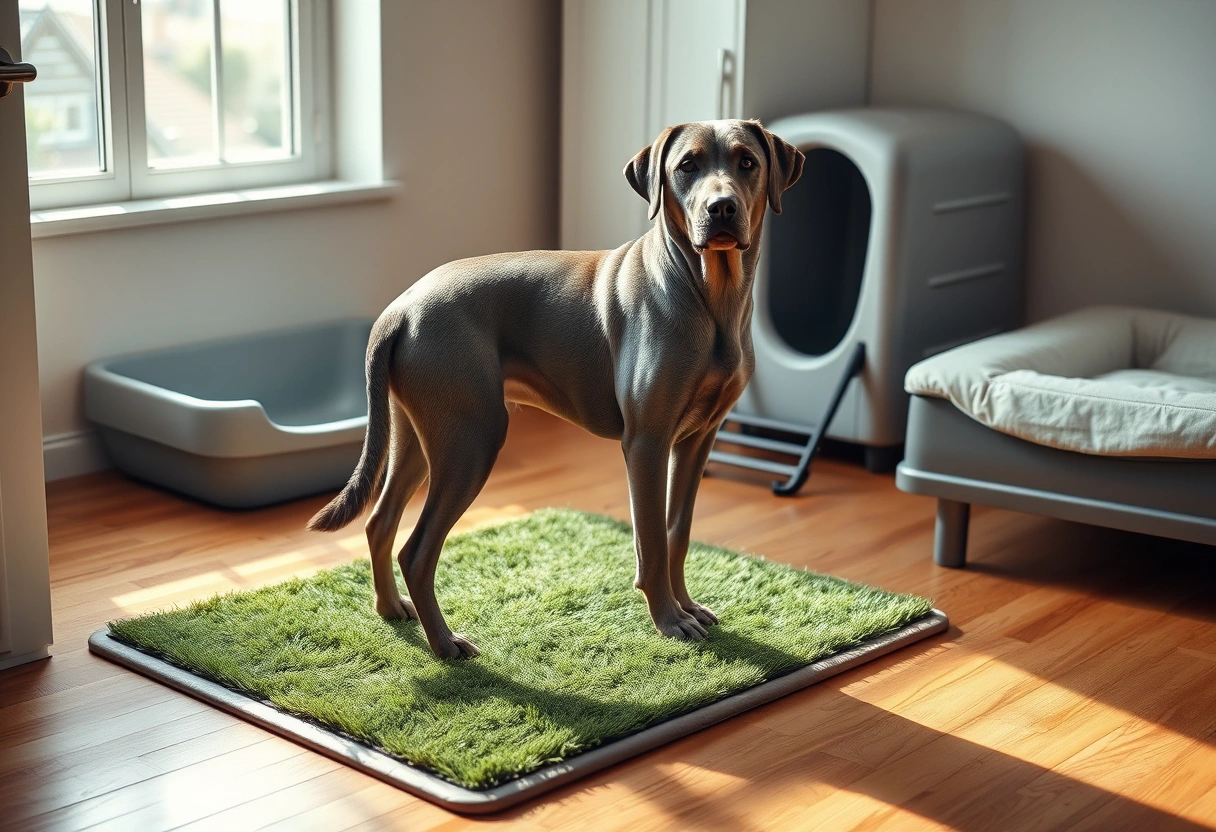
The best dog potty pads and indoor litter boxes for senior dogs share three traits: low-entry design under 2 inches, a surface texture the dog already prefers, and placement within 10 feet of the sleeping area. If your older dog has started having accidents in the apartment, the fix usually has less to do with obedience and more to do with biology, mobility, and geography. Get those three variables right and most house-soiling cases in geriatric dogs improve within two to three weeks.
Key Takeaways
- Cognitive dysfunction affects roughly 28% of dogs aged 11-12 and up to 68% of dogs aged 15-16, and it’s a major driver of house-soiling, according to research in the Journal of Veterinary Internal Medicine.
- A vet visit ruling out UTIs, kidney disease, and diabetes should always precede any behavioral protocol involving dog potty pads and indoor litter boxes.
- Turf-style indoor systems have grown in popularity among senior and urban dog households, according to the American Kennel Club, largely because the texture mimics grass.
- Punishment-based correction raises cortisol and worsens house-soiling frequency rather than resolving it.
- Placement matters as much as product choice. Dog potty pads and indoor litter boxes positioned near the sleeping area cut nighttime accidents significantly in dogs with reduced mobility.
Why Senior Dogs Regress on House Training
Senior dogs don’t forget house training the way people sometimes assume. What actually happens is a layered decline across cognition, joints, bladder physiology, and sensory input, and each of those layers requires a different response. I get a lot of clients who describe their older dog as “being stubborn” about the accidents, and almost every time, the dog is not being stubborn. The dog is working with a body and brain that no longer function the way they did at age four.
Canine cognitive dysfunction (CCD) is the geriatric equivalent of Alzheimer’s disease in humans, and it’s far more common than most owners realize. A study published in the Journal of Veterinary Internal Medicine found that CCD affects approximately 28% of dogs aged 11-12 and jumps to 68% of dogs aged 15-16. House-soiling is one of the core diagnostic markers vets look for, alongside disorientation, altered sleep-wake cycles, and reduced social interaction. If your dog is having accidents indoors and also seems to stare at walls, get “stuck” in corners, or reverse their day/night sleep pattern, CCD needs to be on your radar and on your vet’s differential list.
But CCD isn’t the only explanation, and treating every accident as a cognitive symptom is its own mistake. Mobility decline from arthritis or degenerative myelopathy can mean a dog physically cannot get up fast enough, or cannot navigate stairs or a long hallway to reach the door in time. That’s not a house-training failure. That’s a locomotion problem with a behavioral symptom. Separately, aging kidneys concentrate urine less efficiently, which increases both frequency and urgency, sometimes dramatically. A dog that used to hold it for eight hours might now need to go every three or four.
The functional distinction matters because the fix for each cause looks completely different. A cognitively declining dog needs environmental predictability and possibly medical management. A dog with arthritis needs a shorter path to the elimination area and better traction along the way. A dog with kidney changes needs more frequent access, not more training. Lump all three together under “he’s just getting old” and you’ll apply the wrong intervention.
The Antecedent Management Approach to Apartment Elimination
Antecedent management means adjusting the environment before the behavior happens, rather than reacting after the fact, and it’s the single most effective framework for senior house-soiling cases. Instead of asking “how do I stop the accidents,” the more useful question is “what has to be true right before an accident happens, and can I change that variable.” This is functional analysis applied to a very common apartment problem.
Start by tracking three data points for a week, ideally in a simple notes app or a printed log taped to the fridge:
- Time of day each accident occurs (nighttime clusters suggest disorientation or CCD; daytime clusters after meals suggest urgency or mobility lag).
- Location in the apartment (accidents far from the door suggest a distance/mobility problem; accidents near the bed suggest urgency that outpaces travel time).
- Posture and behavior right before the accident (circling and sniffing suggests intact elimination signaling with a mobility barrier; a blank stare or seeming confusion suggests cognitive involvement).
This log alone often reveals the functional cause without needing to guess. A dog who has accidents almost exclusively between 2 and 5 a.m., appears disoriented, and doesn’t sniff or circle first is showing a different pattern than a dog who circles at the door, whines, then squats halfway there because the hips gave out on the walk over.
Ruling out medical causes is not optional before starting any behavioral protocol. Urinary tract infections, diabetes, kidney disease, Cushing’s disease, and cognitive dysfunction all present with increased indoor urination, and each has a distinct treatment path that behavior modification alone cannot substitute for.
A veterinary visit with bloodwork and a urinalysis should happen before you invest in any specific dog potty pads and indoor litter boxes setup. I’ve seen owners spend weeks retraining a dog for a “behavior problem” that turned out to be an untreated UTI. Once the infection cleared, the accidents stopped almost entirely, and the elaborate retraining plan became unnecessary. Medical clearance first, environmental redesign second, that order isn’t negotiable.

Comparative Breakdown: Potty Pads vs. Indoor Litter Boxes vs. Turf Systems
Choosing between dog potty pads and indoor litter boxes depends primarily on your dog’s joint mobility, substrate preference, and how much odor control your apartment realistically needs. There’s no universal winner here. The right option is the one your specific dog’s body and habits can actually use without friction.
Substrate preference research on house-soiling dogs consistently shows that dogs develop strong texture associations tied to their earliest and most reinforced elimination surface. A dog raised mostly on grass often resists a flat plastic pad and takes to turf far more readily, because the paw-pad sensation is closer to what the brain already associates with “this is where I go.” That’s not stubbornness, that’s a learned substrate preference, and it’s worth designing around rather than fighting.
| System | Entry Height | Best For | Odor Control | Price Range (USD) | Avg. Rating |
|---|---|---|---|---|---|
| Standard Absorbent Pads | Flat, 0 in | Dogs with severe arthritis, easiest to enter | Low-moderate, needs frequent changing | $15-$30 per 100-pack | 4.5/5 |
| Tray-Style Pad Holders | Under 1 in | Preventing pad shredding/sliding | Moderate | $20-$45 | 4.4/5 |
| Indoor Litter Boxes (grated) | 2-4 in wall | Dogs without hind-limb weakness | Moderate-high with regular scooping | $40-$90 | 4.2/5 |
| Low-Entry Litter Trays | Under 2 in | Arthritic or three-legged dogs | Moderate | $35-$70 | 4.3/5 |
| Real/Faux Turf Boxes | 1-3 in | Grass-preferring dogs, best long-term texture match | High with rinse-off trays | $50-$150 | 4.6/5 |
The American Kennel Club has noted a real increase in turf and grass-box adoption among urban and senior dog households over the past several years, and the underlying reason tracks with the substrate research above. Turf systems replicate the outdoor surface a dog has used for a decade, which shortens the relearning curve considerably. The tradeoff is maintenance. Turf needs regular rinsing to stay sanitary, and that’s a task some apartment dwellers without balcony or utility access find impractical.
For dogs with significant arthritis, entry height overrides almost every other variable. A litter box with a 4-inch lip might be functionally excellent on paper but useless if your dog can’t lift a stiff hip over the edge. In that scenario, flat absorbent pads or a low-entry turf tray under 2 inches will outperform a “better” product your dog physically cannot use. I always tell clients: the best dog potty pads and indoor litter boxes on any comparison chart mean nothing if your dog’s body can’t clear the threshold to use them.
Step-by-Step Protocol for Reintroducing Indoor Elimination Without Shame-Based Corrections
Reintroducing dog potty pads and indoor litter boxes to a senior dog works best as a positive-reinforcement process built on canine agency, not correction. Scolding a senior dog for an accident does not teach the dog where to go. It teaches the dog that you are unpredictable, and in cognitively declining dogs especially, punishment reliably increases stress hormone output and worsens the exact house-soiling frequency owners are trying to reduce. This is well established in stress physiology literature: elevated cortisol suppresses learning and increases anxiety-driven elimination, creating a feedback loop that makes things worse, not better.
- Choose placement based on your accident log. Position the dog potty pads and indoor litter boxes within 10 feet of the sleeping area if nighttime accidents dominate, or along the most direct, obstacle-free path if daytime urgency is the issue. Distance is often the single biggest lever you can pull.
- Match the substrate to prior preference. If your dog was primarily an outdoor grass dog, start with turf. If your dog has used pads before (as a puppy, for example), a standard pad will feel familiar faster.
- Use scent transfer to bridge the association. Lightly dab a paper towel on a spot your dog has already eliminated (indoors or on a prior walk) and place it on the new surface for the first several days. Scent cues accelerate substrate recognition far more than verbal cues do.
- Reinforce immediately and specifically. The moment your dog eliminates on the target surface, mark it with a calm, warm verbal cue and a high-value treat within 3 seconds. Timing matters more than enthusiasm here.
- Never punish an accident you didn’t witness in progress. If you find a mess after the fact, clean it silently with an enzymatic cleaner and move on. There is no learning value in after-the-fact correction, only stress.
- Increase access frequency before expecting accuracy. For dogs with kidney changes or urgency, offer access to the pad or box every 3-4 hours rather than waiting for a signal that may no longer be reliable.
- Fade the scent bridge gradually over 10-14 days once consistent use is established, rather than removing it abruptly.
Notice that none of these steps involve rubbing a nose in anything, raised voices, or crate isolation as punishment. Those methods don’t align with how dogs actually process aversive experiences, and in a geriatric dog already managing joint pain or cognitive decline, added stress tends to accelerate decline rather than produce compliance.
Case-Profile Evaluation and a Sample “Happiness Plan”
A structured happiness plan gives you a measurable way to judge whether a house-soiling protocol is actually working, rather than relying on gut feeling after a rough week. Here’s a hypothetical case that mirrors what I see constantly in practice.
Profile: “Biscuit,” a 13-year-old spayed female mixed breed, 42 lbs, living in a 500-square-foot studio apartment. Diagnosed with mild CCD (based on disorientation and altered sleep cycle) and moderate bilateral hip arthritis. Vet has ruled out UTI and kidney disease via urinalysis and bloodwork. Currently having 4-5 indoor accidents per week, primarily overnight.

Plan components:
- Product selection: Low-entry turf tray (under 2 inches) placed 6 feet from Biscuit’s bed, since she was previously an outdoor grass-eliminator and has hip limitations ruling out anything with a taller lip.
- Nightlight installed near the tray path to offset age-related vision decline and nighttime disorientation common in CCD.
- Access schedule: Encouraged access every 4 hours during waking hours, plus one supervised middle-of-the-night opportunity for the first two weeks.
- Weekly tracking metrics:
- Accident frequency (target: reduce from 4-5/week to under 2/week by week 3)
- Latency to use the tray once led to it (target: under 30 seconds by week 2)
- Sleep quality indicators (fewer nighttime pacing episodes)
- Appetite and general engagement (a broader quality-of-life marker for CCD progression)
By week three, if accident frequency hasn’t dropped by at least 40%, that’s a signal to loop the vet back in rather than intensifying the behavioral protocol further. Plans like this work because they give you an actual decision point instead of an open-ended guess. It also protects the dog from an owner escalating frustration when the real issue might need a medication adjustment, like an anti-anxiety supplement or a CCD-targeted diet, rather than more training pressure.
For related reading on managing joint pain that often complicates elimination mobility, see our guide on senior dog arthritis management, and for a deeper look at cognitive decline symptoms, check our article on recognizing canine cognitive dysfunction.
Frequently Asked Questions
What are the best dog potty pads and indoor litter boxes for a senior dog with arthritis?
Low-entry options under 2 inches tend to work best, including flat absorbent pads or low-lip turf trays. Standard litter boxes with a 3-4 inch wall are often too high for a dog with hip or knee arthritis to step over comfortably.
Is house-soiling in old dogs always a sign of dementia?
No. While canine cognitive dysfunction is a common cause, mobility limitations, kidney changes, urinary tract infections, and diabetes can all produce identical symptoms. A veterinary exam is necessary to distinguish between these causes before starting a behavioral protocol.
Should I punish my senior dog for accidents indoors?
No. Punishment-based correction raises stress hormone levels and has been shown to worsen house-soiling frequency rather than improve it, particularly in dogs with cognitive decline. Positive reinforcement and environmental redesign produce more reliable, lasting results.
How long does it take to retrain an older dog to use potty pads or a litter box?
Most dogs show measurable improvement within 2 to 3 weeks when placement, substrate preference, and access frequency are addressed correctly. Dogs with moderate to severe cognitive dysfunction may take longer and benefit from combining behavioral changes with veterinary management.