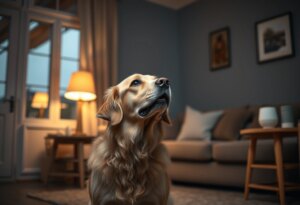
A dog nightlight for barking isn’t a gadget gimmick, it’s antecedent management grounded in sensory biology. When a 13-year-old dog starts erupting at shadows on the wall at 2 a.m., the reflexive owner response is frustration, maybe even a correction. But the data points somewhere else entirely: senior dogs are working with degraded visual and auditory input, and what looks like defiance is usually a startle response to ambiguous stimuli they can no longer resolve. This article breaks down why that happens and which environmental tools actually change the antecedent conditions, rather than just suppressing the symptom.
Why Senior Dogs Bark at Nothing After Dark
Nocturnal vocalization in geriatric dogs is rarely about stubbornness or “acting up.” It’s a function of sensory decline colliding with an environment that hasn’t been adjusted to match. Cataracts and age-related lenticular changes reduce the clarity of visual input. Presbycusis (age-related hearing loss) alters how sound is localized and interpreted. Put those two together in a dark room, and a dog’s brain is left filling in gaps with incomplete data. A curtain moving in a draft, a car’s headlights sweeping across the ceiling, a floorboard creak amplified by an otherwise silent house: any of these can trigger a defensive bark because the dog genuinely cannot resolve what’s making the change. This is disorientation, not misbehavior, and treating it as the latter tends to increase anxiety rather than resolve the vocalization.
If you’re also noticing your dog seems confused during the day, paces at odd hours, or stares at walls, it’s worth cross-referencing those symptoms against Dog Barking at Nothing at Night? Cognitive Decline Signs, since sensory decline and canine cognitive dysfunction frequently overlap and compound each other in dogs over age ten.
The Ethology of Low-Light Vigilance in Aging Dogs
Domestic dogs retain a good deal of their crepuscular ancestry, meaning they’re biologically primed to be alert during dawn and dusk transitions. In a young, sensorially intact dog, this vigilance is calibrated by sharp vision and reliable sound localization. Strip those away, and the vigilance instinct remains active while the discriminating capacity that used to keep it in check erodes. A 2019 study published in Veterinary Ophthalmology found that the majority of dogs over age 13 present with some degree of lenticular sclerosis, a hardening of the eye’s lens that reduces contrast sensitivity even when cataracts haven’t fully formed. Practically, that means your dog can still detect motion and light changes, but can’t resolve fine detail well enough to know whether that shape by the door is a coat rack or an intruder. The dog defaults to caution. Barking is the caution.
This is a useful reframe for owners who feel like their dog “used to be so calm at night.” The dog hasn’t become more reactive by temperament. Its sensory apparatus for correctly identifying non-threats has quietly declined, and the behavioral output (barking) is downstream of that physiological shift.

Antecedent Management: Why Amber Nightlights Work
In applied behavior analysis, the most efficient way to change a behavior is to change the antecedent, the condition that triggers it, rather than only managing the consequence after the fact. For nighttime barking driven by visual disorientation, the antecedent is usually a jarring transition from total darkness to sudden light and shadow movement (a car passing, a hallway light flicking on, moonlight shifting through blinds). A low-lux amber nightlight for dogs addresses this directly by keeping ambient light levels stable and low, so there’s no sharp contrast for the aging eye to misread. Amber and red-spectrum light is preferable to white or blue light because it’s less disruptive to melatonin production and doesn’t create the high-contrast glare that white LED nightlights often do.
Practically, this means placing a soft, warm-toned light source in the dog’s sleeping area, angled so it doesn’t shine directly into the eyes, and keeping it on continuously through the night rather than motion-activated. Motion-activated lights that flick on and off actually recreate the same light-to-dark contrast problem you’re trying to solve, so a steady, low output is the better protocol here.
Sound Masking: The Evidence Behind White Noise for Reactive Barking
Sensory support isn’t only about vision. A 2015 study in Applied Animal Behaviour Science examined ambient sound masking in kenneled and home-based dogs and found that consistent background sound reduced reactive vocalization triggered by unpredictable external noises, things like a neighbor’s car door, wind against a window, or distant sirens. The mechanism is fairly intuitive once you see it laid out: unpredictability is the driver of the startle response, not volume. A white noise machine for dogs works by flattening the auditory environment so that sudden, sharp, novel sounds are less likely to stand out against a totally silent backdrop. If the baseline is quiet static or gentle rainfall sound, a passing car simply blends into the noise floor instead of cutting through it as a jarring anomaly.
This is also why total silence at night, which many owners assume is ideal, can actually work against a senior dog with hearing decline. A partially deaf dog in a silent room is more likely to be startled by unexpected sound because there’s no consistent auditory backdrop for their (already degraded) hearing to calibrate against. For a deeper breakdown of device types and setup, see Best White Noise Machines to Stop Dog Barking at Night.

One option worth considering here is the Soothing Sound Machine for Sleep with a Built-in nightlight, which combines both interventions (light and sound) in a single unit, simplifying setup for owners managing multiple environmental changes at once.

- Soothing Noise Machine: The Adaptive Sound Technologies LectroFan Classic is a sound machine for sleep with a compact de…
- Personalized Sound Selection: This fan sound machine has 20 non-looping sounds that don’t interrupt sleep, a built-in sl…
- Easy-to-Use Sleep Device: This lightweight, USB-powered noise machine blocks ambient sound like snoring, traffic, and no…
Building a Senior Dog Night Anxiety Protocol
Rather than treating the nightlight or sound machine as a standalone fix, it helps to think of them as two components in a broader senior dog night anxiety protocol. Here’s a practical sequence to implement over roughly two weeks:
- Week 1, Days 1-3: Introduce the amber nightlight during a calm daytime nap first, so the dog isn’t experiencing a new light source for the first time at 2 a.m. Pair it with a familiar blanket or bed scent.
- Week 1, Days 4-7: Add the white noise machine at low volume during evening wind-down, roughly 30 minutes before the usual bedtime, so the sound becomes associated with settling rather than sudden onset.
- Week 2: Run both together nightly. Track barking episodes in a simple log (time, duration, apparent trigger if visible) to measure whether frequency is dropping.
- Ongoing: Reassess after two weeks. If barking persists despite consistent environmental changes, that’s a signal to loop in your veterinarian, since pain, cognitive dysfunction, or a urinary issue disrupting sleep could also be contributing.
This structured approach gives the dog agency in a sense: a predictable, low-stimulation environment lets the dog self-regulate arousal rather than relying on the owner to intervene after every episode.
Barking at shadows in a senior dog is very rarely defiance. It’s a sensory system doing its best with degraded input in an environment that hasn’t been adjusted to accommodate it. Change the environment first, and you’ll often see the behavior shift without ever having to “correct” the dog at all.
What Not to Reach For: A Note on Aversive Tools
It’s worth flagging that some owners, at wits’ end after weeks of interrupted sleep, consider aversive correction tools like shock or bark collars as a faster fix for nighttime vocalization. Products such as the ABBIDOT Shock Collar for 2 Dogs, 3300 FT Dog Training Collar are marketed for exactly this kind of persistent barking. But applying an aversive stimulus to a dog whose barking stems from disorientation and sensory decline doesn’t address the antecedent at all. It only adds a painful or startling consequence on top of a dog that’s already anxious and confused, which can escalate fear-based reactivity rather than resolve it. If you’re evaluating training tools for barking more broadly (separate from senior sensory decline), the safer, evidence-supported category is passive deterrent and sound-based devices rather than shock-based corrections. For a rundown of humane options, 7 Best Anti-Barking Devices to Stop Night Barking Fast covers alternatives that don’t rely on pain-based conditioning.

- Your Key to Stress-Free Dog Training: The ABBIDOT dog shock collar anti-shock collar features 9 sound, 36 vibration, and…
- Extended 3,300FT Range & 2 Channel: This dog training collar covers an area of up to 3,300 FT, giving your dog plenty of…
- Suitable for Dogs of All Breeds and Sizes: Designed for dogs with neck sizes ranging from 6 to 27 inches and weighing be…
5 Best Nightlight and White Noise Devices Compared
Below is a comparative breakdown of the top devices for managing nighttime barking solutions in senior dogs, ranked by lux output, decibel range, auto-shutoff safety, and suitability for dogs with diagnosed cognitive dysfunction (CDS). A reliable dog nightlight for barking should sit at the low end of the lux scale, while a white noise machine for dogs should offer a stable, non-looping sound bed rather than short repeating clips that can themselves become a novel, attention-grabbing trigger.
| Device | Light Output | Sound Range | Auto-Shutoff | Best For | Price Tier |
|---|---|---|---|---|---|
| Soothing Sound Machine for Sleep with Built-in Nightlight | Low-lux amber glow | White noise, rain, ocean loops | No (continuous run) | Combined light + sound need, CDS-diagnosed dogs | $$ |
| Sunrise Alarm Clock with White Noise Sound Machine | Adjustable dimmable, amber-capable | Multiple white noise/nature tones | Yes, programmable timer | Owners wanting scheduled wind-down routines | $$$ |
| Basic plug-in amber nightlight (standalone) | Ultra-low lux, steady | N/A | No | Mild visual disorientation only | $ |
| Dedicated white noise sound machine (standalone) | N/A | Continuous non-looping static/fan sound | Optional on select models | Hearing decline with minimal visual issues | $$ |
| Premium smart nightlight + sound hybrid system | App-controlled, full amber spectrum dimming | Curated soundscapes, app-adjustable | Yes, full smart scheduling | Multi-pet households, tech-comfortable owners | $$$$ |
For owners managing a scheduled wind-down routine alongside a light source, the Sunrise Alarm Clock with White Noise Sound Machine, Wake Up offers programmable timing, which is useful if your dog’s barking tends to cluster around a specific pre-dawn window rather than persisting all night.
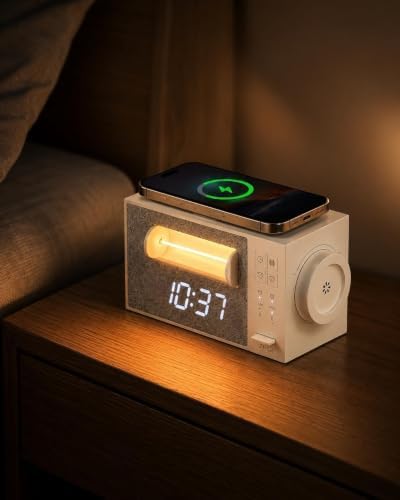
- Better Sleep, Better Mornings—All in One Bedside Hub:Drift off more peacefully, stay asleep through common nighttime dis…
- 20 Relaxing Sounds That Help Mask Everyday Noise:Choose from 20 high-fidelity sleep sounds, including White, Brown and P…
- Wake Up Naturally—Even if You’re a Heavy Sleeper:Start your day with a gentle sunrise simulation that gradually brighten…
When Environmental Fixes Aren’t Enough
A dog nightlight for barking and a white noise machine for dogs are antecedent interventions, meaning they change the triggering conditions, not medical treatments. If a senior dog’s nighttime vocalization persists after two to three weeks of consistent environmental management, that’s a data point worth taking to your veterinarian rather than escalating to punishment-based tools. Persistent nighttime barking despite good environmental control can indicate osteoarthritis pain that worsens at rest, a urinary tract infection disrupting sleep, or progressing canine cognitive dysfunction syndrome, which sometimes requires pharmacological support alongside environmental changes. According to the American Veterinary Medical Association, cognitive dysfunction affects a substantial proportion of dogs over age eleven, and nighttime disorientation is among its most commonly reported early symptoms. A veterinary behavior workup can help distinguish sensory-driven barking from a cognitive or medical process that needs its own targeted care plan.
Frequently Asked Questions
What color nightlight is best for a senior dog with cataracts?
Amber or red-spectrum light is generally best. These wavelengths produce less glare and contrast than white or blue LED light, which matters because a dog with cataracts or lenticular sclerosis already struggles to resolve sharp contrast changes. A steady, low-lux amber dog nightlight for barking reduces the chance of a jarring light-to-dark transition triggering a startle bark.
Can a white noise machine actually stop nighttime barking?
It won’t eliminate barking on its own, but it addresses one of the main drivers: unpredictable external sound. A 2015 study in Applied Animal Behaviour Science found that consistent sound masking reduced reactive vocalization to unpredictable noise triggers, since sudden sounds stand out less against a stable auditory backdrop. Combined with a nightlight, a white noise machine for dogs meaningfully lowers the odds of a startle-triggered bark.
Is nighttime barking always a sign of cognitive dysfunction in older dogs?
No. Nighttime barking can stem from vision loss, hearing decline, pain, or a urinary issue disrupting sleep, in addition to cognitive dysfunction syndrome. That’s why a structured senior dog night anxiety protocol, paired with a veterinary check, is the right first step before assuming cognitive decline is the sole cause.
How long should I trial a nightlight and sound machine before trying something else?
Give it roughly two to three weeks of consistent nightly use, tracking barking episodes in a simple log. Because these are antecedent management tools rather than instant fixes, the nervous system needs repeated, predictable exposure to recalibrate. If nighttime barking solutions like these show no improvement after three weeks, it’s time to consult your veterinarian to rule out pain or medical causes.