A dog raincoat is not a universal requirement for the breed, and the answer depends almost entirely on the individual dog’s age, coat condition, and underlying health status rather than a blanket rule about Golden Retrievers as a whole. I get this question constantly from owners who assume their dog’s famous double coat makes outerwear unnecessary, or even silly. The behavioral and physiological data tell a more nuanced story, particularly once a dog crosses into the senior years, when thermoregulation efficiency starts to shift in ways that owners rarely anticipate.
The Ethological Case: Why the Golden Coat Was Built for Water
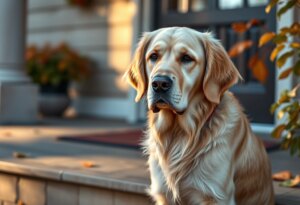
Golden Retrievers were functionally bred as water retrieval dogs, and their coat structure reflects that job description at a cellular level. Per the Golden Retriever Club of America breed standard, the coat is double-layered: a dense, insulating undercoat paired with longer, water-resistant guard hairs on top. Those guard hairs are coated in natural oils (sebum) that cause water to bead and roll off rather than soak through to the skin. This is not decorative. It is a functional adaptation for a dog that was expected to plunge into cold lakes, retrieve waterfowl, and shake off within seconds. A healthy adult Golden with an intact coat genuinely does not need a dog raincoat for Golden Retrievers in most casual rain exposure scenarios. The coat is doing its job as designed.
That said, “as designed” assumes an intact, youthful coat. This is the assumption that breaks down over time, and it is where most of the confusion about a dog raincoat actually originates.
The Senior-Dog Exception: When the Built-In System Degrades
Aging skin and coat tissue undergo measurable changes. Sebaceous gland output declines with age, which means less of that protective oil is available to coat the guard hairs. The undercoat itself often thins, sometimes patchily, as follicle density drops. The practical result is a coat that looks similar to a younger dog’s but performs very differently in wet, cold conditions. Findings consistent with geriatric canine thermal studies published in the Journal of Veterinary Behavior indicate that thermoregulation efficiency declines with age, meaning older dogs lose heat faster and recover core temperature more slowly than young, healthy adults. A senior Golden standing in October drizzle is not the same animal, physiologically, as the three-year-old field dog the breed standard was written around.
This is where a dog raincoat stops being an aesthetic choice and starts functioning as a legitimate piece of senior dog rain gear. I want to be clear that this is not true of every senior dog uniformly. It is true of senior dogs whose coat and skin condition has measurably declined, which is a distinction owners need to actually test rather than assume.
Hypothermia Risk Factors: Why Senior Physiology Changes the Math
Reduced muscle mass is a major, underappreciated variable here. Muscle tissue generates metabolic heat through activity and shivering thermogenesis, and senior dogs typically carry less lean muscle mass than they did in adulthood, particularly if arthritis or general deconditioning has reduced their activity level. Less muscle means less internal heat production, full stop. AAHA senior care guidelines also note that comorbidities common in dogs over age 7, including arthritis, hypothyroidism, and cardiac disease, independently impair heat regulation. Hypothyroidism in particular slows basal metabolic rate, which directly reduces a dog’s baseline heat output regardless of coat quality. Stack a thinning coat on top of a slower metabolic furnace and reduced muscle mass, and you get a dog that is genuinely more vulnerable to cold and wet exposure than breed reputation would suggest. None of this is about babying the dog. It is basic stress physiology and heat exchange, the same principles that apply to any endothermic mammal with a compromised thermal buffer.
The data is contradictory when you look at double-coated breeds as a category, and that is precisely the point. Coat performance is not a breed-wide constant. It is an individual variable that changes with age, health status, and even grooming practices, so blanket statements in either direction (always needs a coat, never needs a coat) are not behaviorally or physiologically defensible.
A 3-Point Observational Checklist Before You Buy
Rather than guessing, I recommend owners run a short functional assessment. This takes about a week of casual observation and gives you actual data instead of assumption.
- Shivering onset time. Take your dog out in cool, damp conditions (above freezing, just genuinely wet or brisk) for five to ten minutes off-leash movement. Time how long it takes for visible shivering, tucked tail, or reluctance to continue to appear. A young, well-coated dog often shows no response in this window. A dog showing shivering or behavioral withdrawal within a few minutes is telling you something real about their current thermal buffer.
- Coat condition test. Part the fur along the back and flank and run a wet finger across the guard hairs. In a healthy, oil-intact coat, water beads and rolls. In a degraded senior coat, the water tends to soak in and darken the hair quickly, which is a direct, observable sign that the natural water resistance has declined.
- Mobility and arthritis status. A dog with joint pain moves less, generates less internal heat through activity, and often stands still in wet conditions rather than moving to self-warm. If your dog has a diagnosed orthopedic condition or you’ve noticed stiffness, factor that into the equation independently of coat quality, because it changes the whole thermal budget.
If two or more of these checkpoints suggest reduced resilience, that’s a reasonably strong behavioral and physiological signal that a dog raincoat is a sensible addition to your dog’s routine rather than an indulgence.
Evidence-Based Buying Protocol: Fit Over Fashion
Once you’ve established actual need, the selection criteria should prioritize function. Chest coverage matters most, since the chest and underside lose heat fastest in standing water or wet grass, and the coat needs to allow full, unrestricted leg movement so gait and comfort aren’t compromised. A poorly fitted coat that binds at the shoulders can actually change a dog’s gait, which is its own welfare concern in a senior dog already managing mobility limits.

For dogs needing genuinely full protection, including belly and leg coverage in sustained wet conditions, a full-body option like the 4-Leg Full Body Dog Rain Suit with Reflective Strips addresses the belly-splash problem that a standard cape-style coat leaves exposed, and the reflective strips add a genuine safety function for early morning or evening walks when visibility is lower.

- Full Waterproof Protection – Waterproof and weather-resistant fabric keeps your dog dry in rain, snow, and wet condition…
- Full Body & 4-Leg Design —Full body coverage with a 4-leg design helps protect your dog’s legs, belly, and chest from …
- Comfortable & Flexible Fit — Made for comfort and freedom of movement. Soft inner feel and flexible structure allow you…
For dogs whose main vulnerability is torso and neck exposure rather than full-body soaking, a hooded style such as the GoTags Personalized Dog Raincoat with Hood covers the neck and head area where cooler air often first triggers a shivering response, and the personalization option is a practical bonus for identification if your senior dog tends to wander during off-leash time.

- Uniquely Tailored for Your Pup – Leave behind the notion of one-size-fits-all. Our raincoat boasts an array of hues and …
- Be Seen, Be Safe – Watch your dog gleam in the darkness with the addition of reflective detailing along the jacket’s tri…
- Swift Dressing and Leash Access – Preparing for your outdoor excursions is a breeze, thanks to the secure and expeditiou…
Owners of shorter-legged or barrel-chested senior dogs sometimes struggle with standard cuts riding up or exposing the belly during movement. A breathable belly-and-chest design like the Waterproof Corgi Raincoat with Belly and Chest Coverage was engineered for exactly that body profile and works well as senior dog rain gear for dogs with a lower center of gravity or reduced flexibility from arthritis, since the design doesn’t require the dog to lift its legs high to get dressed.
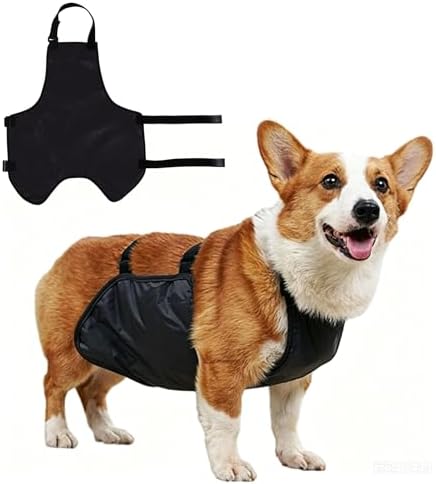
- Waterproof & Breathable Fabric:Crafted from premium waterproof polyester material with good air permeability. It won’t m…
- Targeted Chest & Belly Protection:Specially designed for short-legged dogs like Corgis. It focuses on shielding the ches…
- Convenient for Free Movement & Excretion:The reasonable cut won’t restrict your dog’s daily activities. It features a pr…
Comparing Your Options at a Glance
Below is a functional breakdown of the three options discussed, focused on the traits that actually matter for a senior dog raincoat decision: coverage, mobility, and thermal function rather than color or branding.
| Product | Coverage Type | Best For | Mobility Impact | Price Tier |
|---|---|---|---|---|
| 4-Leg Full Body Dog Rain Suit | Full body, four legs, reflective strips | Senior dogs needing complete waterproof dog coat coverage in heavy rain or muddy trails | Low restriction, designed for active movement | $$$ |
| GoTags Personalized Raincoat with Hood | Torso and head/neck | Dogs sensitive to cold air on the head and neck, or needing ID visibility | Minimal restriction, standard cape fit | $$ |
| Waterproof Corgi Raincoat | Belly and chest focus | Shorter-legged or arthritic dogs with reduced flexibility for dressing | Very low restriction, easy on/off | $$ |
Weighing Function Against the Myth of Universal Rejection
A common owner misconception is that double-coated breeds universally resist or don’t need any form of outerwear, and this belief often gets repeated without regard to individual variation. The data is contradictory on this point once you actually control for age and coat health. Some senior Goldens retain excellent coat oil production well into their teens and genuinely never need a waterproof dog coat. Others show measurable coat degradation by age eight or nine and benefit substantially from added protection, particularly if they also carry a mobility diagnosis. If your senior dog’s behavior around wet weather has changed alongside other symptoms, like disorientation or altered vocalization at night, it’s also worth reading about nighttime barking in senior dogs, since cognitive and physical decline can sometimes present together and get conflated with a simple weather aversion. Treat coat need as an individual, testable variable, not a breed-wide verdict, and you’ll make a far more accurate call than any generalized rule allows.
It’s also worth noting that behavioral responses to rain gear itself vary. Some senior dogs freeze in place the first time a coat goes on, which is a normal novel-stimulus response rather than distress, and usually resolves within a few short, reward-paired sessions of putting the coat on for thirty seconds at a time paired with treats before ever walking out the door.
Putting It Together
The short answer to whether a dog raincoat is necessary comes down to individual assessment rather than breed assumption. A young, healthy Golden with an intact double coat generally does not need one for casual exposure. A senior dog showing reduced coat oil, thinning fur, arthritis, or slower recovery from cold exposure is a genuinely different physiological case, and a properly fitted dog raincoat functions as legitimate senior dog rain gear rather than a fashion accessory. Run the three-point checklist, look at actual coat and mobility data on your own dog, and choose fit and coverage over appearance. For general information on canine coat biology and thermoregulation, the American Kennel Club maintains accessible resources worth reviewing alongside your veterinarian’s specific guidance for your dog’s health status.
Do all Golden Retrievers need a raincoat?
No. Young, healthy Golden Retrievers with an intact double coat and normal sebum production generally have sufficient natural water resistance for casual rain exposure. A dog raincoat becomes more relevant for senior dogs, dogs with thinning coats, or dogs managing arthritis or other conditions that impair heat regulation.
How do I know if my senior dog’s coat has lost its water resistance?
Run a simple coat condition test by wetting a finger and running it against the guard hairs along the back and flank. If water beads and rolls off, natural resistance is likely intact. If the water soaks in and darkens the fur quickly, the coat’s oil production has likely declined, which is a strong signal that senior dog rain gear would be beneficial.
Can a raincoat restrict my dog’s mobility or worsen arthritis discomfort?
A poorly fitted coat can bind at the shoulders or chest and alter gait, which is a real concern for arthritic dogs. Prioritize designs with full leg mobility and easy on/off mechanisms, such as belly-and-chest focused cuts, rather than restrictive full-wrap styles that require excessive limb lifting to put on.
Is hypothermia a real risk for senior dogs in mild rain, or only in extreme cold?
Hypothermia risk isn’t limited to freezing temperatures. Senior dogs with reduced muscle mass, hypothyroidism, or arthritis generate less internal heat and lose it faster when wet, even in mild, brisk conditions. This is why a dog raincoat is a reasonable precaution for at-risk senior dogs even outside of winter weather.