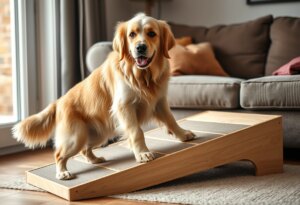
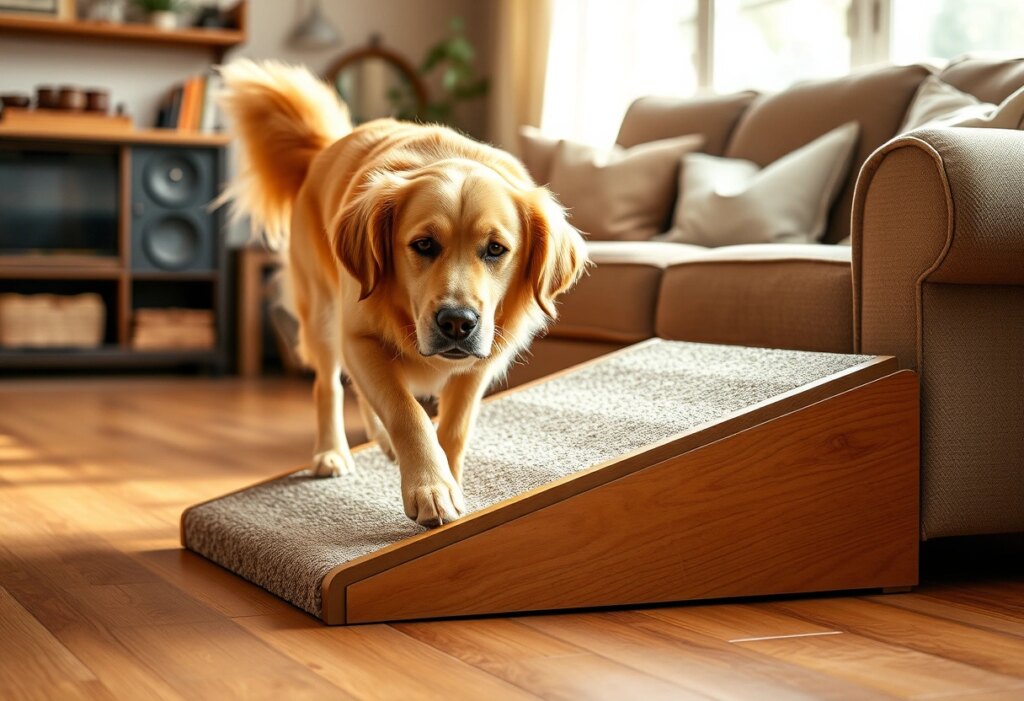

Dog ramps for arthritis exist for a specific physiological reason: repeated jumping loads the coxofemoral and stifle joints with forces several times body weight, and a dog with hind limb osteoarthritis learns quickly that landing hurts. What looks like stubbornness or laziness at the bottom of the stairs is, more often than not, a conditioned avoidance response layered on top of a real orthopedic problem. Solving it takes both the right equipment and an understanding of why your dog’s brain is telling her the stairs are a threat.
Why Arthritic Dogs Start Avoiding Stairs and Furniture (It’s Not Just Pain)
Here’s where a lot of owners misread their dog’s behavior. The initial refusal to jump onto the couch or climb the porch steps is driven by nociception, the physical sensation of joint pain. But after a few repetitions of “movement equals pain,” classical conditioning takes over. The stairs themselves, the sound of the dog’s nails on hardwood near the bed, even the owner’s posture when they’re about to lift the dog, all become conditioned stimuli that predict discomfort. At that point, you’re not just managing a physical limitation anymore. You’re managing a learned emotional response, and that response can persist even after pain is medically controlled, which is why some dogs still hesitate at ramps weeks into a treatment plan. Anticipatory anxiety around a previously painful movement doesn’t resolve on the same timeline as inflammation does. This is a critical distinction for building an effective rehabilitation plan, because it means equipment alone, without a behavioral bridge, frequently fails.
The Real Prevalence of Hind Limb Osteoarthritis in Senior Dogs
The numbers here are larger than most pet parents expect. Research published in the Journal of Small Animal Practice estimates that up to 80% of dogs over age 8 show radiographic evidence of osteoarthritis, and hind limb joints (hips, stifles, and hocks) are disproportionately represented. Yet in clinical practice, owners routinely describe this as “just getting old” rather than a treatable pain state. That framing matters. Slowing down on stairs, reluctance to jump into the car, a stiff gait after resting: these are not neutral aging markers. They’re behavioral proxies for chronic pain, and treating them as inevitable delays intervention that could meaningfully improve quality of life. If you’re already managing joint disease at home, the guidance in Dog Arthritis Relief at Home: Beds, Ramps & Supplements pairs well with the equipment decisions covered here, since beds, supplements, and access aids function as one integrated system rather than separate purchases.

Don’t count on surgery or supplements alone to work miracles. Joint support is multimodal: pain management, environmental modification, and behavior work all have to move together, or the dog simply routes around whichever piece is missing.
Dog Ramps for Arthritis vs. Pet Stairs: A Comparative Breakdown
Neither option is universally superior. The right choice depends on the dog’s body weight, limb length, degree of joint disease, and the height of the surface being accessed. Veterinary rehabilitation guidelines generally recommend an incline angle under 18 to 20 degrees for dogs with hind limb arthritis, since steeper inclines increase stifle and hip flexion torque during ascent, which is exactly the movement pattern you’re trying to reduce.
- Ramps distribute weight-bearing across a continuous slope, which is gentler on hips but requires more floor space and a longer surface to stay under the 18 to 20 degree threshold.
- Stairs are more compact and often easier for dogs to learn quickly, but each step involves a small jump-like flexion, so step height and tread depth need to be proportional to the dog’s leg length, not just the furniture height.
- Traction is non-negotiable on either surface. A slick ramp or stair surface reintroduces the exact instability that triggers a dog’s learned avoidance in the first place. Carpeted or textured non-slip treads matter more for arthritic dogs than for younger, more coordinated ones.
- Weight capacity should be rated well above the dog’s current body weight, since arthritic dogs shift more of their weight onto forelimbs during ascent, concentrating load unevenly on the structure.
For small and toy breeds with hind limb arthritis, a compact multi-step design can work well if the tread depth accommodates a full paw placement. The Dog Stairs for Small Dogs, Bamboo Dog Steps for High Bed is built with this kind of dog in mind, using a low-rise step pattern that reduces the flexion demand on stiff hips.
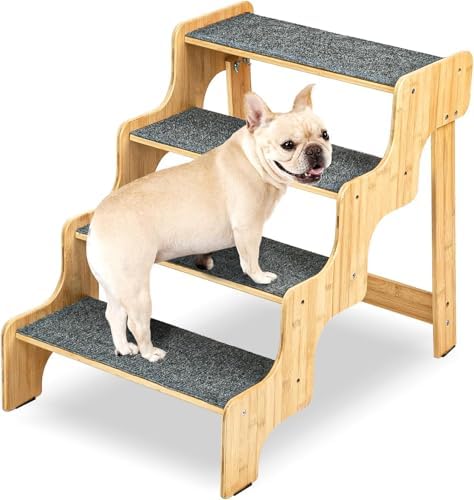
- Safe & Stable Climbing – Our bamboo dog stairs for high beds and couches feature non-slip felt on each tread, providing …
- Perfect for Paws & Joints – The scientifically crafted 4-step height reduces stress on your dog’s joints, making these p…
- Durable Bamboo Construction – Made from smooth, burr-free bamboo, our dog ramp for bed not only offers a sleek design bu…
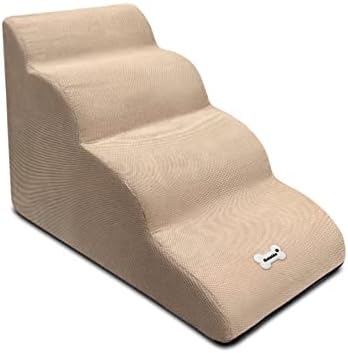
For dogs accessing taller surfaces, like a raised bed frame or a sofa with a deep seat, a four-step configuration spreads the total height gain across more increments, which keeps each individual step within a safer flexion range. The Mesa Lemon 4 Step Dog Stairs Pet Ramp for High Beds, Sofas is a mid-tier option that fits this use case, particularly for medium-breed seniors who need more incremental height coverage than a two-step model provides.

- PERFECT FIT FOR YOUR BED & SOFA: Mesa Lemon sturdy pet stairs give your small or medium-sized dog a safe, gentle climb …
- MULTIPLE SIZES & COLORS: Available in 2, 3, and 4-step options with multiple colors to match your home. Choose the perfe…
- STABLE & NON-SLIP CONSTRUCTION: Your pet’s safety comes first. The soft, waterproof corduroy cover provides great grip f…
Comparison Table: Ramps and Stairs for Hind Leg Mobility Aid
| Product | Type | Best For | Incline/Step Height | Traction Surface | Price Tier |
|---|---|---|---|---|---|
| Dog Stairs for Small Dogs, Bamboo Dog Steps | Stairs (low-rise) | Small/toy breeds, mild hind limb arthritis | Short, shallow steps | Textured bamboo tread | $$ |
| Mesa Lemon 4 Step Dog Stairs Pet Ramp | 4-Step Stairs | Medium breeds, taller furniture access | Moderate, evenly spaced steps | Carpeted non-slip tread | $$$ |
| Dog Stairs, Removable and Washable, 4-Steps | 4-Step Stairs | Dogs needing hygienic, washable surfaces | Moderate step depth | Removable non-slip cover | $$ |
Behavioral Protocol: Building Ramp Confidence After a Negative Association
If your dog already has a history of hesitating, freezing, or refusing at the base of stairs, dropping a new ramp into the living room and expecting immediate use is a common mistake. You’re asking a dog with an existing negative association to trust a novel object that resembles the thing that hurt her. Desensitization and counter-conditioning, done systematically, resolves this far more reliably than repetition or physical coaxing.
- Step 1: Static exposure. Place the ramp flat on the floor, no elevation, for several days. Scatter high-value treats along its surface so the dog investigates it voluntarily. No cues, no pressure.
- Step 2: Paw contact reinforcement. Reinforce any voluntary paw placement on the ramp with a marker word and a treat. This builds a specific, deliberate association between contact with the surface and a positive outcome, independent of movement.
- Step 3: Low-angle introduction. Prop the ramp against a low, stable surface, well under the target incline. Lure with treats for a single step up and back down. Keep sessions under two minutes; fatigue erodes confidence in dogs already anxious about the movement.
- Step 4: Gradual incline increase. Raise the ramp’s angle in small increments across multiple sessions, never exceeding the 18 to 20 degree ceiling appropriate for arthritic joints. If hesitation reappears at any stage, drop back one increment rather than pushing through it.
- Step 5: Full functional use. Once the dog ascends and descends without hesitation at full height, begin fading the lure and reinforcing independent use with praise and intermittent treats.
This process gives the dog agency in the interaction rather than physical guidance or lifting, which matters because dogs who are picked up and placed on equipment don’t develop the same confident, self-initiated movement pattern. They learn to tolerate being moved, not to trust the ramp itself.

Case-Profile Evaluation: A Sample Happiness Plan for Mobility Baseline
Before purchasing any equipment, a structured baseline assessment tells you what you’re actually solving for. Tools like the Canine Brief Pain Inventory or COAST scoring give a more objective read on functional impairment than casual observation, since owners consistently underestimate chronic pain in pets who don’t vocalize.
- Observation window: Track the dog across a full week, noting stiffness after rest, reluctance at specific heights, and any change in willingness to initiate jumps versus being coaxed.
- Baseline scoring: Use a validated pain inventory to establish a numeric score before introducing equipment, so improvement (or lack of it) can be measured rather than assumed.
- Equipment fit trial: Test the ramp or stairs at the lowest achievable incline first, observing gait quality, not just whether the dog completes the climb.
- Re-score at two weeks: Reassess pain inventory scores after consistent equipment use to confirm whether the intervention is producing measurable functional gains.
Red flags that warrant a veterinary reassessment rather than continued equipment reliance include sudden refusal to move at all, vocalizing on contact with a limb, asymmetric muscle loss in one hind leg versus the other, or any acute change in gait following a fall. Equipment addresses environmental load, not underlying disease progression, and a sudden behavioral shift is a clinical signal, not a training problem. For dogs where hygiene and easy cleaning are a priority, particularly households managing incontinence alongside mobility loss, the Dog Stairs, Removable and Washable Pet Stairs, 4-Steps offers a practical, budget-conscious solution with a cover that comes off for regular washing.
Behavioral changes around mobility rarely occur in isolation. If you’re also noticing new vocalization patterns, restlessness, or nighttime barking alongside physical stiffness, it’s worth reading Senior Dog Trainer Tips: Sudden Barking Explained, since pain and cognitive changes frequently present together in aging dogs and get misattributed to one cause when two are actually at play. According to the American Veterinary Medical Association, osteoarthritis in dogs is a progressive condition best managed through combined environmental, pharmacological, and physical rehabilitation approaches, not any single intervention in isolation.
Choosing Dog Ramps for Arthritis Based on Your Dog’s Specific Profile
The single best piece of equipment on paper isn’t universally correct for every dog. A 70-pound senior Labrador with bilateral hip arthritis needs a wider, more stable ramp with a shallow incline and high weight tolerance. A 12-pound senior dachshund with early-stage stifle changes may do better with a short, low-rise staircase that matches her leg length precisely. Matching dog ramps for arthritis to body size, joint location, and behavioral history is what separates equipment that actually gets used from equipment that ends up ignored in a corner. Reassess the fit every few months, since arthritis is progressive and the incline that worked at diagnosis may need to be lowered further as the disease advances.
What incline angle is safest for dog ramps for arthritis?
Veterinary rehabilitation guidelines generally recommend keeping the incline under 18 to 20 degrees for dogs with hind limb arthritis. Steeper angles increase flexion torque on the hips and stifles during ascent, which can worsen discomfort and reinforce avoidance behavior rather than resolve it.
How do I know if my dog needs a pet stairs for dogs solution instead of a ramp?
Pet stairs for dogs work well for dogs with mild to moderate arthritis who have space constraints, since stairs are more compact than a low-incline ramp. Dogs with more advanced joint disease, larger body size, or significant instability generally do better with a longer, gentler ramp that reduces flexion at each joint.
Can behavior training alone fix a hind leg mobility aid avoidance problem?
No. Behavior training addresses the learned fear component, but if the underlying joint pain isn’t medically managed, the dog’s avoidance will likely persist or return. A combined approach, veterinary pain management plus desensitization training around any hind leg mobility aid, produces more reliable and lasting results.
How quickly should I expect a senior dog ramp to be adopted?
For dogs with no prior negative association, adoption can happen within days. For dogs with an existing fear response tied to stairs or jumping, a structured desensitization protocol over two to four weeks is more realistic, and pushing a senior dog ramp on a faster timeline often backfires by reinforcing the original fear.