
Dog ramps solve a problem that most owners misread as stubbornness or laziness, when in reality it’s a learned pain response with a clear behavioral and biomechanical explanation. If your senior dog hesitates at the bottom of the stairs, hangs back before jumping onto the couch, or refuses the car entirely, you’re watching an animal make a rational risk assessment, not throwing a tantrum. Understanding that distinction changes how you approach the fix, and it’s why the right ramp or stair set does more than add convenience. It restores a dog’s ability to move through the house without associating movement with pain.
Why Senior Dogs Avoid Jumping: The Ethology of Height Aversion
Behaviorally, this is textbook operant conditioning. A dog with early osteoarthritis jumps off the bed once, feels a jolt of pain on landing, and the brain files that information immediately. The next approach to the same height triggers hesitation, then avoidance, then outright refusal. This is not laziness. It’s a conditioned association between a specific action and an aversive consequence, and it generalizes fast. A dog that associates pain with jumping off the bed will often extend that caution to the car, the porch steps, and eventually flat ground transitions that involve any joint loading at an angle.
Owners frequently misread this avoidance as decreased motivation or “slowing down with age,” but the behavior is functional and adaptive. The dog is doing exactly what a rational organism should do: avoiding a predictably painful stimulus. The mistake is assuming the avoidance will resolve on its own once the acute injury heals. It usually doesn’t, because the learned association persists independent of the current pain level. This is why dog ramps for seniors work best when introduced early, before avoidance calcifies into a fixed behavior pattern that outlives the original injury.
The Data on Joint Load: Why Front Limbs Matter Most
Veterinary biomechanics research consistently shows that a dog’s front limbs absorb a disproportionate share of body weight during landing, with estimates putting front-limb load at roughly 60 percent of total body weight on impact. That number matters enormously for any senior dog recovering from a cranial cruciate ligament (CCL) repair, managing elbow dysplasia, or dealing with early-stage carpal arthritis. Every uncontrolled jump off furniture is a repeated loading event on joints that are already compromised.
This is also the biomechanical argument behind post-surgical rehabilitation protocols that mandate ramp use rather than allowing dogs to negotiate stairs or jump during recovery. If you’re weighing surgical versus non-surgical management for a chronically unstable joint, the injection-based option is worth researching separately; our breakdown of Librela vs Adequan vs Synovetin for canine arthritis covers how these therapies interact with mobility support tools like ramps. A ramp doesn’t replace medical treatment, but it removes a major source of repetitive joint stress that can undermine whatever treatment plan is already in place.
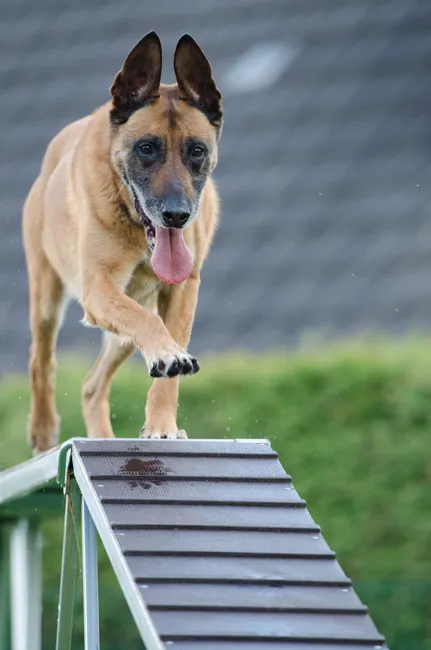
Ramp vs. Stairs: What the Incline Angle Data Actually Shows
This is where a lot of well-meaning owners get the purchase wrong. Steps feel intuitive because they mimic human staircases, but gait analysis studies on canine locomotion suggest that inclines steeper than about 18 to 20 degrees meaningfully increase shear force across the hip joint during ascent and descent. Shear force, unlike straight compressive load, is the kind of stress that aggravates hip dysplasia and lumbosacral instability, both of which are common in aging large-breed dogs.
Stairs with narrow, tall risers concentrate that shear force into short, steep bursts. A well-designed ramp spreads the same vertical distance across a longer, shallower incline, which lowers peak joint stress at any single point in the stride. That’s the mechanical case for choosing a ramp over stairs for dogs with confirmed hip dysplasia or lumbar spine issues. Stairs still have a place, particularly for space-constrained homes or dogs who are cognitively more comfortable with a stepped surface, but the angle math favors ramps for true hip-driven mobility limitations.
The behavioral goal is never to force the dog onto the new equipment. It’s to make the ramp the path of least resistance and least discomfort compared to every other option the dog has for getting where it wants to go.
The Top 5 Product Analysis: Traction, Capacity, and Portability
I evaluate mobility equipment against a short functional checklist: surface traction under a dog’s paw pads, stated weight capacity relative to the dog’s actual size, incline angle when fully extended, and how easily the unit folds for daily storage or travel. A ramp that scores well on paper but slides on hardwood, or a stair set with tall risers marketed as “senior-friendly,” will not hold up to actual use.
For dogs who do better with a stepped surface, the LoopTime Dog Stairs for Large Dogs, 4-Step Foldable Dog Ramp uses shallower individual step heights than most competitors, which reduces the per-step joint flexion demand on arthritic hips and knees. The foam-based tread also gives better paw grip than the hard plastic steps found on older stair designs, and the folding mechanism makes it realistic to store between uses rather than leaving it as a permanent floor obstacle.

- 【Gentle Ramp for Joint Protection】Designed with a 4-step gentle incline structure, each step is evenly spaced to follow …
- 【Enhanced Non-Slip Safety Design】The dog steps for car surface features a paw-textured anti-slip coating designed to enh…
- 【Heavy-Duty Stable Construction】Built with a reinforced thick steel tube frame combined with double-layer 600D Oxford fa…
If your household needs one piece of equipment that works for the bed, the couch, and the car, adjustability becomes the deciding factor. The Dog Ramp for Bed, Couch, Car, 5-Level Adjustable Foldable Pet Ramp lets you set the incline angle to match the specific height it’s bridging, which directly addresses the shear force problem discussed above. Keeping the incline as shallow as the furniture height allows is the single biggest thing you can do to protect a dysplastic hip during daily transitions, and a fixed-angle ramp can’t offer that flexibility.

- 【5 Adjustable Heights】 Designed with 5 adjustable height settings to fit a variety of furniture and vehicle heights. The…
- 【Enhanced Safety】Built with removable safety rails and a high-traction non-slip rubber walking surface, this pet ramp he…
- 【Foldable & Portable】 The foldable design makes this portable dog ramp easy to move, carry, and store when not in use. I…
For owners specifically managing large-breed dogs where standard stair sets feel undersized or wobbly under real weight, the Oiilores Foldable Dog Stairs for Large Dogs has a wider base footprint that reduces lateral wobble, a common failure point that makes nervous senior dogs abandon stair use after one unstable step. Base stability matters as much as tread traction when you’re working with a dog who already has reduced proprioception or early vestibular changes, both of which are common in the geriatric population.

- Extra Wide & Joint-Friendly Design – Frequent jumping can strain a dog’s joints, Oiilores pet stairs are designed with a…
- Durable & Stable for Large Breeds – Constructed with high-grade, rust-resistant metal and reinforced with load bars, the…
- Secure Non-Slip Surfacing – The stair surface features a textured, non-slip pattern for secure footing, while rubberized…
Below is a side-by-side functional comparison of the three models discussed, scored against the criteria that actually predict whether a senior dog will adopt the equipment long term.
| Product | Type | Incline/Step Design | Best Suited For | Traction Surface | Price Tier |
|---|---|---|---|---|---|
| LoopTime 4-Step Dog Stairs | Stairs | Shallow 4-step rise | Moderate mobility loss, medium to large dogs | Foam tread, high grip | $$ |
| 5-Level Adjustable Pet Ramp | Ramp | Adjustable incline, 5 height settings | Hip dysplasia, multi-surface use (bed/couch/car) | Textured non-slip surface | $$$ |
| Oiilores Foldable Dog Stairs | Stairs | Wide-base stepped design | Large breeds needing lateral stability | Carpeted tread, firm grip | $$ |
None of these units are luxury-tier equipment; they sit in the budget-friendly to mid-tier range, which makes them reasonable to trial without a major financial commitment. If you’re also reworking your dog’s resting setup alongside adding a ramp, it’s worth reviewing our guide to orthopedic beds for senior dogs with mobility issues, since a supportive bed and a low-angle ramp address the same underlying joint protection goal from two different angles.

Counter-Conditioning Protocol: Teaching Your Dog to Use a Ramp
Here’s the misconception I hear most often in consults: owners assume a dog will “instinctively” understand what a ramp is for and walk right up it. That’s not how novel objects work for most dogs, especially seniors who may have reduced vision or increased general caution (neophobia tends to increase with age in many individuals, not decrease). A ramp is a strange, hollow-sounding, unfamiliar surface, and forcing a dog onto it before it’s been desensitized often creates a negative association that’s harder to undo than the original avoidance behavior.
Use this shaping sequence instead:
- Static exposure first. Lay the ramp flat on the floor, unfolded, for several days with no pressure to interact. Let the dog sniff and investigate on its own terms.
- Reward proximity, not performance. Toss high-value treats near the base of the ramp, then progressively onto the ramp surface itself, rewarding any voluntary paw contact.
- Shape one step at a time. Once the dog will place a front paw on the ramp for a treat, mark and reward incrementally further steps, working toward full traversal. Do not lure the dog the entire distance in one attempt.
- Install at low stakes first. Practice with the ramp bridging a very small height (a single stair or low step) before deploying it at full bed or couch height.
- Pair with a consistent cue. Once the behavior is reliable, attach a verbal cue (“ramp” or “up”) so the behavior becomes voluntary and cued rather than physically guided.
This process typically takes one to two weeks of short, low-pressure sessions. Dogs recovering from orthopedic surgery, or those with confirmed hip dysplasia, may need the process extended further since pain-related hesitation compounds general novelty caution. The goal throughout is canine agency: the dog chooses to engage with the ramp because it’s been reinforced as safe and rewarding, not because it’s been picked up and placed there.
Building a Realistic Mobility Support Plan
A ramp or stair set is one piece of a broader mobility management plan, not a standalone fix. I typically advise owners to combine equipment changes with environmental audits: non-slip runners on hardwood floors, night lighting for dogs with reduced vision, and consistent placement of ramps so the dog isn’t relearning the layout every time furniture gets rearranged. According to the American Kennel Club, early intervention in mobility support meaningfully slows the secondary muscle atrophy that comes from a dog voluntarily reducing activity to avoid pain, which is exactly the avoidance cycle described earlier in this article.
Selecting the right dog ramps for your specific dog means matching incline angle and traction to the dog’s actual joint pathology, not just picking whatever looks sturdiest in a product photo. A dog with hip dysplasia needs the shallowest incline you can manage. A dog with more general age-related stiffness but no confirmed joint disease may do fine with a compact stair set. Getting this match right the first time avoids a costly cycle of returns and, more importantly, avoids reinforcing further avoidance behavior if the first piece of equipment feels unstable or too steep.
Frequently Asked Questions
Are dog ramps better than stairs for senior dogs?
For dogs with confirmed hip dysplasia or lumbar spine issues, ramps are generally the better choice because they distribute joint load over a shallower, longer incline instead of concentrating shear force at each step. Dogs with primarily front-limb or elbow issues, or those without a specific joint diagnosis, often do fine on well-designed stairs with shallow risers and high-traction treads.
How long does it take a senior dog to learn to use a ramp?
Most dogs adapt within one to two weeks using a gradual shaping protocol with high-value treats and no physical forcing. Dogs with a strong prior negative association, such as a history of painful falls, may take longer and benefit from starting the ramp at a very low, low-stakes height before progressing to full bed or car height.
What incline angle is safe for a dog with hip dysplasia?
Gait research on canine locomotion generally recommends keeping ramp inclines below 18 to 20 degrees for dogs with hip dysplasia, since steeper angles increase shear force across the hip joint during both ascent and descent. Adjustable ramps are useful here because they let you match the incline to the specific furniture height rather than accepting a fixed, potentially steeper angle.
Why does my senior dog suddenly refuse to jump on the couch?
Sudden refusal to jump is a classic sign of a learned pain association rather than simple stubbornness. The dog likely experienced discomfort during a previous jump or landing and has since generalized that experience into an avoidance behavior. This warrants a veterinary evaluation for underlying joint disease, along with introducing dog ramps to remove the aversive stimulus going forward.