
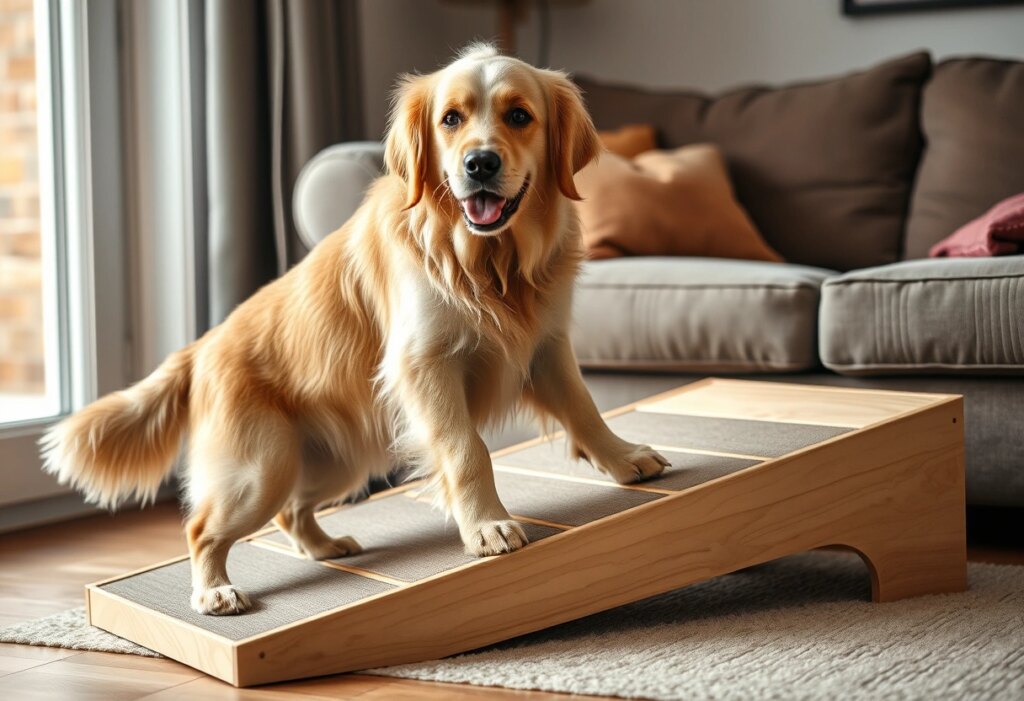

I still remember one of our old souls at the sanctuary, a stiff-hipped shepherd girl named Willow, standing at the bottom of the porch steps just… staring. Not whining. Not trying. Just staring up at those three little steps like they were a mountain. When it comes to ramps vs stairs for aging dogs, that hesitation is not stubbornness. It’s data. Your dog is telling you something real about her body, and our job is to actually listen instead of coaxing her up anyway because we’re in a hurry.
That pause at the couch, the car bumper, the back door. It matters. And figuring out whether a ramp or a set of steps is the right tool isn’t just about convenience for us. It’s about protecting what’s left of her comfort in those joints.
Why That Hesitation at the Couch or Car Is Worth Paying Attention To
Dogs don’t fake reluctance. When a senior dog who used to launch herself onto the bed now stands there thinking about it, that’s her nervous system doing quiet math. Weighing pain against reward. Weighing confidence against risk.
She knows her body better than we do. We just have to be humble enough to trust what she’s showing us.
This is where the ramps vs stairs question actually starts. Not in a product review. In a real moment of watching your dog’s face, her weight shift, the way she tests a surface with one paw before committing.
Honestly, who thinks like that?? “She’s fine, she just needs to get used to it.” No. If she’s hesitating every single time, she’s not “getting used to it.” She’s telling you it hurts. Listen the first time, not the fifteenth.
The Biomechanics Nobody Explains Simply Enough
Here’s the part that actually matters medically. Stairs demand repetitive flexion and extension of the hips, knees, and elbows, plus real weight-bearing impact every single time a paw lands on a step. For a young, healthy dog, that’s no big deal. For an arthritic senior, it’s like asking someone with bad knees to do lunges just to reach the bathroom.
Ramps work differently. They spread body weight across a gradual incline instead of concentrating it into sudden up-and-down motion. Less impact per step, more sustained but gentler load. That distinction is the whole ballgame when we’re talking about joint support for dogs who are already inflamed, arthritic, or recovering from something.
This isn’t a small population of dogs either. According to the American College of Veterinary Surgeons, osteoarthritis affects an estimated 20% of dogs over one year old, and it touches the majority of dogs past age eight. So if your senior is slowing down on stairs, she’s not being difficult. She’s very likely part of that majority, and the choice between ramps vs stairs becomes a quality-of-life decision, not a convenience one.

The Honest Case for Stairs
I’m not anti-stairs. I want to say that clearly, because some dogs genuinely do better on them.
Short, controlled bursts of stair climbing can help maintain muscle tone in dogs with mild stiffness who are otherwise stable. There’s a strengthening component to it. A dog with early arthritis and decent muscle mass in her hind end might actually benefit from the small resistance stairs provide, as long as the steps are shallow and grippy.
Stairs also take up less floor space, which matters in a small apartment or a tight bedroom corner. And some dogs, especially confident, food-motivated ones, learn stairs faster than they learn to trust a moving-feeling ramp surface.
The Kohentact Dog Stairs, Steps and Ramp for High Bed & Sofa is actually a nice hybrid option here. It’s built with shallower rise steps than a lot of standard pet stairs, which matters enormously for a dog with hip dysplasia or lumbar spine sensitivity.

- Ultimate Support & High-Density Comfort – Filled with 40D high-resilience foam, Kohentact pet stairs provide sturdy supp…
- Flexible Modular Design & Easy Storage – Available in 2-to-5 tier options, these stairs have a unit height ranging from …
- Certified Safety & Non-Slip Stability – Your pet’s health is our top priority. These stairs are OEKO-TEX certified, ensu…
The Honest Case for Ramps
Now for the dogs I worry about most. The severe arthritis cases. The post-surgery recoveries. The dogs prone to intervertebral disc disease (IVDD), like Dachshunds, Corgis, and other long-backed breeds who cannot afford a single bad landing.
For these dogs, ramps aren’t a nice-to-have. They’re often non-negotiable.
A 2020 study published in Frontiers in Veterinary Science looked directly at how incline angle and surface traction affect joint loading in dogs, and found both factors significantly change the strain placed on limbs during ascent and descent. Translation: a poorly designed ramp with a steep angle and slick surface can be just as hard on joints as stairs, maybe worse. The engineering matters just as much as the ramps vs stairs decision itself.
This is exactly why we’ve moved several of our sanctuary dogs onto proper ramps after knee or spine surgery. There’s no jarring impact, no twisting motion, just a smooth, even climb their healing bodies can handle. If your dog has had TPLO surgery, is managing IVDD risk, or has advanced hip dysplasia, a well-built ramp is very often the safer call. Pairing that with the right senior dog food for joint pain and arthritis gives you a fuller picture of joint support, not just a mobility aid but nutrition working alongside it.

The Wotunest 2-in-1 Indoor Pet Ramp is a solid example of design done right, with a folding three-tier surface that keeps the incline gentle instead of steep.

- 2-IN-1 CONVERTIBLE DESIGN – Our 2-IN-1 dog ramp allows you to easily convert the pet steps to a pet ramp,Finding the rig…
- HIGH TRACTION AND NON SLIP – The walking surface of the dog ramp is covered with grooved high traction fabric. Give the …
- FOLD & EASY TO CARRY – The pet ramps can fold up for easy transport or store away in compact spaces,Easily to be stored …
Comparing Your Real Options Side by Side
Specs matter here more than marketing photos do. Below is a straightforward look at how these three real products stack up for aging joints, so you’re not guessing in a store aisle.
| Product | Type | Best For | Incline / Rise | Price Tier |
|---|---|---|---|---|
| Mesa Lemon 4 Step Dog Stairs Pet Ramp | Hybrid stairs/ramp | Moderate stiffness, small-to-medium dogs, tight spaces | Shallow 4-step rise | $$ |
| Wotunest 2-in-1 Indoor Pet Ramp | Folding wooden ramp | Severe arthritis, post-surgery, IVDD-prone breeds | Gentle 3-tier gradual slope | $$$ |
| Kohentact Dog Stairs, Steps and Ramp | Hybrid stairs/ramp | Confident climbers with mild-to-moderate joint issues | 13-inch shallow steps | $$ |
A Practical Checklist Before You Buy Either One
Skip the guesswork. Before choosing between dog ramps for seniors and traditional pet stairs for dogs, walk through this honestly:
- Diagnosis first. Has your vet confirmed arthritis, hip dysplasia, IVDD risk, or recent surgery? That alone should tip the scale toward a ramp.
- Weight matters. Larger, heavier dogs put more torque through joints on stairs. Smaller dogs may manage stairs fine if the rise is shallow enough.
- Confidence level. Some dogs are genuinely more nervous on a moving-feeling ramp surface than on solid steps. Watch her, not the marketing copy.
- Available space. Ramps need more floor length to keep the incline gentle. If you’re tight on room, a compact stair-ramp hybrid might be your only real option.
- Non-negotiable safety features:
- Non-slip surface, not just textured paint but actual grip material
- Incline ratio under 18 to 20 degrees for arthritic or post-op dogs
- Secure side rails or bumpers to prevent slipping off the edge
- Weight capacity that comfortably exceeds your dog’s actual weight
The Mesa Lemon 4 Step Dog Stairs Pet Ramp checks several of these boxes for smaller senior dogs who need a shallow rise but don’t have room for a full-length ramp.

- PERFECT FIT FOR YOUR BED & SOFA: Mesa Lemon sturdy pet stairs give your small or medium-sized dog a safe, gentle climb …
- MULTIPLE SIZES & COLORS: Available in 2, 3, and 4-step options with multiple colors to match your home. Choose the perfe…
- STABLE & NON-SLIP CONSTRUCTION: Your pet’s safety comes first. The soft, waterproof corduroy cover provides great grip f…
Watch Her Body, Not the Rulebook
Here’s the truth I’ve learned after years of caring for old dogs with worn-out hips and tired backs: there is no universal answer to ramps vs stairs. There’s only what works for the dog standing in front of you, right now, in her actual body.
Does she approach the ramp with her tail relaxed, or does she freeze and back away? Does she take the stairs two at a time out of habit, or does she wince at the top? These small signals are the real answer key. Not a blog post. Not even this one.
Ask yourself: does she trust this tool enough to actually use it on her own, without being lifted or bribed? If the answer is no, it doesn’t matter how good the reviews are. It’s the wrong fit for her.
Give her time. Let her sniff it, step on it slowly, back off if she needs to. Rushing a nervous senior onto a new ramp or staircase just teaches her to fear it more. Patience here isn’t optional, it’s the whole method.
And if you’re navigating other end-of-lifecycle changes, like an older dog struggling with house training accidents from arthritis-related mobility loss, you’re not alone in that either. Cleaning those spots properly with the best enzyme cleaners for older dogs peeing in the same spot can save your floors and your patience while you sort out the mobility piece.
Frequently Asked Questions
Are ramps always safer than stairs for senior dogs?
Not always, but generally, yes for dogs with diagnosed arthritis, IVDD risk, or post-surgical recovery. The debate between ramps vs stairs really comes down to your individual dog’s diagnosis and confidence level. A well-built ramp with a gentle incline under 20 degrees typically places less strain on hips and elbows than repeated stair climbing.
What incline angle is safe for a dog with arthritis?
Most veterinary rehab specialists recommend keeping ramp incline under 18 to 20 degrees for dogs with joint disease. Steeper angles increase shear force on the hips and knees, which defeats the purpose of choosing a ramp in the first place.
Can a dog use both ramps and stairs depending on the situation?
Absolutely, and many households do exactly that. A dog might use a ramp for the car or a tall bed, but manage shallow, grippy stairs for a low couch. The ramps vs stairs choice doesn’t have to be all-or-nothing; it can flex with the task and the dog’s daily pain levels.
How do I know if my senior dog needs joint support beyond a ramp or stairs?
If your dog is hesitating at low thresholds, slipping on hard floors, or showing stiffness after rest, it’s time for a vet visit to discuss joint supplements, pain management, or diet changes. Mobility aids like ramps and stairs help mechanically, but real joint support for dogs often needs a nutritional and medical layer too.
Whatever you choose between ramps vs stairs, choose it with her actual body in mind, not just what looks tidy in your living room. She’s told you what she needs. We just have to keep listening.
Tell your pup I said Hi! — Dawn