


Dog training tools can genuinely change the trajectory of a demand barking problem, but only when you understand what’s driving the behavior in the first place. Demand barking is not a personality flaw or a sign of a “bad” dog. It’s an operant behavior, meaning it’s a response your dog has learned produces a consequence they want, whether that’s attention, food, or access to something in the environment. Once you look at it through that lens, choosing the right dog training tools stops being guesswork and starts being a functional decision based on what’s actually reinforcing the noise.
Demand barking is fundamentally different from alarm barking or territorial barking. Alarm barking is triggered by a perceived threat and involves the sympathetic nervous system ramping up in response to a startling stimulus. Territorial barking is tied to resource guarding and space defense, often with a visual or olfactory trigger like a mail carrier or a strange dog outside the fence. Demand barking, by contrast, is maintained purely by its consequences. Your dog barks, you look up, hand over a treat, or open the door, and the barking gets exactly what it was designed to get. Behaviorally speaking, that’s a textbook example of positive reinforcement strengthening a behavior over time.
What the Data Actually Shows About Attention-Seeking Vocalizations
A 2021 study published in Applied Animal Behaviour Science found that attention-seeking vocalizations in dogs increase significantly when they’re reinforced on an intermittent schedule, meaning the owner doesn’t respond every single time. This mirrors the extinction-burst pattern well documented in operant conditioning literature: when a previously reliable reinforcement schedule becomes unpredictable, the behavior doesn’t fade quietly. It escalates first, often dramatically, before it decreases. Owners frequently misread this escalation as the dog “getting worse” and cave in, which unfortunately just re-establishes the intermittent schedule that made the barking so durable to begin with.
The ASPCA’s behavior complaint data backs this up from a different angle. Nuisance barking consistently ranks among the top five owner-reported behavior complaints in dogs over age seven, and it tends to worsen with age-related anxiety or sensory decline rather than improve. That’s a critical detail for anyone managing an older dog, because it means the barking you’re dealing with today may have a different underlying cause than the barking your dog exhibited at age three, even if the topography of the behavior looks identical from the outside.
Why Senior Dogs Are Particularly Prone to Demand Barking
Older dogs face a unique convergence of factors that make demand barking more likely and more persistent. Reduced mobility means a dog that once could get up and follow you to the kitchen now has to bark to request the same outcome. Age-related anxiety, often tied to declining vision or hearing, increases baseline arousal, making dogs more reactive to changes in their environment and more likely to vocalize when they feel uncertain. And for a subset of senior dogs, emerging cognitive dysfunction syndrome (CDS), the canine analog to Alzheimer’s disease, disrupts sleep-wake cycles and disorientation in ways that produce vocalization that looks like demand barking but actually has a neurological component.
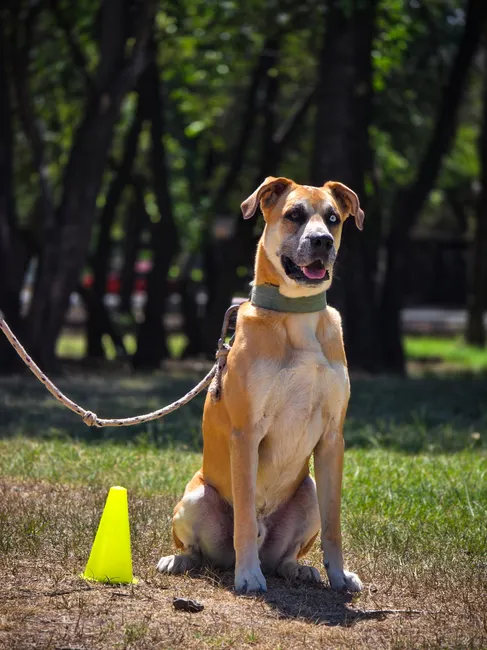
This is why dog training tools for demand barking cannot be applied generically to a senior dog the way you might with a younger, healthier animal. A tool that works beautifully for a two-year-old Labrador with straightforward attention-seeking behavior may be inappropriate, or even harmful, for a twelve-year-old dog with arthritis and early CDS. Any protocol needs to start with a functional assessment: what is maintaining this specific dog’s barking, right now, in this specific context? If you’re also managing a senior dog that seems restless or under-stimulated in ways that contribute to vocalization, our guide on Best Toys & Enrichment for a High-Energy Senior Dog covers how to channel that energy into appropriate outlets rather than attention-seeking noise.
Don’t count on a single gadget to make demand barking disappear permanently. The behavior was built through reinforcement, so it has to be dismantled through a change in reinforcement contingencies. The tool is the scaffolding. The protocol is the structure.
The 5 Dog Training Tools, Broken Down by Mechanism of Action
Below is a breakdown of the five categories of dog training tools most relevant to demand barking, organized by how each one actually functions behaviorally rather than by marketing claims.
1. Interactive Treat-Dispensing Puzzle Feeders
These tools work by redirecting the dog’s reinforcement-seeking behavior toward an independent task instead of a vocalization directed at you. Functionally, this is antecedent management: you’re changing the environment so the dog has an alternative route to reinforcement that doesn’t involve barking. A Pup Culture Dog Treat Pouch with Poop Bag Dispenser is a practical companion tool here, letting you deliver small, well-timed reinforcers for calm behavior throughout the day rather than scrambling for treats after the barking has already started.

- FINALLY, A Dog Treat Bag You WANT To Carry – Lets face it, most treat pouches for pet training are boring and industrial…
- REMOVABLE/WASHABLE TREAT BAG- Unlike other dog treat bags, our dog treat holder has a removable treat bag that can be wa…
- NEVER BE CAUGHT WITHOUT A POOP BAG AGAIN – Our discrete poop bag dispenser allows for quicker pick ups and more walking,…
2. Citronella or Vibration Deterrent Collars
These tools use an aversive or startling stimulus (a burst of citronella spray or a vibration) contingent on barking, with the goal of suppressing the vocalization through punishment rather than reinforcing an alternative. In senior dogs, I recommend real caution with this category. Stress physiology research consistently shows that aversive-based suppression can raise cortisol and generalize anxiety to unrelated contexts, and older dogs, already managing reduced sensory processing and possibly CDS, are less resilient to that added stress load. If a vibration collar is used at all, it should be a last resort, paired with a functional behavior assessment, and never the first tool reached for with a geriatric patient.
3. White Noise or Calming Pheromone Diffusers
Unlike the tools above, this category targets arousal-based barking rather than attention-seeking barking specifically. White noise machines mask external triggers (footsteps, traffic, neighborhood dogs) that spike a senior dog’s baseline arousal, while synthetic pheromone diffusers work on the vomeronasal system to lower generalized anxiety. These are especially useful for dogs whose demand barking has an anxious undercurrent, since a calmer baseline state makes the rest of your training protocol far more effective.
4. Clicker-Based Communication Training Kits
A clicker is one of the most precise dog training tools available for building an alternative “quiet” cue, because it marks the exact moment of desired behavior with a consistent, unambiguous signal. This matters enormously in demand barking cases, where timing errors (rewarding a half-second too late, after the bark rather than during the pause) are the most common reason owners feel like “positive reinforcement doesn’t work” on their dog. It does work. It just requires mechanical precision that a clicker provides and a raised voice or vague praise does not. For dogs who also bark at you out of frustration or attention-seeking outside of demand contexts, our article on Senior Dog Barking at You? 5 Vet-Backed Solutions walks through additional differential diagnosis steps worth reviewing alongside this protocol.

5. Physical Barrier and Mat-Training Platforms
Station or mat-training tools teach a “settle” behavior through differential reinforcement of an incompatible response, meaning the dog is reinforced for lying calmly on a designated mat, a behavior that is physically incompatible with pacing, jumping, and barking. For senior dogs specifically, an orthopedic-friendly platform also doubles as a low-impact resting spot, which supports joint comfort while the behavioral training is underway. Pairing station work with light physical engagement, like a short session with a Tug E Nuff Faux Fur Bungee Dog Toy Chaser Tug, can help satisfy a dog’s need for interactive play in a structured way that doesn’t reinforce barking as the currency for attention.

Comparing the 5 Tools Side by Side
| Tool | Mechanism of Action | Best For | Senior Dog Suitability | Price Tier |
|---|---|---|---|---|
| Treat-Dispensing Puzzle Feeder | Redirects reinforcement-seeking to independent task | Attention/food-seeking demand barking | High, low physical demand | $$ |
| Citronella/Vibration Collar | Punishment-based suppression | Persistent barking unresponsive to reinforcement methods | Use with caution, stress risk | $$$ |
| White Noise/Pheromone Diffuser | Lowers baseline arousal | Anxiety-linked or sensory-decline barking | High, gentle and passive | $$ |
| Clicker Training Kit | Builds precise alternative “quiet” cue | Owners committed to reinforcement-based protocols | High, minimal physical strain | $ |
| Mat-Training Platform | Differential reinforcement of incompatible settle behavior | Pacing, restlessness, station training | High, orthopedic benefit | $$$ |
A Structured Protocol for Using These Tools Correctly
None of these dog training tools function as standalone fixes. They’re most effective as antecedent-management aids layered onto a proper behavior modification protocol. Here’s the sequence I recommend to clients:
- Identify the antecedent. Track exactly what happens in the 30 seconds before the barking starts. Is your dog near the food bowl, the door, or you specifically? Keep a simple log for one week before assuming you know the trigger.
- Remove the existing reinforcement schedule. This means no more eye contact, treats, or door-opening in direct response to barking, even intermittently. Consistency here is non-negotiable, since intermittent reinforcement is exactly what makes demand barking so resistant to fading.
- Install a replacement behavior via positive reinforcement. Teach and heavily reinforce an incompatible behavior, like settling on a mat or offering a “quiet” cue, so your dog has a clear, learnable alternative path to the same outcome.
- Layer in the tool as support, not substitute. Use the puzzle feeder, diffuser, or mat platform to make the replacement behavior easier to perform and more rewarding, not as a device you deploy instead of doing the training work.
If anxiety appears to be a major driver of your dog’s demand barking rather than pure attention-seeking, it’s worth reviewing our roundup of 7 Best Calming Aids for Senior Dogs with Anxiety, since addressing the underlying arousal state often reduces the frequency of demand barking episodes on its own.
The Myth of Permanent Suppression Through Punishment
A persistent misconception among owners is that a correction-based tool “fixes” demand barking once and for all. The data is contradictory on this point, and it’s worth being honest about what it actually shows. Punishment can suppress a behavior quickly, sometimes within days, which feels like success. But suppression and extinction are not the same phenomenon. Suppression means the behavior stops occurring in the presence of the punishing stimulus. Extinction means the underlying motivation to perform the behavior has actually diminished because it no longer produces reinforcement. When owners rely solely on punishment-based dog training tools, they frequently see the barking return, sometimes in a different, less predictable form, once the punishing stimulus is removed or the dog habituates to it.
This is precisely why a functional behavior assessment should precede any tool selection. According to the American Veterinary Medical Association, behavior modification approaches that address the underlying motivation for a vocalization, rather than simply suppressing the output, produce more durable outcomes across a dog’s lifespan. For senior dogs specifically, where cognitive and physical resilience is already reduced, choosing dog training tools that support rather than punish is not just a training preference. It’s a welfare consideration.
Bringing It All Together for Your Senior Dog
Choosing the right dog training tools for a demand barking senior dog comes down to matching the tool’s mechanism to your dog’s actual motivation, not to what’s trending or what worked for a friend’s younger, healthier dog. Start with observation, remove the reinforcement that’s maintaining the behavior, install a replacement behavior your dog can succeed at, and only then bring in a tool to support that new pattern. Dog training tools work best as scaffolding around a sound behavioral protocol, never as a replacement for one.
Are anti barking devices safe for senior dogs?
Some are, and some warrant caution. Passive tools like puzzle feeders, calming diffusers, and mat-training platforms are generally safe and well-suited to older dogs. Aversive anti barking devices, like citronella or vibration collars, should be used sparingly, if at all, because senior dogs often have reduced stress resilience and may already be managing anxiety or cognitive dysfunction that aversive stimuli can worsen.
How long does it take for dog training tools to stop demand barking?
Most owners see a meaningful reduction within two to four weeks when tools are paired with a consistent reinforcement protocol. Expect an initial extinction burst, a temporary increase in barking, in the first several days as your dog tests whether the old reinforcement schedule has truly changed. This is a normal and expected part of the process, not a sign that the approach has failed.
What is the best dog barking deterrent for a dog with cognitive dysfunction syndrome?
For dogs with suspected CDS, the most appropriate dog barking deterrent options are ones that lower arousal and support orientation, such as white noise machines, pheromone diffusers, and predictable routines paired with a veterinary consultation. Punishment-based deterrents are not appropriate for CDS-related vocalization, since the barking often stems from disorientation or altered sleep-wake cycles rather than a learned attention-seeking behavior.
Can I stop demand barking without using any tools at all?
Yes, a consistent reinforcement-based protocol can work without any dog training tools whatsoever, since the core mechanism is a change in what you reinforce, not the equipment itself. That said, tools like clickers, puzzle feeders, and mat platforms make the process considerably easier and more consistent, particularly for owners who are new to behavior modification or managing multiple triggers at once.