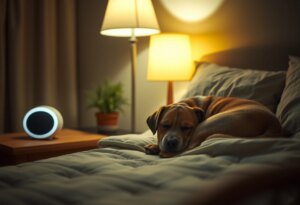
Senior dog sleep barking is, in most cases, nothing more than a dog acting out a dream, but the pattern of the episode is what tells you whether you’re watching normal REM activity or something that needs a veterinarian’s attention. As a behaviorist, I get some version of this question in nearly every consult involving a dog over age nine: “Is my old dog having a nightmare, or is this a seizure?” The honest answer is that you can usually tell the difference yourself, if you know what to look for and you’re willing to observe rather than react on instinct. This article walks through the sleep physiology behind it, the specific behavioral markers that separate dreaming from a medical event, and a simple logging protocol you can bring to your vet instead of relying on a foggy 3 a.m. memory.
The Sleep Architecture Behind Senior Dog Sleep Barking
Dogs cycle through non-REM and REM sleep stages roughly every 20 minutes, a much shorter cycle than the 90-minute human pattern. During non-REM sleep, the body is restoring itself and movement is minimal. During REM sleep, the brainstem is highly active, muscle tone drops (a state called atonia), but the motor cortex still fires impulses. That’s why you see paw paddling, whisker twitching, muffled vocalization, and occasionally a full-volume bark, all while the dog stays fully asleep. Sleep physiology researchers, including work summarized by the National Institutes of Health, describe this as a well-conserved mammalian trait, not a canine quirk. Older dogs tend to spend a larger proportion of total sleep time in these lighter, twitchy stages, partly because their sleep architecture fragments with age, similar to what’s documented in aging humans.
What this means practically: senior dog sleep barking during REM is a sign the brain is functioning normally, not a red flag by itself. The dog is essentially rehearsing motor sequences, chasing, alerting, maybe replaying a walk, without acting them out at full intensity because the atonia is holding the muscles back. Some dogs “leak” through that inhibition more than others, which is why older, less muscularly toned dogs sometimes look more dramatic mid-dream than they did at age three.
Normal Dreaming vs. Dog Twitching in Sleep That Signals a Problem
The behavioral distinction between benign dog twitching in sleep and something medical comes down to four observable variables: duration, rhythm, responsiveness, and recovery.

- Duration: Normal REM twitching episodes last seconds to about a minute or two. Seizure activity frequently runs longer, sometimes several minutes, and rarely resolves the instant you touch the dog.
- Rhythm: Dreaming movement is irregular and variable, a paw twitch, then a pause, then a muffled bark. Seizure activity is often more rigid and repetitive, sometimes described by owners as “paddling stiffly” rather than the loose, floppy motion of dream paddling.
- Responsiveness: This is the single most useful field test. Call your dog’s name calmly. A dreaming dog will usually wake up within a few seconds, look mildly confused, and settle back down. A dog in a seizure will not respond to voice or touch at all during the event.
- Recovery: After a dream, a dog reorients almost immediately. After a seizure, dogs frequently show post-ictal signs: disorientation, wobbly gait, temporary blindness, drooling, or loss of bladder control, and this altered state can last several minutes to hours.
If you see rigidity, involuntary urination, or a dog that stays glassy-eyed and unresponsive for minutes after waking, treat it as a seizure until your veterinarian tells you otherwise. Don’t try to physically restrain a dog mid-episode; give them space and time it instead.
“Owners consistently underestimate how normal vocal dreaming is in senior dogs, and just as consistently underestimate how disorienting a true post-seizure state looks. The line between the two isn’t loudness, it’s responsiveness and recovery time.” — clinical observation from geriatric canine behavior consults
Cognitive Dysfunction and Night Vocalization: A Different Category Entirely
There’s a third possibility that doesn’t fit neatly into “dream” or “seizure,” and it’s one I see underdiagnosed constantly: canine cognitive dysfunction (CCD), the dog dementia analog to Alzheimer’s disease. Landsberg and colleagues (2012) found that up to 28 percent of dogs over age 11 show at least one recognizable sign of cognitive decline, and disrupted sleep-wake cycles with nighttime vocalization, often called sundowning, is one of the documented hallmark symptoms. This isn’t the dog dreaming. This is a dog who is awake, disoriented, and vocalizing because their circadian rhythm and spatial orientation are degrading.
The tell here is timing and context rather than motor pattern. CCD-related barking tends to happen when the dog is genuinely awake (eyes open, standing, sometimes pacing or staring at walls) rather than during sleep itself. It often clusters in the early evening or the middle of the night, and it’s frequently accompanied by other CCD signs: house-soiling in a previously reliable dog, getting “stuck” behind furniture, reduced interest in greeting family members, or reversed sleep schedules where the dog sleeps more by day and wanders at night. If this sounds familiar, it’s worth reading our detailed breakdown of 7 signs of cognitive decline in aging dogs, since night vocalization rarely shows up as an isolated symptom.
Environmental management matters a lot here. Dogs with CCD-related night anxiety often do better with consistent, low-stimulation sleep environments. A calming, enclosed crate space can reduce disorientation-driven vocalization for some dogs, and if you’re evaluating options, our guide to the best calming crate covers for senior dog anxiety covers what actually has behavioral support versus what’s just marketing.

Building an Observational Log Instead of Relying on Memory
Vets need pattern data, not a panicked description from memory at a 7 a.m. appointment. I ask every client dealing with senior dog sleep barking to keep a simple log for at least one to two weeks before their vet visit. It takes thirty seconds per episode and dramatically improves diagnostic accuracy.
| Field to Log | What to Record | Why It Matters |
|---|---|---|
| Time of night | Exact clock time episode began | Clusters at consistent hours suggest circadian/CCD pattern rather than random dreaming |
| Duration | Seconds to minutes, timed if possible | Anything past 2-3 minutes warrants closer seizure evaluation |
| Responsiveness | Did the dog wake when name was called? | Immediate response points to dreaming; no response points to seizure or deep CCD confusion |
| Physical signs | Rigidity, drooling, urination, eyes open/closed | These are the clearest seizure red flags a vet needs to hear about |
| Recovery time | Minutes until fully normal and oriented | Fast recovery = dream; slow, disoriented recovery = medical concern |
Filming the episode on your phone (without waking the dog) is one of the most useful things you can hand a veterinarian. If you’re already recording nighttime sound or movement for other reasons, a nursery-style monitor camera set up near the dog’s bed captures far more reliable data than a half-asleep human observer. Devices like the While You Dream Artificial Intelligence sleep monitor are built for tracking human sleep stages but the underlying logic applies well to repurposed pet monitoring setups: consistent overnight footage removes the guesswork from what actually happened during senior dog sleep barking episodes.

The Decision Protocol: Film It, Call the Vet, or Let Sleeping Dogs Lie
Here’s the structured checklist I give owners so they’re not making a 2 a.m. judgment call from panic alone.
- Let it be if: the episode lasts under a minute, the dog wakes promptly when you speak, there’s no rigidity or urination, and the dog resettles normally within a minute or two. This is almost certainly ordinary dreaming and doesn’t need intervention.
- Film it and monitor if: episodes are becoming more frequent, longer, or louder than they used to be, or if you’re unsure whether the dog is asleep or awake during the vocalization. Send the footage to your vet at the next routine visit.
- Call the vet within 48 hours if: you notice a new pattern of night waking, pacing, disorientation while conscious, or vocalization paired with house-soiling. These point toward CCD or another medical driver that benefits from early management, since dog dementia symptoms tend to progress and early intervention (diet, enrichment, sometimes medication) has better outcomes than waiting.
- Seek same-day veterinary care if: you observe rigidity, paddling that doesn’t stop when touched, loss of bladder or bowel control, prolonged disorientation after waking, or any signs consistent with a seizure. Don’t wait this one out.
Sleep quality matters just as much as diagnosis. A dog waking repeatedly from disrupted, shallow sleep is going to show more dramatic senior dog sleep barking simply from more frequent REM transitions. An orthopedic bed that keeps joints supported and a quiet, low-traffic sleep space both reduce the number of partial wake-ups that can look alarming but are really just noise in the data.
When the Issue Extends Beyond the Bedroom
Owners managing a senior dog with fragmented sleep or CCD-related confusion often notice the same disorientation shows up during car travel, another situation involving unfamiliar motion and reduced spatial control. If your dog already startles or vocalizes in the car, it’s worth protecting your vehicle’s interior while you sort out the underlying cause. The 4Knines Heavy-Duty Rear Seat Cover for Dogs is a practical, mid-tier investment for owners dealing with senior dogs who pace, drool, or have accidents during travel-related anxiety spikes.

- ENGINEERED FOR ALL VEHICLES: Our 4Knines Dog Car Seat Cover is designed to fit cars, trucks, and SUVs. With a 60-inch wi…
- PREMIUM DURABILITY WITH REAL QUILTING: Crafted from heavy-duty 600D polyester, our dog seat cover features real quilting…
- ADVANCED WATERPROOF PROTECTION: Featuring exclusive K9-Shield waterproof technology, this back seat dog cover protects y…
Comparison: Dreaming vs. Seizure vs. CCD Night Vocalization
| Feature | Normal REM Dreaming | Dog Sleep Seizures | CCD Night Vocalization | Price Tier (Tools to Help Monitor) |
|---|---|---|---|---|
| Consciousness state | Fully asleep | Unconscious/altered | Awake, disoriented | N/A |
| Duration | Seconds to 1-2 minutes | Often 1-5+ minutes | Variable, can persist for an hour | N/A |
| Responds to name | Yes, wakes quickly | No response during event | Delayed or confused response | N/A |
| Recovery | Immediate, normal | Slow, disoriented, may urinate | Gradual, may pace or repeat pattern | N/A |
| Monitoring tool: overnight sleep tracker | Useful for pattern logging | Useful for capturing footage for vet | Useful for tracking sundowning timing | $$$ |
| Monitoring tool: vehicle seat protection for vet visits | Not applicable | Helpful for emergency transport | Helpful for anxious travel to vet | $$ |
Frequently Asked Questions About Senior Dog Sleep Barking
Is senior dog sleep barking normal in older dogs?
Yes, in most cases. Senior dog sleep barking during REM sleep is a normal part of canine sleep physiology and reflects active dreaming rather than distress. It only becomes a concern when episodes last longer than a minute or two, the dog doesn’t respond to their name, or physical signs like rigidity or urination accompany the vocalization.
How do I tell dog twitching in sleep apart from a seizure?
Try calling your dog’s name calmly during the episode. Dream-related dog twitching in sleep typically resolves within seconds and the dog wakes and reorients quickly. Seizure activity does not respond to voice or touch, often lasts longer, and is followed by a disoriented recovery period that can last minutes to hours.
Can dog sleep seizures be mistaken for dreaming?
Yes, and this is a common misread among owners. Dog sleep seizures can look superficially similar to dreaming at a glance, but the key differences are duration, rigidity, unresponsiveness, and a slow, confused recovery. Filming the episode and reviewing it with your veterinarian is the most reliable way to distinguish the two.
Does canine cognitive dysfunction cause nighttime barking?
It can. Canine cognitive dysfunction disrupts circadian sleep-wake regulation, and night vocalization while the dog is awake and disoriented, often called sundowning, is a documented symptom. This differs from sleep barking because the dog is conscious, not dreaming, during the episode.
Most senior dog sleep barking you’ll witness is simply the tail end of an active dream, and treating every twitch as an emergency does more harm to your own sleep than good for your dog’s. The behavioral markers here, responsiveness, duration, and recovery, give you a reliable field test you can apply in the moment, and the logging habit turns vague nighttime worry into data your veterinarian can actually use. When in doubt, film it, note the time, and let the pattern speak for itself rather than the fear.