


The right dog food for joint pain will not reverse arthritis in your Golden Retriever, but it can measurably change how your dog moves, rests, and engages with the world during the second half of life. That distinction matters, because a lot of marketing around senior dog nutrition implies a cure that does not exist. What the peer-reviewed literature actually supports is more modest and more useful: specific nutrients, at specific doses, can reduce inflammatory load on joints and slow the functional decline that comes with osteoarthritis. This article walks through the biological rationale, the behavioral signs that tell you it is time to intervene, and a structured protocol for evaluating whether a diet change is actually working, rather than just hoping it is.
Why Golden Retrievers Are Predisposed to Joint Disease
Golden Retrievers are not randomly unlucky when it comes to hips and elbows. According to Orthopedic Foundation for Animals (OFA) Hip Registry data, the breed sits among the top 20 for hip dysplasia prevalence, with reported incidence in the range of 20 to 21 percent. That is a structural, heritable vulnerability, not a lifestyle failure on the owner’s part. Dysplastic joints develop abnormal wear patterns early, and by the time a dog reaches its senior years, the cartilage has often been absorbing uneven mechanical stress for a decade or more. This is the biological backdrop for why joint support dog food is not a fringe category for this breed. It is a functional necessity for a large share of the population. For readers who want a broader look at breed-specific health risks that often go unnoticed until they are advanced, our piece on early warning signs Golden Retriever owners frequently miss covers several conditions that share this “silent until moderate” progression pattern with osteoarthritis.
The mechanical piece is only half the story. Cartilage degradation triggers a low-grade inflammatory cascade inside the joint capsule. Inflammatory mediators like prostaglandins and cytokines sensitize local nerve endings, which is part of why arthritic pain tends to worsen gradually rather than appear as a single dramatic event. This is the physiological reason arthritis dog food formulations built around anti-inflammatory fatty acids are not just a nice-to-have add-on. They are targeting the actual mechanism driving discomfort, not just the downstream symptom.
Behavioral Signs That Diet Intervention Is Warranted
Owners tend to look for limping as the signal that something is wrong. Limping is a late-stage indicator. Behaviorally, the earlier and more reliable signs show up as changes in previously reinforced behavior sequences, meaning activities your dog used to seek out on its own. Watch for:
- Gait changes under load, such as a bunny-hop pattern going up stairs, or a wider stance when standing from rest.
- Reduced activity-seeking behavior, where a dog that used to initiate play by bringing a toy now waits to be invited, or stops initiating altogether.
- Latency increases in response to cues that require movement, like a slower response time to “let’s go” or hesitation before jumping into the car.
- Postural guarding, including reluctance to lie fully on one hip, or curling in a way that keeps weight off a particular limb.
- Grooming or licking concentrated over a joint, which can indicate localized discomfort even before lameness is visible.
These are not personality changes. They are functional adaptations a dog makes to manage pain, and they tend to precede an owner’s conscious recognition of “my dog has arthritis” by weeks or months. If you are noticing two or more of these patterns together, that is the point to introduce dietary intervention alongside a veterinary orthopedic exam, not after.

Do not count on diet alone to produce dramatic mobility changes within days. The joint-support nutrients we know work best, omega-3 fatty acids in particular, require sustained tissue-level accumulation before their anti-inflammatory effect becomes behaviorally observable. Owners who quit after two weeks because “nothing changed” are usually stopping right before the effect would have become measurable.
What the Research Actually Shows About Joint-Support Ingredients
The supplement aisle is full of claims that outrun the evidence. Here is what is actually supported by controlled studies, broken down by ingredient:
| Ingredient | Mechanism | Evidence Strength | Best Use Case |
|---|---|---|---|
| EPA/DHA Omega-3 Fatty Acids | Competes with arachidonic acid pathway, reducing production of inflammatory prostaglandins | Strong. A 2020 study in the Journal of Veterinary Internal Medicine documented measurable improvement in weight-bearing scores in osteoarthritic dogs fed omega-3 enriched diets | Dogs with confirmed osteoarthritis, especially those also showing skin or coat inflammation |
| Glucosamine | Provides substrate for glycosaminoglycan synthesis in cartilage matrix | Moderate. Effect sizes vary by study; benefit appears more consistent when combined with chondroitin | Early to moderate joint degeneration, preventive use in high-risk breeds |
| Chondroitin Sulfate | Inhibits cartilage-degrading enzymes, supports joint fluid viscosity | Moderate, generally studied alongside glucosamine rather than alone | Paired use with glucosamine for structural joint support |
| Green-Lipped Mussel Extract | Natural source of omega-3s plus glycosaminoglycans | Emerging, smaller sample sizes but consistent direction of effect | Owners seeking a whole-food-derived alternative to isolated supplements |
The data is contradictory when it comes to glucosamine and chondroitin as standalone interventions. Some trials show clear improvement in owner-reported comfort scores, others show no statistically significant difference from placebo. What is more consistently supported is the omega-3 pathway, which is why any serious senior dog joint supplements discussion should treat EPA and DHA as the foundation, with glucosamine and chondroitin as reasonable additions rather than the primary mechanism of action.
Evaluating Food Choices: Caloric Density, Protein Quality, and Anti-Inflammatory Profile
Body weight is arguably the single most controllable variable in managing canine arthritis, more controllable than the joint itself. Every extra pound of adipose tissue increases mechanical loading force on already compromised cartilage, and fat tissue is also metabolically active, secreting its own inflammatory cytokines. This means dog food for joint pain selection has to account for caloric density, not just supplement content. A food loaded with glucosamine but calorically excessive for your dog’s activity level can work against itself.
When evaluating options, look at protein quality (highly digestible animal-based sources support lean muscle mass, which stabilizes joints), fat content relative to your dog’s current body condition score, and the presence of marine-sourced omega-3s specifically, since plant-based ALA omega-3s convert to EPA/DHA in dogs at a notably inefficient rate. Air-dried formulations have become a popular middle ground between raw and kibble because they preserve more of the natural nutrient profile of the protein source without the caloric concentration of some traditional raw diets. ZEAL Canada Air-Dried Chicken Recipe for Dogs is one option worth evaluating in this category, offering a high-protein base that can be paired with a joint supplement regimen rather than relying on fortified kibble alone.
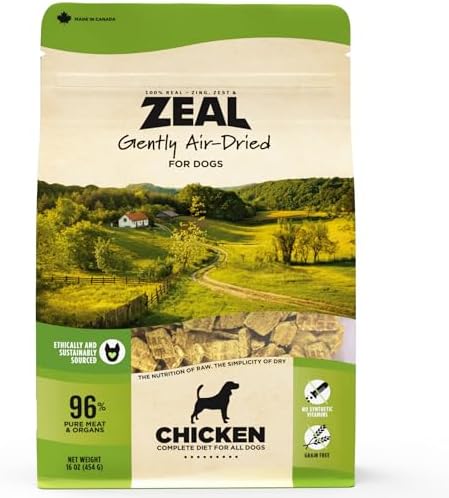
- 96% Free-Range Chicken and Organs for Optimal Health: Made with free-range chicken, liver, gizzard, and heart, providing…
- Natural and Organic Superfoods for Complete Wellness: Enriched with ethically sourced green-lipped mussels for joint sup…
- Air-Dried to Retain Nutrients Naturally: Our gentle air-drying process locks in all the nutrients without synthetic addi…
For dogs whose appetite has become inconsistent, which is common in senior Goldens managing chronic discomfort, feeding mechanics matter as much as formula selection. An elevated bowl reduces the need to lower the head and neck into a hunched posture that can strain the cervical spine and shoulders, both of which are already compensating for hip or elbow pain. The addggo Elevated Ceramic Slow Feeder Dog Bowls Anti-Choking design also slows intake, which is useful for dogs on calorie-controlled plans where eating too quickly can undermine portion discipline.

- addggo’s elevated ceramic dog slow feeder dog bowl convenient for dogs to eat and Preventing bad habits,avoiding dog’s n…
- 1.6Cup Capacity pefect for Small&Medium size dog:This raised slow feeder dog bowls small breed 6.3” Dia x 4.92” H”H perf…
- Premium material made it durable easy to clean Dishwaher-safe and Oven-safe Microwave-safe: The food grade ceramic dog s…
The American Kennel Club recommends senior dogs undergo more frequent veterinary evaluation as part of managing age-related conditions like arthritis, since dosing for supplements and dietary fat content should be adjusted based on individual kidney and pancreatic function, not applied uniformly. You can review the AKC’s general senior dog care guidance at AKC’s senior dog health resource for context on how nutrition fits into broader geriatric care planning.
Comparing Joint-Support Products at a Glance
Below is a comparative breakdown of the three products referenced in this article, useful for owners deciding where to start.

| Product | Primary Function | Best For | Price Tier |
|---|---|---|---|
| ZEAL Canada Air-Dried Chicken Recipe | High-protein base diet, minimal processing | Dogs needing a nutrient-dense base to pair with joint supplements | $$$$ |
| addggo Elevated Ceramic Slow Feeder Bowls | Feeding posture support, portion pacing | Dogs with neck/shoulder compensation or fast eating habits | $$ |
| Vita-Tabs Silver for Senior Dogs | Daily vitamin-mineral supplementation | Senior dogs needing broad nutritional support alongside joint care | $ |
Supplementing the Diet: Where Vitamin-Mineral Support Fits In
Joint-targeted nutrients do not operate in isolation. Senior dogs often have reduced digestive efficiency, meaning nutrient absorption from food alone can decline even when the diet itself is well-formulated. This is where a daily multivitamin becomes a reasonable complement rather than a redundant add-on. Vita-Tabs Silver for Senior Dogs is formulated specifically for the geriatric nutritional profile, filling gaps that a joint-focused diet alone might not fully address, particularly around antioxidant support, which plays a secondary but real role in managing oxidative stress within inflamed joint tissue.

- Comprehensive Nutrition: Vita-Tabs provide a balanced blend of essential vitamins and minerals to support your dog’s ove…
- Immune System Support: Packed with antioxidants, these tabs help strengthen your dog’s immune system, promoting a robust…
- Healthy Coat and Skin: The inclusion of Omega-3 fatty acids contributes to a lustrous coat and healthy skin, ensuring yo…
If your Golden has also started showing reduced interest in meals altogether, which is a separate but related issue from joint pain, it is worth reviewing our roundup of wet food options for senior Golden Retrievers losing appetite, since palatability and joint support are not mutually exclusive goals.
A Structured Protocol for Tracking Whether the Diet Change Is Working
This is the step most owners skip, and it is the reason so many conclude “diet doesn’t work” when they simply were not measuring the right variables. Functional mobility change from dietary intervention typically becomes observable in the 4 to 6 week range, not the first several days. Here is a structured approach:
- Week 0 baseline: Record three specific behaviors on video: rising from a lying position, navigating a single flight of stairs, and the first 30 seconds of a walk. This becomes your comparison point.
- Weeks 1 to 2: Transition the new joint support dog food gradually over 5 to 7 days, mixing increasing ratios with the old diet to avoid gastrointestinal upset, which can otherwise be mistaken for a food intolerance and derail the trial.
- Weeks 3 to 4: Begin tracking activity-seeking behavior daily using a simple yes/no log: did the dog initiate play, request a walk, or navigate stairs without hesitation today?
- Week 5 to 6: Re-film the same three behaviors from baseline under similar conditions (same time of day, similar temperature, similar surface) and compare directly.
- Ongoing: If no measurable change appears by week 6, this is the point to return to your veterinarian to reassess, rather than concluding nutrition has no role at all. Some dogs need concurrent pain management or physical rehabilitation to see nutritional benefits translate into visible mobility gains.
This kind of structured before-and-after comparison also protects against a well-documented observer bias: owners who are hoping a change will work often report subjective improvement even when video evidence shows no change in gait or latency. Video comparison removes that bias.
Common Misconceptions About Arthritis Dog Food
A few myths persist that are worth addressing directly, without judgment, since they come from reasonable but incomplete assumptions:
- “Grain-free is automatically better for joints.” There is no established mechanistic link between grain content and joint inflammation. This myth conflates grain-free marketing with anti-inflammatory benefit, which are unrelated claims.
- “More glucosamine means faster results.” Dosing follows a therapeutic window, not a linear dose-response curve. Excess amounts are typically just excreted rather than providing additional benefit.
- “Surgery will fix the diet dependency.” Don’t count on surgery to work miracles that eliminate the need for ongoing weight and nutrition management. Post-surgical dogs still carry elevated arthritis risk in the joint and often in compensating limbs.
- “If the dog isn’t limping, there’s no pain.” As covered above, behavioral compensation frequently precedes visible lameness by a significant margin.
Building a Realistic Happiness Plan Around Joint Health
A useful exercise borrowed from behavioral case management is building a brief “Happiness Plan” for your dog’s current life stage, essentially a short list of what quality of life looks like given the joint limitations present. This might include: maintaining two short walks daily instead of one long one, keeping favorite toys accessible at floor level rather than requiring jumping, and preserving at least one form of mentally engaging play that does not require full-speed movement, like scent work in the yard. The goal is not to eliminate activity out of caution. It is to redesign the activity so the dog retains agency and choice, which matters as much for behavioral wellbeing as the dog food for joint pain matters for the physical side of the equation.
How long does it take for joint support dog food to show results?
Most owners begin seeing measurable behavioral changes in the 4 to 6 week range, since omega-3 fatty acids and other anti-inflammatory nutrients need time to accumulate in tissue before their effect becomes functionally observable. Expecting results within the first week is one of the most common reasons owners abandon a diet change prematurely.
Is dog food for joint pain enough on its own, or do I still need supplements?
Diet alone can help, but most senior Golden Retrievers with confirmed arthritis benefit from a combined approach: a nutritionally dense base diet, targeted omega-3 supplementation, and in many cases a daily multivitamin to address broader geriatric nutrient gaps. Diet should be viewed as one component of a larger management plan, not a standalone fix.
Can weight loss alone reduce arthritis symptoms without a special diet?
Weight loss does reduce mechanical loading on joints and is one of the most effective interventions available, but combining it with an anti-inflammatory nutritional profile addresses both the mechanical and biochemical drivers of arthritis pain. Relying on caloric restriction alone misses the inflammatory component entirely.
What behavioral signs suggest my Golden Retriever needs a joint-focused diet now rather than later?
Watch for reduced activity-seeking behavior, hesitation before stairs or jumping into vehicles, changes in gait under load, and postural guarding around a specific joint. These behavioral markers typically appear before visible limping and are a reliable early signal that dietary and veterinary intervention should begin.