
Standing in the pet store aisle staring at two bags that both promise to be exactly what your old dog needs, that’s a moment almost every senior dog parent has lived through. Blue Buffalo senior food sits right next to the adult formula, both covered in confident marketing claims, and you’re left guessing which one actually belongs in your dog’s bowl. Here’s the honest truth: the answer isn’t printed in bold letters on either bag. It lives in your dog’s body, her joints, her energy, and her latest bloodwork. Let’s get into what actually separates these formulas, and how to stop guessing.
The Real Nutritional Differences Between Senior and Adult Formulas
I’ve fed a lot of old dogs over the years at the sanctuary, and I can tell you the differences between these two formulas are real, but they’re not mysterious. Adult formulas are built for dogs in their prime, dogs who are still hiking, working, romping around the yard for hours. They run higher in fat and calories, typically somewhere around 340 to 370 kcal per cup, because that energy gets burned off. Blue Buffalo senior food takes a different approach entirely. Most senior formulas sit closer to 260 to 280 kcal per cup, according to Blue Buffalo’s own published guaranteed analysis, and they lean into joint-support ingredients like glucosamine and chondroitin that adult formulas often skip or include in smaller amounts.
That calorie gap matters more than most people realize. An old dog who’s slowing down, sleeping more, and taking shorter walks simply doesn’t need the same fuel load as a three-year-old lab bouncing off the walls. Feed her the adult formula out of habit, and you may be quietly setting her up for weight gain she can’t afford, especially if her hips or knees are already talking back to her.
If you’re trying to figure out where a specific senior blend lands nutritionally, our breakdown on Blue Buffalo senior dog food reviews walks through the ingredient panels in more detail, formula by formula.
There’s No Legal ‘Senior’ Category, and That Changes How You Should Think About This
Here’s something that surprises a lot of pet parents. According to AAFCO nutrient profiles, there is technically no separate, legally defined “senior” life stage category for dog food. What that means practically is that every senior formula, including every blue buffalo senior food product on the shelf, is formulated within the same “adult maintenance” standard as regular adult food. The company just adjusts the calorie density down and adds joint or mobility support ingredients on top of that baseline.
So when you see “senior” on a bag, you’re not looking at a different regulatory tier. You’re looking at a marketing and formulation choice built around what companies believe aging dogs typically need less of (calories) and more of (joint support). That’s useful information, but it also means the word “senior” isn’t a guarantee that the formula fits your particular dog. Your dog is not a category. She’s an individual with her own body, her own history, her own aches.

This is exactly why comparing senior wet versus dry food options matters just as much as comparing senior versus adult. The right texture and moisture content can matter enormously for dogs with dental issues or kidney concerns, regardless of which life stage label is on the bag.
Why So Many Senior Dogs Are Overweight, and What That Means for Your Bag Choice
A 2011 Banfield Pet Hospital State of Pet Health report found that over 40% of dogs age seven and older were classified as overweight. That number has stuck with me for years because it tells a story that has nothing to do with neglect and everything to do with habit. People keep feeding the same amount, the same formula, long after their dog’s metabolism and activity level have quietly shifted underneath them.
This is where calorie density, not the word “senior” printed on the bag, needs to drive your decision. A senior formula won’t do much good if you’re still scooping adult-sized portions, and an adult formula isn’t automatically wrong if your seven-year-old is still lean, muscular, and active. The label is a starting point, not a verdict.
For dogs who are still fairly active and lean but showing early joint stiffness, something like NUTRO NATURAL CHOICE Adult Dry Dog Food can offer a middle ground, real farm-raised protein with the energy density an active older dog still needs, without tipping into the calorie-heavy territory built for working dogs half their age.

- Supports Whole-Body Health: NUTRO NATURAL CHOICE Adult Dry Dog Food is made with essential nutrients and antioxidants to…
- Made With Real Lamb: Real lamb is the #1 ingredient in this protein-rich recipe
- Supports Healthy Skin & Coat: Made with high-quality protein, this delicious dry dog food also contains Omega 3 & 6 fatt…
On the flip side, dogs who are already carrying extra weight, or who have slowed down noticeably, usually do better shifting toward true senior-formulated calorie density paired with added joint nutrients. That’s the whole point of choosing between an adult vs senior dog food formula intentionally instead of just grabbing whatever’s on sale.
A Simple Comparison to Bring With You to the Store
I put this table together because I know how overwhelming those aisles can feel when you’re standing there with your dog’s leash in one hand and two bags in the other.
| Formula Type | Typical Calories (kcal/cup) | Joint Support Additions | Best Suited For | Price Tier |
|---|---|---|---|---|
| Blue Buffalo Adult Formula | 340-370 | Minimal to none | Active, lean dogs 7+ with normal energy | $$$ |
| Blue Buffalo Senior Formula | 260-280 | Glucosamine, chondroitin | Slower, overweight-prone, or joint-stiff seniors | $$$ |
| Air-Dried Alternative (e.g., ZEAL) | Varies (denser, less filler) | Varies by recipe | Sensitive stomachs, picky eaters, gentle transitions | $$$$ |
| High-Protein Active Formula | 350+ | Minimal | Working or high-activity older dogs | $$$ |
Notice that price tier alone tells you nothing about whether a formula fits your dog. A premium bag of senior dog food formula isn’t automatically the right choice just because it costs more. Fit matters far more than price point ever will.

When a Gentler, Simpler Recipe Makes Sense
Some of our sanctuary dogs, especially the ones arriving with a lifetime of neglect behind them, need food that’s easier on a compromised digestive system before we even worry about calorie counts. For dogs like that, something like ZEAL Canada Air-Dried Chicken Recipe for Dogs can be a gentle bridge, minimally processed, easier to digest, and less likely to upset a stomach that’s already dealing with enough.
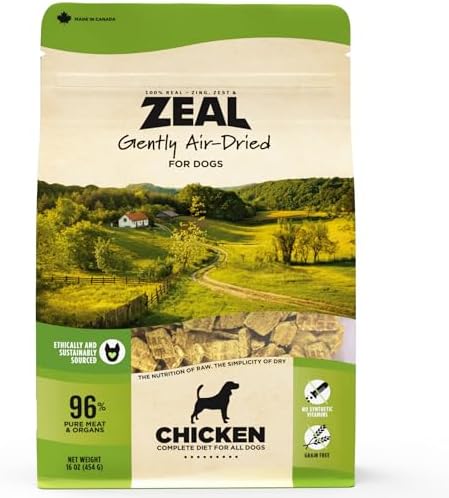
- 96% Free-Range Chicken and Organs for Optimal Health: Made with free-range chicken, liver, gizzard, and heart, providing…
- Natural and Organic Superfoods for Complete Wellness: Enriched with ethically sourced green-lipped mussels for joint sup…
- Air-Dried to Retain Nutrients Naturally: Our gentle air-drying process locks in all the nutrients without synthetic addi…
I’ll also say this, because I think it gets skipped over too often: probiotic support isn’t just a puppy thing. Aging guts need good bacteria too, especially after antibiotics or a rough medical stretch. Nulo Puppy Food Grain Free Dry Food With Bc30 Probiotic was built for younger dogs, but the probiotic concept behind it is worth asking your vet about when you’re choosing any formula, adult or senior, for a dog whose gut health needs extra care.

- GRAIN-FREE recipe contains no corn; wheat; soy; white potatoes; tapioca; artificial colors, flavorings or preservatives….
Nutrition isn’t a label you trust blindly. It’s a conversation you keep having with your dog’s body, week after week, year after year. That’s the sacred trust we take on when we bring these old souls into our lives.
How I’d Actually Evaluate This for My Own Dog
If you asked me to sit down with you and figure out which bag belongs in your cart, here’s exactly what I’d want to know first:
- Body condition: Can you feel her ribs easily without pressing hard? Is there a visible waist when you look down at her from above?
- Joint health: Is she stiff getting up in the morning? Slower on stairs? Reluctant to jump into the car?
- Energy level: Has her activity dropped off in the last six months, or is she still keeping pace with younger dogs?
- Recent bloodwork: Has your vet flagged anything, kidney values, thyroid, blood sugar, that would change what she should be eating?
- Current weight trend: Has she gained or lost weight in the past year without a diet change?
Answer those honestly, and you’ll already know more than any bag label can tell you. A lean, active nine-year-old might do beautifully on an adult formula. A stiff, slightly heavy seven-year-old might need the calorie drop and joint support that comes with blue buffalo senior food specifically. There’s no universal answer here, and honestly, anyone who tells you there is hasn’t spent enough time with enough old dogs.
I’ll be direct about something else too. I’ve met people who keep their dog on the same food for a decade because “she’s always eaten this,” even as her body clearly changes underneath her. Honestly, who thinks like that?? These dogs trust us completely to notice what they can’t tell us in words. Watching her weight creep up or her joints stiffen and not adjusting her food accordingly, that’s a quiet failure of the trust she’s placed in us.
The Bloodwork Conversation No Bag of Kibble Can Replace
I want to be honest with you here, because I think the pet food industry sometimes lets bag labels do too much talking. No formula, no matter how well marketed, replaces an actual conversation with your vet about your dog’s kidney function, her thyroid levels, her joint imaging if she’s had any. Choosing between an adult vs senior dog food formula should happen after that conversation, not instead of it.
If your vet has flagged early kidney concerns, that changes the protein conversation entirely. If she’s dealing with early arthritis, that shifts you firmly toward joint-support formulas regardless of her age on paper. Bloodwork tells a truth that a bag simply can’t.
Frequently Asked Questions
Is Blue Buffalo senior food necessary once my dog turns seven?
Not automatically. Age alone doesn’t determine whether your dog needs the lower calorie density and added joint support found in blue buffalo senior food. A lean, active seven-year-old may do fine on adult formula for another year or two, while a dog already showing weight gain or joint stiffness may benefit from switching sooner. Body condition and vet input matter more than the number on her birthday.
What’s the biggest difference between adult vs senior dog food formulas?
The most consistent difference is calorie density. Adult formulas typically run 340 to 370 kcal per cup to fuel active metabolisms, while senior formulas usually sit around 260 to 280 kcal per cup. Senior formulas also tend to add glucosamine and chondroitin for joint support, ingredients that adult formulas often include in smaller amounts or skip entirely.
Can I mix senior and adult formulas together during a transition?
Yes, gradual transitions over seven to ten days, mixing increasing amounts of the new senior dog food formula with decreasing amounts of the old food, help avoid digestive upset. This is especially important for older dogs whose gut systems don’t bounce back from sudden changes as quickly as they once did.
Should overweight senior dogs always switch to senior formula?
Generally, yes, the lower calorie density in most senior formulas supports gradual, healthy weight loss better than adult formulas built for higher energy needs. That said, portion control matters just as much as the formula itself. Your vet can help you calculate the right daily amount based on her current weight and target weight.
Whatever you decide, decide it on purpose. Watch her body, trust her bloodwork, and don’t let a bag label make choices that belong to you and your vet. That’s what real advocacy for these old souls looks like, quiet, attentive, and consistent. Tell your pup I said Hi! — Dawn