
Dog gates for puppies are not a luxury item when you’re integrating a new arrival into a household with an aging dog. They are a behavioral necessity, and the data backs this up. A senior dog’s nervous system simply does not recover from arousal spikes the way it did at two years old, and pretending otherwise sets both animals up for a bad outcome.
I get variations of the same question from clients constantly: “Why is my ten-year-old suddenly snapping at the puppy when she used to be so tolerant?” The honest answer is that tolerance was never infinite, and age has eroded the buffer that used to absorb rude puppy behavior without incident. This article walks through the physiology behind that erosion, the mismatch in play styles that triggers it, and the actual hardware, meaning dog gates for puppies, freestanding pens, and pressure-mounted barriers, that let you manage the household while you do the slower work of building a real relationship between the two dogs.
Why Senior Dogs Need Recovery Time After Arousal Events
Research out of the University of Lincoln on aging canine cognition (Piotti & Satchell, 2019) found measurable declines in stress tolerance among dogs aged seven and older, with cortisol reactivity data showing that older dogs take noticeably longer to return to baseline after a startle or overstimulation event than younger adult dogs do. This is not a training failure. It’s a physiological shift in the hypothalamic-pituitary-adrenal axis, the same system that governs how quickly any mammal downshifts out of a stress response.
Practically speaking, this means a senior dog who gets barreled into by a puppy doesn’t just have a bad thirty seconds. He may be running elevated cortisol for hours, which lowers his threshold for the next trigger and the one after that. Owners often describe this as their senior dog “getting grumpier,” when what’s actually happening is a stacking effect: repeated arousal spikes without adequate recovery windows between them. This is exactly where dog gates for puppies earn their keep. A physical barrier is not a punishment for either dog. It’s an antecedent management tool that removes the trigger before the stress response ever fires.
The Ethological Mismatch: Puppy Play Style Meets Sensory Decline
Puppies communicate through high-frequency solicitation behaviors: play bites, body-slamming, pawing, and relentless resource-testing. These are developmentally normal and, with another puppy or a tolerant young adult, they typically get correctly interpreted and reciprocated. The problem is that senior dogs are frequently working with degraded sensory input. Peripheral vision narrows, hearing thresholds rise (especially in the higher frequency ranges where a puppy’s yip often lands), and proprioception in arthritic joints becomes less reliable.

A puppy that darts into a senior dog’s blind spot isn’t being disrespectful. But from the senior dog’s perspective, an unseen, unheard object suddenly making contact with his body is indistinguishable from a threat. This is the mechanism behind so-called “unprovoked” senior dog aggression toward puppies. It’s not unprovoked. It’s a defensive reaction to a genuinely startling sensory event, and it will keep happening unless you change the antecedent conditions. Dog gates for puppies solve this by controlling the geometry of the interaction: no more surprise contact from a blind angle, no more high-speed approach the senior dog can’t track in time to prepare.
Comparative Breakdown: Freestanding Pens, Pressure Gates, and Exercise Pens
Not all barriers function the same way behaviorally or physically, and the wrong choice can create new problems, particularly for a dog with mobility limitations. I evaluate these tools on three criteria: containment reliability against a puppy’s climbing and chewing instincts, ease of navigation for a senior dog (avoiding high step-over thresholds that load arthritic hips and shoulders), and how well the unit holds up to sustained daily use without needing to be reset or re-tensioned.
| Product | Type | Senior-Friendly Threshold | Puppy Containment | Price Tier |
|---|---|---|---|---|
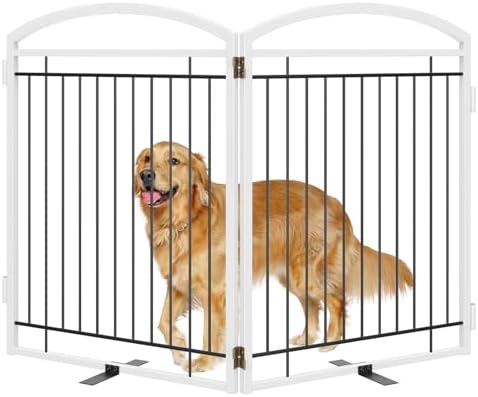
| Paulmele Full Metal Freestanding Dog Gate | Freestanding, no wall mounting | Low step-over bar, no drilled threshold | High, metal bars resist chewing | $$ |
| LZRS Wooden Free Standing Dog Gate | Freestanding, decorative wood panel | Moderate, wide panel base | Moderate, wood can be chewed by teething puppies | $$$ |
| Urnporium Pet Dog Gate Freestanding | Freestanding, folding panels | Low, flexible panel configuration | High, sturdy folding joints | $$ |
Freestanding units generally beat pressure-mounted gates for this specific use case, mainly because pressure gates rely on a rigid frame wedged into a doorway, which almost always creates a raised threshold. That’s a fine tradeoff for a healthy young dog, but for a senior dog managing hip dysplasia or spinal arthritis, stepping over a raised bar multiple times a day adds cumulative joint strain you don’t need. The Paulmele Full Metal Freestanding Dog Gate is worth a look here because it doesn’t require a threshold bar at all, letting your senior dog walk through an open doorway configuration if you position it as a room divider rather than a doorway blocker.
If you’re aiming for something that blends into the room rather than reading as obvious hardware, the LZRS Wooden Free Standing Dog Gate is a mid-tier option worth considering, though I’d flag that the wood panels are more vulnerable to a teething puppy’s chewing than metal bars are. If your puppy is under six months, budget for chew deterrent spray or supervise the gate’s base closely during the first few weeks.

- Durable Solid Wood Construction: Crafted from high-quality natural hardwood for a long-lasting and stylish design that s…
- Freestanding & Foldable: The free standing dog gate requires no installation.—simply set it up in any space and fold it …
- Convenient Height & Coverage: At 24 inches tall, it’s easy to step over while effectively containing pets, fully extends…
Exercise pens (the circular or modular wire enclosures) work well for containing the puppy in a fixed zone while giving the senior dog free run of the rest of the house, which is often the more sensible arrangement since the senior dog is the one who most needs unrestricted, low-stress movement. A folding freestanding gate like the Urnporium Pet Dog Gate Freestanding functions similarly and gives you more flexibility to reconfigure the barrier shape as your management plan evolves, which matters because your setup in week one should not look identical to your setup in month three.

- This is a freestanding wooden pet dog gate with 2-way hinges. Our dog gates for the house can be used in several configu…
- STRONG, DURABLE & STYLISH PET GATE – Crafted from premium Acacia wood, this accordion-style wooden pet gate is built for…
- Versatile Freestanding Wooden Pet Gate blends seamlessly with living room décor while securely blocking doorways in kitc…
A Structured Protocol for Supervised Reintroduction
Dog gates for puppies are the management layer, not the training plan. The actual behavior change comes from structured, low-arousal exposure sessions that pair the puppy’s presence with calm outcomes for the senior dog. This is antecedent management combined with counterconditioning, and it works because you’re controlling the variables that predict success rather than hoping the dogs “work it out.”
Don’t count on time alone to build tolerance. Proximity without a positive contingency just teaches the senior dog that the puppy predicts nothing good, or worse, that vigilance is required whenever the puppy is near. The pairing has to be deliberate.
A sample daily structure I give clients looks like this:
- Morning (high puppy energy window): Puppy gets structured play or a training session behind the gate or pen, physically separated from the senior dog’s resting area. This is when puppy zoomies peak, and it’s the worst possible time for unsupervised proximity.
- Midday (senior dog’s rest cycle): Senior dog naps undisturbed. No gate transitions, no puppy access to this space at all during this window.
- Afternoon (low-arousal session): Ten to fifteen minutes of parallel activity with the gate still up. Both dogs get calm chews or licking mats on their respective sides. The goal is mutual presence without contact, reinforcing that the other dog’s existence predicts something pleasant.
- Evening (short supervised contact, only if week one and two sessions were incident-free): Brief, leashed, gate-optional contact under direct supervision, ended before either dog shows early stress signals, not after.
If you’re managing this transition alongside other household changes, our piece on bringing a puppy into a home with an older dog covers the broader adjustment period in more depth, including timeline expectations that a lot of new owners find reassuring.
Case-Profile Evaluation: Scoring Your Senior Dog’s Tolerance Threshold
Before deciding between partial integration and permanent management with barriers, score your senior dog honestly across these domains. This isn’t about labeling your dog as “difficult.” It’s a functional assessment that tells you how much buffer you’re working with.

- Mobility: Can he reposition or retreat quickly if the puppy approaches from behind? Limited mobility means reduced ability to self-advocate, which raises the stakes for every unsupervised interaction.
- Hearing: Does he startle at close-range sounds he previously ignored? Reduced hearing means less advance warning before contact, which increases defensive reactions.
- Vision: Any evidence of blind spots or cloudiness consistent with cataracts? Vision loss compounds the startle risk described earlier.
- Baseline irritability: Independent of the puppy, has his tolerance for noise, handling, or disruption changed in the past six to twelve months? This often signals an underlying medical issue (pain, cognitive decline, sensory loss) that should be evaluated by your veterinarian before you invest heavily in behavioral integration work.
The American Veterinary Society of Animal Behavior has published position statements cautioning against forced socialization in geriatric or medically compromised animals, and that guidance applies directly here. If your senior dog scores poorly across two or more of these domains, permanent management with dog gates for puppies and pens is not a failure state. It’s the medically appropriate outcome, and it keeps both dogs safer than pushing for a full integration that the senior dog’s body simply can’t support anymore.
For owners weighing what kind of companion might eventually suit a household already managing a senior dog’s needs, our breakdown of the Goberian versus Shepsky comparison is a useful read if you’re still in the decision phase before bringing a new dog home at all.
Choosing the Right Pet Pen for Dogs Based on Your Home Layout
A pet pen for dogs works best when it matches your home’s actual traffic patterns, not just the marketing photos. Open-concept homes usually do better with a single wide freestanding panel positioned at a hallway chokepoint, since that gives you one barrier controlling access to multiple rooms. Homes with distinct room divisions often do better with a smaller pen confining the puppy to one designated space, leaving the senior dog free to roam without navigating any barrier at all.
Whichever configuration you choose, prioritize a design that a puppy cannot climb, since determined puppies will test vertical surfaces well before they test locks or latches. Panel height matters more than latch complexity in the first few months.
Frequently Asked Questions
How long should I keep dog gates for puppies up before allowing free interaction?
There’s no fixed timeline that applies to every pair. Base the decision on observable data: consistent calm parallel sessions over two to three weeks, no defensive signals from the senior dog, and a puppy who has started to moderate his own play intensity around the older dog. Some pairs are ready for supervised off-gate time within a month. Others, especially where the senior dog has significant mobility or sensory decline, will do better with dog gates for puppies remaining a permanent household fixture rather than a temporary bridge.
Is a pet pen for dogs better than a gate for puppy and senior dog separation?
It depends on your goal. A pet pen for dogs is better when you want to contain the puppy’s high-energy zone while giving the senior dog unrestricted movement through the rest of the house. A gate is better when you need to control passage through a specific doorway or hallway. Many households end up using both, a pen for the puppy’s home base and a gate at key thresholds.
What are signs my senior dog is not tolerating the puppy well, even with a barrier in place?
Watch for pacing near the barrier, avoidance of the shared room entirely, reduced appetite, or increased sleep disruption. These signs indicate that visual or auditory contact through the barrier is still generating stress, even without physical interaction. If you see this, increase physical distance between the setups, add a visual blocker to the barrier itself, and consult your veterinarian to rule out a pain-related component to the irritability.
Can dog safety gate barriers actually reduce cortisol-driven stress in senior dogs?
Yes, indirectly. A dog safety gate doesn’t lower cortisol on its own, but by removing unpredictable startle events and giving the senior dog reliable recovery windows, it reduces the frequency of arousal spikes that drive cortisol elevation in the first place. Fewer triggers, more predictable rest cycles, and controlled exposure sessions all support faster physiological recovery over time.