
Dog jealous behavior aimed at your partner during a hug or a kiss is not your dog being “possessive” in the human sense. It’s a predictable, well-documented response rooted in resource guarding and arousal physiology, and it shows up in a striking number of dogs. Harris and Prouvost’s 2014 PLOS ONE study found dogs displayed jealous-type behaviors toward a rival (in their case, an animatronic dog receiving affection from the owner) in 78% of trials. If your senior dog growls, wedges between you and your partner, or paces when affection escalates, you’re not dealing with a spoiled pet. You’re dealing with a behavior pattern that has clear antecedents, a predictable function, and a fixable protocol.
Behavioral Context: What “Jealousy” Actually Looks Like in a Dog’s Brain
Researchers are careful with the word “jealousy” because it implies a level of cognitive complexity we can’t fully confirm in dogs. What we can confirm, observationally and physiologically, is that dogs respond to a perceived threat to a valued resource, and that resource is often proximity to their person. This is functionally similar to jealousy even if the underlying cognition differs from the human experience. The Harris and Prouvost study is frequently cited because it was one of the first to apply a controlled, quantifiable design (borrowed from human infant jealousy research) to dogs, and the results held up: dogs pushed, nosed, and vocalized at the rival object significantly more than at a neutral one.
In senior dogs specifically, this pattern is worth watching closely because aging changes the calculus. Reduced mobility means a dog can’t easily reposition itself for a better vantage point of the couch. Sensory decline, particularly hearing loss, means your dog may be startled by sudden affection they didn’t see coming, which reads behaviorally like jealousy but is partly a startle response. Cognitive changes associated with canine cognitive dysfunction can also lower the threshold for anxiety-driven arousal. This is not a dominance issue. It’s a dog managing a limited set of resources (your attention, physical comfort, and predictability) with a body and brain that don’t process change as efficiently as they used to.
Functional Analysis: What Triggers the Growl
Every growl has an antecedent, and identifying it is the first step in any behavior modification plan. In social jealousy cases, the usual suspects are:
- Proximity changes: your partner sitting closer to you than your dog is allowed to be
- Tone shifts: a softer, quieter voice register that dogs associate with a different social channel closing them out
- Physical affection: hugging or kissing, which involves faster movement and closer body contact than baseline sitting
- Loss of access: your dog being physically blocked from the couch or your lap during the interaction
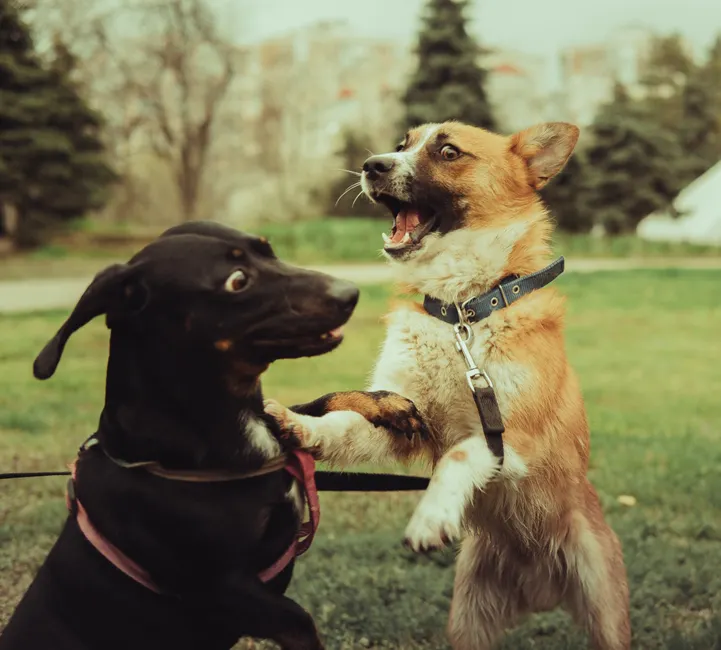
The growl itself is a distance-increasing signal. It is communication, not confrontation. Stress physiology backs this up. When a dog perceives a resource threat, cortisol and adrenaline rise, preparing the body for a fight-flight-or-freeze response. Growling is the cheapest, lowest-risk option on that continuum. It requires no contact, costs little energy, and often works, because the human backs off. That reinforcement history is exactly why the behavior persists and why punishing it is counterproductive, which I’ll get to next.
Misconception Correction: Growling Is Not a Behavior to Punish
“Punishment doesn’t just fail to solve resource guarding, it actively erodes the warning system that keeps everyone safe. A dog that has been punished for growling doesn’t stop feeling anxious. It simply stops telling you before it bites.” — consistent with ASPCA behavioral guidance on resource guarding and aggression
The ASPCA’s behavioral guidance on this topic is unambiguous: growling is a warning, and suppressing warnings through punishment (yelling, leash jerks, or physical correction) does not remove the underlying anxiety. It removes the dog’s willingness to communicate that anxiety before escalating. This is one of the more common and consequential misconceptions I see in consult cases. Owners assume a growl at a kissing couple is the dog “testing boundaries,” so they scold the dog to reassert hierarchy. What actually happens, in dogs with punishment histories for growling, is a compressed warning sequence. The next incident may skip the growl and go straight to a snap, because growling has been punished out of the behavioral repertoire without addressing the emotional state driving it.
The correct read is that a growling dog is giving you information for free. Your job is to change the emotional association behind the antecedent, not to eliminate the signal.
Practical Protocol: A Desensitization and Counterconditioning Plan
This is a structured, evidence-based process. It takes longer than a scolding, but it produces a durable change in the underlying emotional response rather than a suppressed symptom.
- Establish a baseline distance. Find the distance at which your dog can watch you and your partner show mild affection (holding hands, a brief side hug) without growling, stiffening, or moving away. This is your starting point, not the finish line.
- Install management tools immediately. A baby gate or an exercise pen section can physically separate your dog from the interaction zone while training is underway. This isn’t a punishment, it’s antecedent management, removing the setup for rehearsal of the unwanted behavior.
- Mat train a settle behavior. Teach your dog to lie on a specific mat or bed for high-value reinforcement, unrelated to the couple’s interaction at first. Build this into a reliable, low-arousal default behavior before introducing it near triggers.
- Pair the trigger with reinforcement (counterconditioning). At the baseline distance, have your partner initiate brief affection while you deliver high-value treats to your dog on the mat. The sequence matters: affection starts, treats follow immediately. You are building an association between “they’re being affectionate” and “good things happen to me.”
- Use engage-disengage exercises. Reinforce your dog for voluntarily looking at the couple and then looking back at you. This builds an active coping skill instead of passive tolerance, and it gives your dog agency in choosing to check in rather than react.
- Shrink the distance gradually. Only decrease proximity once your dog is relaxed and voluntarily engaging at the current distance across multiple sessions. Rushing this step is the most common reason desensitization plans fail.
- Track sessions. Logging session length, distance, and your dog’s stress signals (lip licking, whale eye, muscle tension) lets you see progress that’s easy to miss day to day. A dedicated Beagle Training Journal: 90-Day Puppy Progress Tracker style log works well for this even in dogs well past puppyhood, since the structured daily format keeps you honest about whether you’re actually shrinking distance or just repeating the same session.
For senior dogs with mobility limits, this entire protocol should happen on their terms physically. Don’t ask an arthritic dog to hold a settle position on a hard floor for the length of a full session. Pair the mat training step with the same orthopedic comfort principles you’d use for any other resting spot in the house, and keep sessions short (three to five minutes) since fatigue in older dogs lowers frustration tolerance and can undercut the counterconditioning you’re trying to build.

Buyer’s Guide Breakdown: Choosing Evidence-Based Training Tools Over Gimmicks
Not every tool marketed for jealous or reactive dogs is backed by behavioral science. Some are genuinely useful management aids. Others are novelty items that address the symptom, not the antecedent. Here’s how I evaluate them with clients:
- Does it manage the antecedent or just distract from the behavior? A baby gate manages proximity. A squeaky toy thrown at a growling dog just adds noise to an already aroused animal.
- Is it aversive? Anything designed to startle, shock, or physically correct the dog works against the counterconditioning goal by adding more stress to an already stressed dog.
- Does it support calm, structured engagement? Long-line leashes, treat pouches for rapid reinforcement delivery, and calming mats all support the protocol above. They give you the mechanics to reinforce quickly and manage distance without a fight.
- Is a basket muzzle actually necessary? If your dog has a bite history or you’re working with a professional in person, a well-fitted basket muzzle (never a soft “sleeve” muzzle for active training) is a legitimate safety tool that allows the dog to pant, drink, and take treats. It is not a punishment device and should be introduced with its own desensitization process.
| Tool | Best For | Key Feature | Price Tier |
|---|---|---|---|
| Baby Gate / Exercise Pen | Antecedent management, physical separation | Removes rehearsal opportunity for growling near the couch | $$ |
| Treat Pouch | Rapid reinforcement delivery during counterconditioning | Hands-free access for split-second timing | $ |
| Calming Mat / Orthopedic Bed | Settle training, senior joint comfort | Supportive foam reduces pressure on aging joints during long settles | $$$ |
| Basket Muzzle | Safety management with bite history | Allows panting, drinking, and treats while preventing contact | $$ |
| Long-Line Leash | Controlled distance work indoors or in yard | Allows gradual distance reduction without losing control | $$ |
Distance work and controlled movement exercises also translate well from structured physical activities. Clients who’ve used Dog Agility Equipment Agility Trainer with Tunnel setups for mentally engaging, low-impact enrichment often find the same focus and impulse control carries over into engage-disengage work near triggers. The goal isn’t to turn your living room into a training course, it’s to build a dog that has practiced choosing calm behavior under mild arousal, which is exactly what agility-style groundwork reinforces in short, joint-friendly sessions suited to a senior dog’s mobility.

- Promote Canine Coordination: This dog agility equipment provides structured drills to effectively improve physical coord…
- Versatile Occasions: The agility training equipment for dogs works for diverse scenarios, perfect for indoor exercises, …
- Long Lasting: Crafted from high-quality materials, this dog agility training equipment ensures long-term performance sta…
If your dog’s jealous dog training needs extend beyond couch-side growling into broader anxiety around attention or new household members, it’s worth reading our breakdown of the dog anxiety vest for jealousy and attention-seeking behavior, which covers pressure-based calming tools that pair well with the desensitization steps above. And if the trigger isn’t your partner but a new puppy or younger dog in the house competing for your attention, our guide to enrichment toys to calm senior dogs around puppies addresses that specific dynamic in more depth.
What a Realistic Timeline Looks Like
Owners often ask how long dog jealous behavior takes to resolve. In my case files, mild cases (occasional growling, no contact) show measurable improvement in two to four weeks of consistent, short daily sessions. Moderate cases, where the dog physically inserts itself or has a longer reinforcement history, typically take six to eight weeks. Don’t count on a single tool purchase or one dramatic training session to work miracles. This is incremental, and the dogs that improve fastest are the ones whose owners are consistent with short sessions rather than occasional long ones. Managing dog growling jealousy is a process of shrinking distance and building positive association step by step, not a switch you flip.
For deeper reading on the original research behind these findings, the PLOS ONE study on jealousy in dogs is publicly available and worth reviewing if you want the full experimental design behind the 78% figure cited above.
Is my dog actually jealous, or is this just anxiety?
Both explanations can be true at once. The behavior looks functionally like jealousy, a response to a perceived threat to a valued resource (your attention), but the underlying driver is often generalized arousal and stress physiology rather than a complex emotional judgment. Treating it as resource guarding tied to specific antecedents, rather than a personality trait, is what makes the training protocol effective.
Should I punish my dog for growling at my partner?
No. ASPCA behavioral guidance is clear that punishing a growl suppresses the warning signal without resolving the anxiety behind it, which increases the risk of an escalation straight to a bite in the future. Address the antecedent and the emotional response instead, using desensitization and counterconditioning.
Are training tools like basket muzzles necessary for jealous dog training?
Not for every dog. A basket muzzle is a safety management tool reserved for dogs with a bite history or active behavior modification under professional supervision. Most cases of dog growling jealousy respond well to management tools like baby gates, mat training, and treat pouches without needing a muzzle at all.
How long does it take to fix dog jealous behavior?
Mild cases often show improvement within two to four weeks of consistent, short daily sessions. Moderate cases with a longer reinforcement history can take six to eight weeks. Consistency in short sessions matters more than the intensity of any single session.