
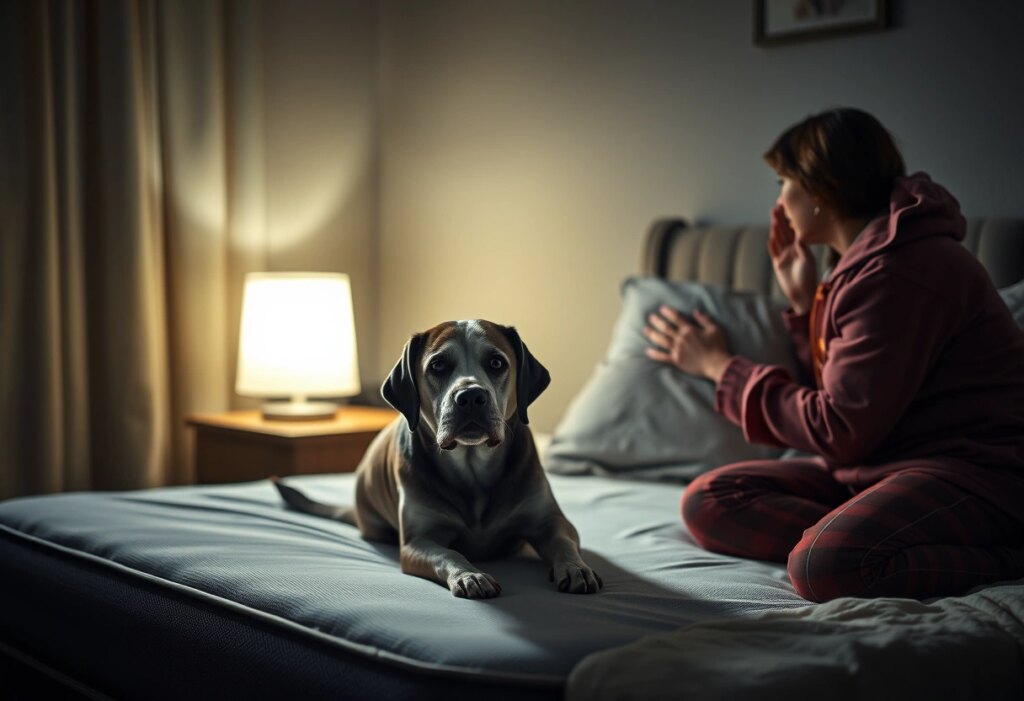

If your old dog is suddenly barking at night, please hear me on this: it is not defiance, and it is not your dog “acting up” for attention. In almost every case I’ve seen at the sanctuary, old dog barking at night is a symptom your body is trying to tell you about, not a training failure. That distinction matters enormously, because the response to a symptom is investigation and comfort. The response to a “behavior problem” is often correction, and correcting a scared, confused, or hurting senior dog is one of the cruelest mistakes a loving pet parent can accidentally make.
I’ve held a lot of old souls in the dark hours of the night. I’ve sat on cold floors at 3 a.m. with dogs who couldn’t tell me what was wrong, only that something was. So let’s talk honestly about what’s actually happening when old dog barking at night starts out of nowhere, and what genuinely helps.
This Is a Symptom, Not a Behavior Problem
Here’s the thing nobody tells new senior dog parents: a dog who barked calmly through puppyhood and adulthood does not just wake up one day and decide to become a nuisance. Something changed. Something in that aging body or aging brain shifted, and the barking is the only language available to say “I’m not okay.”
When people tell me they’ve started using shock collars or yelling at their old dogs to “just stop,” I have to be honest. Who thinks like that?? This is a dog who trusted you for ten, twelve, fourteen years. The golden years deserve a golden response, not punishment for a symptom they cannot control.
A senior dog’s sudden vocalization at night is almost always the body or brain sending up a flare. Our job isn’t to silence the flare. It’s to find out what’s burning.
Canine Cognitive Dysfunction and “Sundowning”
One of the most common and heartbreaking causes behind old dog barking at night is canine cognitive dysfunction, or CCD. Research published in the Journal of the American Veterinary Medical Association estimates that CCD affects somewhere between 14 and 35 percent of dogs over age 10. That’s not a small number. That’s a huge portion of our senior dog population quietly struggling with what is essentially a canine form of dementia.
CCD often brings on something caregivers call “sundowning,” where confusion and distress spike in the evening and overnight hours. Your dog may stare at walls, pace in circles, forget where the water bowl is, or bark at nothing you can see. This is dog sundowning symptoms in action, and it is disorienting and frightening for the dog experiencing it.
Ask yourself honestly:
- Does the barking happen at roughly the same time each night?
- Does your dog seem lost or confused, even in familiar rooms?
- Has there been a change in the sleep-wake cycle, like sleeping all day and pacing all night?
- Does your dog seem to be barking at something that isn’t there?
If you’re nodding along, please bring this to your veterinarian. There are prescribed medications and supplements that can genuinely help slow cognitive decline and ease the confusion. This isn’t something to just live with.
Pain Is Quiet Until It Isn’t
Here’s a statistic that should stop every senior dog parent in their tracks: the American Animal Hospital Association reports that osteoarthritis affects roughly 80 percent of dogs over age 8. Eighty percent. That means the vast majority of our gray-muzzled companions are living with some degree of joint pain, often silently, because dogs are stoic by nature.
Pain that’s manageable during the busy, distracted daytime hours can feel unbearable at 2 a.m. when the house is still and there’s nothing to distract from the ache. Stiff hips, arthritic knees, and sore backs tend to scream loudest in the quiet. That nighttime bark you’re hearing might genuinely be your dog saying “it hurts to lie here.”

A supportive sleep surface matters more than people realize. Cheap, flat bedding does nothing for arthritic joints. I always recommend an orthopedic memory foam bed with real joint support, because pressure relief can be the difference between a dog who sleeps soundly and one who tosses, shifts, and eventually barks out of discomfort.
If pain is even a possibility, and honestly it almost always is with dogs this age, a full veterinary workup is non-negotiable. Bloodwork, a joint exam, and an honest conversation about pain management options can change everything.
Sensory Decline: When the World Gets Dimmer and Quieter
Vision and hearing loss creep in slowly, and most dogs adapt beautifully while their bodies are still healthy enough to compensate. But layer sensory decline on top of an aging brain and body, and the nighttime world can become genuinely disorienting.
A dog who can’t see well may bark at shifting shadows or unfamiliar sounds they can no longer place visually. A dog with hearing loss may startle awake, confused and vocal, unable to orient themselves the way they used to. Combine that with darkness, and you have a recipe for anxious, reflexive barking that has nothing to do with training and everything to do with a dog trying to make sense of a suddenly unreliable world.
Reflect on this for a moment: has your dog been bumping into furniture more? Startling more easily? Sleeping through sounds they used to react to instantly? These small clues add up to a bigger picture.
Anxiety and the Disrupted Sleep-Wake Cycle
Senior dogs often experience real, clinical anxiety, separate from cognitive decline. Age brings vulnerability, and vulnerability breeds fear. A dog who once slept soundly through thunderstorms may now startle at every creak of the house settling. This kind of senior dog vocalization is frequently rooted in a nervous system that’s simply lost some of its resilience.
Disrupted circadian rhythms compound this. Aging brains produce less melatonin naturally, and the internal clock that once reliably said “it’s nighttime, rest now” can become unreliable. That’s part of why nighttime barking causes so often cluster around dusk and the early morning hours instead of staying random throughout the day.
If your dog’s nighttime anxiety seems tangled up with excessive barking that started suddenly, it’s worth reading our detailed piece on sudden excessive barking in older dogs and the calming aids that actually help. It goes deeper into the anxiety-specific triggers I don’t have room to fully unpack here.
Building a Calmer Night: Vet-Recommended Fixes That Actually Work
Once you and your veterinarian have ruled out or identified the medical piece, here’s where the real, tender work of environment-building begins.
Start with the veterinary workup. I cannot say this enough. Bloodwork, a thorough pain assessment, and a cognitive screening should always come before any behavioral intervention. You cannot fix what you haven’t diagnosed.

Add a soft night-light near the sleeping area. Total darkness is disorienting for a dog with declining vision. A gentle, warm glow (not harsh or blue-toned) helps your dog orient themselves if they wake confused.
Anchor the space with familiar scent. An unwashed blanket that smells like you, placed near your dog’s bed, can be remarkably regulating. Scent is one of the last senses to decline, and it’s deeply tied to a dog’s sense of safety.
Talk to your vet about melatonin or prescribed CCD medications. There are real, clinically supported options for supporting healthier sleep cycles and slowing cognitive symptoms. Never start supplements without professional guidance, dosing matters enormously in senior dogs with other health conditions.
Some pet parents have also found gentle comfort in calming soundscapes designed to ease nighttime anxiety in both pets and their humans, like the While You Dream Artificial Intelligence Sleep Sound Machine, which some households use to create a steady, predictable auditory environment that can help mask disorienting household sounds during the night.

Keep bedtime sacred and consistent. Same time, same routine, same calm energy from you. Predictability is deeply regulating for an anxious or confused senior brain.
Here’s a comparison of a few categories of tools that genuinely support calmer senior dog nights. I’ve broken it down by what each addresses and its general investment tier.
| Solution Type | Best For | Key Feature | Price Tier |
|---|---|---|---|
| Orthopedic Memory Foam Bed | Arthritis-related nighttime barking | Joint pressure relief, supportive foam density | $$$ |
| Warm-Glow Night-Light | Vision decline and disorientation | Non-disruptive, soft ambient lighting | $ |
| Veterinary CCD Medication | Confirmed canine cognitive dysfunction | Prescribed, clinically supported dosing | $$$$ |
| AI Sleep Sound Machine | Anxiety and disrupted sleep cycles | Consistent, calming ambient audio environment | $$$ |
| Melatonin Supplement (vet-approved) | Circadian rhythm disruption | Supports natural sleep-wake regulation | $$ |
General Vet vs. Veterinary Behaviorist: Who to Call
Start with your general practice veterinarian for a full physical workup, bloodwork, and pain assessment. That’s always step one for old dog barking at night. If your vet rules out or treats the physical causes and the barking persists, or if anxiety and cognitive symptoms are clearly dominant, ask for a referral to a veterinary behaviorist. These specialists can build a tailored behavioral and pharmacological plan specifically for anxiety and CCD, something a general practice visit often doesn’t have time to fully address.
While you’re building your senior dog’s overall care plan, it’s also worth thinking about the financial side of aging. Many chronic conditions tied to nighttime barking causes, like arthritis and cognitive decline, come with ongoing costs. Our breakdown on whether pet insurance is worth it for an older dog can help you plan ahead financially so a medical diagnosis doesn’t come with added financial panic.
According to the ASPCA’s senior pet care guidance, routine veterinary visits become even more critical as dogs age, since many conditions driving nighttime distress are treatable when caught early. That’s not just institutional advice. That’s the lived truth I’ve seen play out again and again in sanctuary life.
What This Really Comes Down To
Every senior dog deserves to be believed. When your old dog is barking at night, they are not being difficult. They are being honest about something hard, in the only way they know how. Old dog barking at night is a call for investigation, patience, and gentleness, never punishment.
This is a sacred trust we take on when we commit to loving a dog through their golden years. Dignity in aging isn’t a bonus feature. It’s the whole point.
Why is my old dog suddenly barking at night when he never used to?
Sudden old dog barking at night in a previously quiet dog usually points to a new physical or cognitive change, such as emerging arthritis pain, vision or hearing decline, or early canine cognitive dysfunction. A veterinary exam is the right first step to identify the underlying cause before trying any behavioral fix.
What are the most common dog sundowning symptoms to watch for?
Dog sundowning symptoms often include increased confusion in the evening, pacing, staring blankly at walls or corners, disrupted sleep-wake cycles, and vocalizing without an obvious trigger. These symptoms are commonly associated with canine cognitive dysfunction and tend to worsen as daylight fades.
Can arthritis really cause a senior dog to bark at night?
Yes. Osteoarthritis affects roughly 80 percent of dogs over age 8, and joint pain often intensifies at night when the body is still and there are fewer distractions. This makes arthritis one of the most overlooked nighttime barking causes in senior dogs, and it responds well to proper veterinary pain management and supportive bedding.
Should I ignore my senior dog’s nighttime barking so they learn to stop?
No. Ignoring old dog barking at night can leave a genuinely painful, confused, or frightened dog feeling abandoned in distress. Because this vocalization is almost always symptom-driven rather than attention-seeking, the appropriate response is a veterinary evaluation, not extinction-based training techniques.
Thank you for loving your old dog enough to ask why instead of just wanting it to stop. That question, asked with an open and patient heart, is exactly what dignity in aging looks like. Tell your pup I said Hi! — Dawn