
Puppy gates are the single most underrated tool in a multi-dog household, and if you’re bringing a new puppy home to meet your senior or adult Golden Retriever, you need them in place before that puppy ever crosses your threshold. I’ve spent years at the sanctuary watching introductions go sideways because someone skipped the barrier step, thinking their sweet old dog would “just know” how to handle a bouncing, boundary-less baby dog. She didn’t know. None of them do, not really, not without help from us.
This isn’t about being overly cautious or dramatic. It’s about respecting two individual dogs who didn’t ask to share a home and giving them the physical space to figure each other out on their own terms. A gate isn’t a punishment. It’s a bridge. It lets both dogs see, smell, and hear each other without the pressure of full contact before either one is ready.
Why Safe, Gated Introductions Actually Matter
Golden Retrievers are famously easygoing, but “easygoing” doesn’t mean “immune to stress.” Your resident dog has spent months or years building a rhythm in your home. The couch is his. That patch of sun by the window is hers. A new puppy barreling in without boundaries can trigger resource guarding, anxiety, or just plain exhaustion in a dog who didn’t sign up for that.
The ASPCA has long recommended gradual, structured introductions for multi-dog households precisely because rushed meetings are one of the top predictors of ongoing tension between housemates. Gradual exposure through a barrier lets cortisol levels settle before anyone’s nose-to-nose.
Every successful introduction I’ve ever witnessed had one thing in common: nobody rushed it. The dogs decided when they were ready, not the humans on a schedule.
I say this with love, but also with some fire in my chest: if you’re bringing home a puppy and you don’t have a plan for safe, separated introductions, you’re setting both dogs up to fail. That’s not fair to either of them. This is a sacred trust, this business of merging two lives under one roof, and it deserves preparation, not improvisation.
Top-Rated Puppy Gates for Open Floor Plans
Most modern homes have open concept layouts, which sounds lovely until you’re trying to keep a wobbly eight-week-old puppy from ambushing your fourteen-year-old Golden’s afternoon nap. That’s where freestanding gates earn their keep. Unlike pressure-mounted gates, they don’t need walls on both sides, so you can section off a room, a hallway opening, or even a corner of the living room without drilling a single hole.
One option that holds up well in busy households is the Paulmele Full Metal Freestanding Dog Gate with Door. It folds flat for storage, has a walk-through door so you’re not stepping over it fifty times a day, and the full metal construction means an anxious puppy can’t chew through it during those early unsupervised gate sessions.
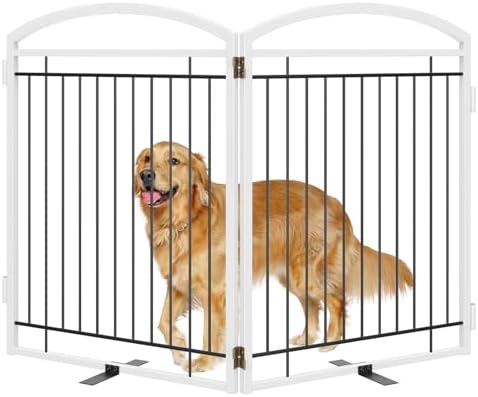
If your senior dog needs a taller barrier (some Goldens are surprisingly good jumpers even in their golden years, and puppies get bold fast), a taller freestanding option is worth the investment. Height matters more than people expect when a determined puppy decides the grass is greener on the other side.
Puppy Gates vs. Crates: Which Barrier Fits Which Moment
Gates and crates aren’t interchangeable, even though they get lumped together. Gates give both dogs a shared visual and olfactory space while keeping bodies apart. Crates give one dog, usually the puppy, a fully enclosed den where they can decompress completely, away from any dog’s gaze. You’ll want both in your toolkit.
Here’s how the leading puppy gates compare when you’re shopping for a sibling introduction setup:
| Product | Type | Best For | Key Feature | Price Tier |
|---|---|---|---|---|
| Paulmele Full Metal Freestanding Gate | Freestanding, foldable | Open floor plans, doorless room dividers | Walk-through door, all-metal chew resistance | $$ |
| 71″ Extra Tall Pet Gate with Cat Door | Extra-tall freestanding | Jump-prone or larger senior dogs | 32.3″ height plus built-in small-pet passage | $$$ |
| Urnporium Freestanding Folding Gate | Freestanding, panel-style | Multi-room flexibility, travel setups | Strong durable folding panels, quick reconfiguration | $$ |
Best Crates for Separate Safe Spaces
Every puppy needs a den of their own during this transition, a space that belongs only to them, where no other dog can loom over their food bowl or their favorite chew. Wire crates offer better airflow and visibility, which some puppies find reassuring since they can still see their people and their new sibling from a safe distance. Plastic crates feel more enclosed and den-like, which tends to soothe puppies who get overstimulated easily.
For sizing, remember that Golden Retriever puppies grow fast. A crate that fits a ten-pound puppy in month one will feel like a shoebox by month four. Buy for their projected adult size (55 to 75 pounds) and use a divider panel to shrink the space down while they’re small. This also matters for house-training, since a crate that’s too roomy defeats the whole purpose.
If you’re also managing a resident Golden who’s getting older and slower, you might find yourself rethinking your whole home setup. I’ve written before about what it actually looks like to bring a puppy companion into a senior dog’s world, and honestly, the crate and gate setup you choose now will shape the entire first six months of their relationship.
Flexible Freestanding Options for Multi-Room Homes
Some households need more than one barrier point. Maybe the puppy sleeps in the laundry room but plays in the kitchen, and your senior dog needs a gated buffer in both spots. This is where a lightweight, reconfigurable option like the Urnporium Pet Dog Gate Freestanding Folding Gate earns its place. It’s easy to move room to room, which matters a lot when you’re still figuring out where each dog feels most settled.

- This is a freestanding wooden pet dog gate with 2-way hinges. Our dog gates for the house can be used in several configu…
- STRONG, DURABLE & STYLISH PET GATE – Crafted from premium Acacia wood, this accordion-style wooden pet gate is built for…
- Versatile Freestanding Wooden Pet Gate blends seamlessly with living room décor while securely blocking doorways in kitc…
I’ll be honest, I’ve moved gates around my own sanctuary more times than I can count, chasing the right configuration for whichever pair of dogs is learning to coexist that season. There’s no shame in trial and error here. Flexibility is a feature, not a failure.
Step-by-Step Introduction Protocol Using Puppy Gates
The American Veterinary Society of Animal Behavior recommends a gradual, structured approach to multi-dog introductions, and puppy gates are the backbone of that plan. Here’s the protocol I use and recommend to every family bringing home a new puppy:

- Scent swapping first. Before the dogs even see each other, swap blankets or toys so each one gets familiar with the other’s smell in a low-pressure way.
- Neutral territory meeting. If possible, let the first face-to-face happen somewhere that belongs to neither dog, like a friend’s yard or a quiet park corner.
- Gated sessions at home. Once home, keep the dogs separated by a puppy gate for all early interactions. Watch body language closely on both sides.
- Short, supervised increments. Ten to fifteen minutes of gated time, several times a day, beats one long unsupervised session every time.
- Gradual, supervised contact. Only after days (sometimes weeks) of calm gated behavior should you consider supervised time without the barrier, and even then, keep it brief at first.
Puppy gates give you control over the pace without needing to physically restrain either dog, which keeps the whole process lower stress for everyone involved, including you.
Common Mistakes That Undo a Good Introduction
I’ve seen the same handful of mistakes derail otherwise thoughtful introductions, over and over.
- Rushing physical contact because the puppy seems “so friendly” and the older dog seems “so tolerant.” Tolerant isn’t the same as comfortable.
- Removing barriers too soon after just one or two calm sessions, before the relationship has any real foundation.
- Ignoring the resident dog’s body language. Stiff posture, whale eye, a low growl, these are all requests for more space, not just noise to push through.
- Assuming size difference isn’t a risk. A puppy that’s still growing into their body can misjudge play with an older dog whose joints don’t bounce back like they used to.
- Skipping the crate step entirely and expecting the puppy to self-regulate without a den to retreat to.
Honestly, who thinks a full-contact free-for-all is a good first impression?? It baffles me every time. Dogs deserve the same grace we’d want for ourselves meeting a stranger who’s about to live in our house forever.
When Jealousy or Guarding Shows Up
Sometimes even a well-managed introduction reveals jealousy you didn’t expect, especially once the puppy starts competing for attention, affection, or a favorite spot on the couch. If your resident dog starts growling during moments of closeness with you specifically, that’s worth addressing head-on rather than brushing off as quirky behavior. I’ve covered this pattern in more depth if you want to understand what’s driving jealous behavior around affection between you and your partner, because the same principles apply when a new puppy enters the picture.
Puppy gates help here too, actually. They create natural pauses in the day where your older dog gets guaranteed one-on-one time with you, no puppy underfoot, no competition. That predictability does more for reducing jealousy than almost anything else I’ve tried.
My Honest Take After Years of Introductions
I won’t pretend every introduction goes smoothly just because you’ve got the right gear. Some dogs take weeks to warm up. Some never become best friends, and that’s okay too, as long as they can coexist peacefully. What I can promise is that puppy gates and a proper crate setup dramatically lower the odds of a scary or heartbreaking first encounter. They buy time. They buy safety. And time and safety are exactly what a nervous senior dog and an overeager puppy both need most.
Quality puppy gates aren’t glamorous. Nobody’s showing off their gate collection on Instagram. But in my years running a sanctuary full of aging dogs, gates have quietly prevented more fights, more fear, and more heartbreak than almost any other single piece of equipment I own.
How long should I use puppy gates before letting my dogs interact freely?
There’s no universal timeline, but most successful introductions keep puppy gates in place for at least one to two weeks of calm, supervised sessions before allowing any unsupervised contact. Some senior dogs need longer. Watch their body language, not the calendar.
What size gate do I need for a Golden Retriever puppy and adult dog?
Look for puppy gates at least 30 inches tall once your puppy starts growing, since Golden Retrievers can clear shorter barriers within a few months. Extra-tall freestanding models offer the most security for growing or athletic dogs.
Should I use dog crates for puppies even if I already have puppy gates set up?
Yes. Crates give your puppy a private den separate from shared gated spaces, which matters for house-training and for giving them a place to fully decompress away from the resident dog’s presence.
Are freestanding pet safety gates better than pressure-mounted ones for introductions?
For most sibling dog introductions, freestanding puppy gates are more practical since they don’t require wall mounting and can be repositioned easily as you adjust the introduction process room by room.
Bringing a new puppy home is one of the most tender, complicated things you can do to your household’s rhythm. Give it the patience it deserves. Give your senior dog the dignity of choice. And give yourself credit for slowing down enough to do it right.
Tell your pup I said Hi! — Dawn