
A senior dog crate that once felt like a safe den can turn into a source of dread almost overnight, and if you’re standing in your kitchen at 2 a.m. wondering why your old dog is suddenly barking at four walls he’s slept next to for years, you’re not imagining it. Something shifted. And most of the time, that shift has a name.
I’ve sat on the floor of more than one sanctuary room at Woody’s Place, coaxing a trembling old shepherd back toward a crate he used to love, so I want to say this plainly: it’s not stubbornness, and it’s not “bad behavior.” It’s a body and a brain that are aging, and they need us to notice.
Why Aging Dogs Suddenly Fear Confinement
Here’s what nobody tells new senior dog parents. The same crate, the same blanket, the same room, and suddenly your dog acts like it’s a trap. That’s rarely about the crate itself. It’s about what’s happening inside your dog.
Vision starts to fog. Hearing dims. Depth perception gets unreliable, so a low doorway that used to be nothing now feels like a cliff edge. And then there’s the piece that breaks my heart every single time I see it in an intake dog: canine cognitive dysfunction, which is basically the canine version of Alzheimer’s.
The ASPCA notes that cognitive dysfunction affects up to 28% of dogs aged 11 to 12, and that number climbs to a staggering 68% in dogs aged 15 to 16. Read that twice. That means most dogs who make it to their late teens are dealing with some degree of brain change. Confusion. Disorientation. A loss of the spatial memory that used to make a crate feel like home instead of a box.
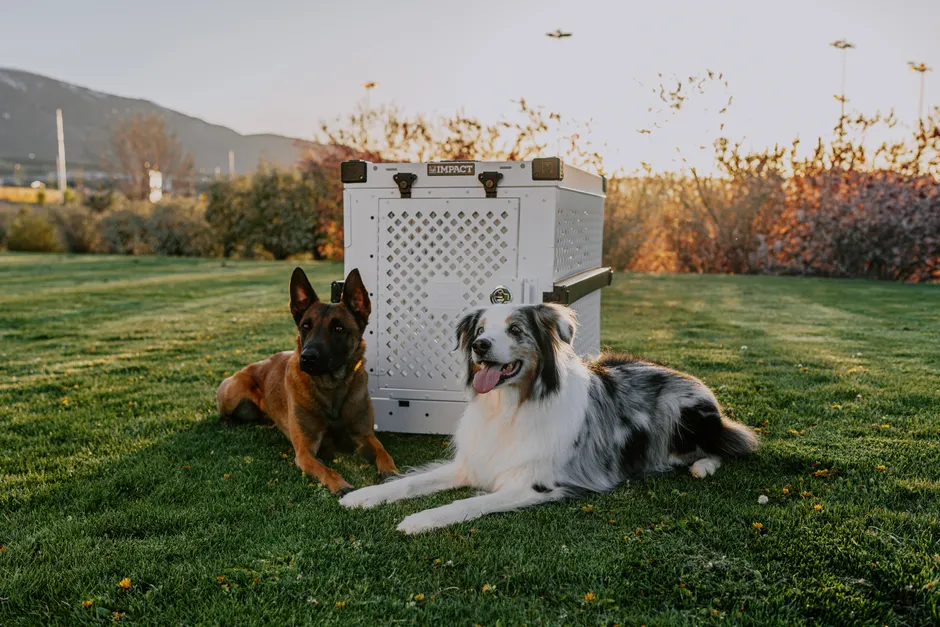
So when an old dog starts barking the second that crate door closes, ask yourself: is this really defiance, or is this a dog who genuinely doesn’t recognize where he is anymore?
Anxiety-driven barking in a senior dog is rarely about the crate. It’s a message. Our job is to slow down long enough to actually receive it.
What a True Senior Dog Crate Should Actually Offer
A lot of crates marketed for “all dogs” simply were not built with an arthritic, half-blind, cognitively foggy old soul in mind. If you’re shopping for a senior dog crate, here’s what I look for, no exceptions:
- Low entry threshold. If your dog has to hike his back legs up and over a lip to get in, that’s a hesitation point, and hesitation turns into avoidance fast.
- Real orthopedic padding. Thin bedding on tired hips and shoulders is a recipe for restlessness, and restlessness reads as barking.
- Airflow. Older dogs regulate body temperature poorly. A stuffy crate makes anxiety worse, not better.
- Sightlines. Solid plastic walls can feel like solitary confinement to a dog whose hearing is already unreliable. Mesh or wire sides that let him see you moving around the room matter more than people realize.
Padding is honestly where I see the most immediate difference. The Veehoo Orthopedic Memory Foam Dog Bed for Senior Dogs is one I’d trust inside a crate for a dog with visible joint stiffness. It contours instead of flattens, which matters enormously once a dog stops shifting position as often as he used to.

- 7″ Orthopedic Relief for Aching Joints: Give your senior companion or large breed the pain-free rest they deserve. Our t…
- Sprawled-Out Freedom for Large Breeds & Seniors: Our generously sized large dog bed 52″L x 36″W x 7″Th offers ample spac…
- Luxurious Plush Fur for Deep Healing Sleep: Imagine your cherished dog sinking into cloud-like comfort. The ultra-soft f…
This is a budget-conscious, mid-tier option for most households, and honestly, it’s the kind of upgrade I wish more people made before the barking starts instead of after.
Size, Stability, and Joint Support for Wobbly Bodies
A crate that’s too small forces cramped, painful positioning. A crate that’s too large, without proper support, lets an unstable dog slide around every time he tries to lie down or push himself back up. Neither one is okay.
The AAHA senior care guidelines emphasize that joint support and mobility monitoring should be a routine part of senior wellness visits, not an afterthought once a dog is already limping. That guidance applies directly to crate setup. A dog with arthritis needs a surface with grip, cushioning that doesn’t bottom out, and enough room to fully stretch without wedging against a wall. If you’re dealing with a larger breed senior who also runs warm at night, something like the WATANIYA PET XL Cooling Dog Bed for Large Dogs can genuinely change how well an old dog settles. Heat buildup makes stiff joints feel worse and makes an anxious dog more reactive, not less.

- Gel Memory Foam: Our memory foam dog bed added cooling gel helps regulate your pup’s body heat to create an optimal slee…
- Sleep Surface: The cozy sleep surface is lined with thick, cuddly soft, plush dense faux fur that is friendly on noses a…
- 100% Waterproof Liner & Non Slip Bottom: Pets can present some unique cleaning challenges, so our waterproof dog bed has…
If your dog also struggles at night with unsettled pacing or vocalizing that has nothing to do with the crate itself, it’s worth reading our piece on calming aids for senior dogs barking at night, since sometimes the crate is only part of a bigger nighttime anxiety picture.

Comparing Senior Crate Bedding Options
| Product | Best For | Key Feature | Price Tier |
|---|---|---|---|
| Veehoo Orthopedic Memory Foam Dog Bed | Arthritic dogs needing joint support | Contouring memory foam, low-profile design | $$ |
| WATANIYA PET XL Cooling Dog Bed | Large senior dogs prone to overheating | Breathable cooling surface, XL 41-inch size | $$$ |
| NUPIDA Waterproof XL Crate Bed | Dogs with incontinence or mobility loss | Waterproof liner, easy-clean crate fit | $$ |
Reintroducing the Crate Without Forcing Anything
You cannot muscle an anxious old dog back into loving a crate. Believe me, I’ve tried the shortcuts, and they never hold. What works is patience, repeated in small doses, over and over, until trust rebuilds on its own timeline. Here’s the approach I use with every dog who comes through our door:
- Leave the door open for several days. No pressure to go in. No pressure to stay.
- Feed meals near the crate, then gradually inside it, so the space earns positive association again.
- Add familiar scent, a worn blanket or unwashed shirt, so the crate smells like safety instead of confinement.
- Keep sessions short at first. Five calm minutes beats thirty anxious ones.
- Never close the door on a barking dog as a way to “wait it out.” That teaches fear, not comfort.
For dogs with real incontinence or mobility struggles layered on top of the anxiety, a crate with easy-clean, waterproof bedding removes one more stressor from the equation. The NUPIDA Waterproof XL Extra Large Dog Crate Bed has been a quiet workhorse for a few of our senior residents, since nobody settles calmly on a soaked pad, and nobody should have to.

- Comfortable Surface: Dog crate bed has an ultra-soft velvet sleep surface with a luxury cozy flexible faux fur, which is…
- Strong Support: The X Large dog bed is filled with 3 inches of polypropylene fiber, it can distribute the dog’s weight e…
- Removable Cover: Washable dog bed comes with a premium L-shaped zipper, it is smooth and durable, making it easy to remo…
A properly outfitted senior dog crate should feel like relief to your dog, not a punishment cell. If it doesn’t yet, that’s information, not failure.
When Barking Means Something Deeper Than the Crate
Sometimes we fix the padding, lower the entry, add the nightlight, and the barking still doesn’t fully resolve. That’s the moment to stop troubleshooting gear and start asking bigger questions. Is there pain we haven’t identified yet? Hips, spine, dental disease that flares at night when everything else goes quiet? Or is this the cognitive fog deepening, the kind of disorientation where a dog forgets he’s even in his own home? This is exactly why I push every senior dog parent, gently but firmly, to loop in their vet the moment barking patterns shift. A proper screening for pain and canine cognitive dysfunction isn’t overreacting. It’s love, taking action instead of just hoping things settle down on their own.
I’ll also say this, because I think about it more than people realize: dogs communicate through the only language they have. Barking at 2 a.m. in a crate is not noise to silence. It’s a sentence in a language we owe it to them to learn.
A Note on Genetics and Anxiety Sensitivity
Some breed lines carry more baseline sensitivity to environmental stress than others, and that sensitivity doesn’t disappear with age, it often intensifies. If you’re curious how early breed temperament and lineage can shape a dog’s stress responses later in life, our guide on the English Cream Golden Retriever’s temperament and value touches on how breeding choices ripple forward into a dog’s emotional resilience for years to come.
Frequently Asked Questions
Why is my senior dog suddenly barking in his crate when he never used to?
New barking in a previously calm crate usually points to a physical or cognitive change, not defiance. Declining vision, joint pain, or early canine cognitive dysfunction can make a familiar space suddenly feel confusing or unsafe. A vet check is the right first step before assuming it’s purely behavioral.
What features matter most in a senior dog crate to reduce anxiety?
A low entry threshold, orthopedic padding, good airflow, and clear sightlines to the rest of the room all matter enormously. A senior dog crate that reduces physical strain and visual isolation tends to lower anxiety-driven barking significantly over time.
Should I force my senior dog to stay in the crate if he’s barking?
No. Forcing compliance builds fear, not comfort. Gradual reintroduction with an open door, positive associations like meals and familiar scent, and short low-pressure sessions work far better than waiting out the barking behind a closed door.
Could my dog’s crate barking be a sign of cognitive dysfunction?
It’s possible. Cognitive dysfunction becomes increasingly common in dogs over age 11, and disorientation in familiar spaces, including crates, is a recognized symptom. If barking is paired with confusion, pacing, or changed sleep patterns, ask your vet about a cognitive screening.
Every old dog deserves to feel safe in the small spaces of their world, not just the big ones. If you’re rebuilding trust around a crate right now, go slow, watch closely, and trust what your dog is telling you. That’s the whole job, really. Tell your pup I said Hi! — Dawn