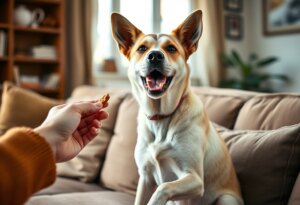


Senior dog dominance is one of the most misunderstood terms in canine behavior, and it’s costing multi-dog households a lot of unnecessary stress. When an aging dog growls at a bouncing new puppy, most owners assume they’re watching a fixed personality trait play out: the “alpha” dog putting the newcomer in its place. That’s not quite what’s happening physiologically or socially, and understanding the actual mechanism is the difference between a household that adapts smoothly and one that spirals into chronic tension.
Let’s start with the biology, because it changes how you should intervene. Bradshaw et al. (2009) examined dominance-related behavior in domestic dogs and found that what we call “dominance” is context-dependent, not a stable personality attribute. A dog doesn’t wake up dominant. A dog exhibits dominance-related behaviors around specific, high-value resources (a favorite bed, a bully stick, proximity to the owner) in specific contexts, and those behaviors shift depending on the resource, the environment, and the physical condition of the animal. Senior dog dominance, when we see it directed at an incoming puppy, is almost always resource-holding potential in action: an older dog with reduced mobility, possible joint pain, and fewer social reserves for tolerating chaos is defending what she has left. That’s not tyranny. That’s a rational response from an animal whose physical and sensory resources are already stretched thin.
This reframe matters clinically. If you treat senior dog dominance as a fixed trait, you tend to either punish the growl (which suppresses the warning signal without addressing the underlying resource conflict) or you avoid managing resources altogether because you assume “she’s just dominant, that’s her personality.” Both responses increase risk. The productive path is functional: identify what resource is being protected, in what context, and modify the antecedents so the senior dog never needs to escalate to get her point across.
Pre-Introduction Protocol: Lowering Arousal Before Anyone Meets Nose-to-Nose
Most conflict I see in newly formed puppy-senior pairings isn’t caused by the introduction itself. It’s caused by skipping the steps that should happen before the introduction. Puppies are neophilic by nature (drawn toward novelty) and their arousal regulation is developmentally immature. Senior dogs, in contrast, often have elevated baseline stress reactivity due to age-related sensory decline (reduced hearing and vision make sudden approaches genuinely startling) and potential chronic pain that lowers bite threshold. You are managing two animals with opposite arousal profiles, and your job before any face-to-face meeting is to narrow that gap.
- Scent swapping first. Before the dogs see each other, exchange bedding or a worn towel between their spaces for several days. Dogs process identity and threat assessment largely through olfaction; letting the senior dog investigate the puppy’s scent on her own terms, without the pressure of a live, moving stimulus, reduces the novelty spike considerably.
- Parallel walks on neutral territory. Two handlers, two leashes, enough distance that neither dog is fixating (roughly 15 to 20 feet to start). Walk in the same direction, not toward each other. This lets both dogs observe calm, non-confrontational body language from the other without any pressure to interact. Gradually close the distance across multiple sessions only if both dogs remain loose and relaxed.
- Control arousal thresholds, not just distance. Watch for the puppy’s arousal ceiling (frantic pulling, high-pitched vocalizing) and the senior’s stress ceiling (stiffening, whale eye, retreating) and end the session before either dog crosses it. Ending on a calm note is what actually builds the association you want.
If your household already includes an older dog dealing with new arrivals of any kind, the groundwork is similar to what we outline in our safe introduction guide for pairing a new puppy with a senior Golden Retriever, which covers breed-specific pacing considerations worth reviewing alongside this protocol.
Reading the Signals Before They Escalate
Owners frequently intervene at the wrong moment: after the growl, after the snap, after the puppy yelps. By then you’ve missed roughly six or seven earlier signals the senior dog was broadcasting. Canine appeasement and threat displays exist on a gradient, and reading the early end of that gradient is the single most useful skill you can develop for managing senior dog dominance without conflict.
- Lip licking or tongue flicks with no food present, often the first low-grade stress marker.
- Turning the head or body away while remaining stationary, an appeasement gesture requesting space.
- Freezing, a full-body stillness that signals the animal is deciding between flight and confrontation.
- Hard stare, direct unblinking eye contact, typically the last cue before an escalation to a growl or snap.
- Raised hackles (piloerection), which indicate heightened arousal but not necessarily aggression; context and the dog’s overall body posture matter here.
- Whale eye (visible white sclera) combined with a lowered head, a classic conflict signal in resource-adjacent situations.
Your intervention point should be lip licking or head turning, not the hard stare. If you consistently wait for growling before separating the dogs, you’re reinforcing the idea, correctly, that growling is the only signal that gets a response. That’s how you end up with a senior dog who skips the polite warnings altogether over time.

The Structured Introduction Protocol
Once parallel walks are calm and consistent, move to a structured, staged introduction. This is not a one-afternoon event. Expect this phase to run anywhere from one to several weeks depending on the senior dog’s temperament and health status.
- Barrier introductions first. Use a baby gate or exercise pen so the dogs can see and smell each other without full body contact. Keep sessions under five minutes initially. Reward calm behavior from both sides with quiet praise or a low-value treat delivered away from the barrier itself, so treats don’t become a resource dogs compete over at the gate.
- Short, supervised off-barrier sessions. Once barrier sessions are consistently calm across several days, allow brief supervised contact in a neutral room, leashes on but slack, for two to three minutes at a time. End before either dog shows the early stress signals listed above.
- Separate feeding stations, permanently. This is non-negotiable, not a temporary measure during the introduction period. A frequently cited pattern in Applied Animal Behaviour Science research on multi-dog households found that resource guarding incidents dropped significantly once owners implemented separate feeding zones with physical distance or barriers between dogs during meals. Feed the senior dog in her established spot, away from foot traffic and away from the puppy’s crate or feeding area.
- Stagger high-value chews and toys. Never present a marrow bone, bully stick, or new toy to both dogs in the same room during the early months. Give the senior dog her chew in her retreat space, and occupy the puppy elsewhere. High-value items are the single most predictable trigger for resource-guarding displays, and staggering removes the antecedent entirely rather than trying to manage the consequence.
- Increase unstructured time gradually. Only after weeks of calm supervised sessions should you consider longer periods of loose supervision, and even then, keep a physical barrier option available for the senior dog to use at will.
Recovery periods matter here too. If your senior dog is coming off a surgery or a mobility-limiting flare-up during this introduction window, her pain threshold and patience will both be lower than baseline. Products like the MIDOG Inflatable Dog Cone After Surgery, Donut Collar can help a recovering senior dog stay comfortable and protected from incision irritation without the rigid plastic cone bumping into furniture or a curious puppy during this already stressful adjustment period.

- STRESS-FREE RECOVERY: See, Eat & Sleep in Comfort! Our inflatable donut design provides a full range of vision, allowing…
- EFFECTIVE BARRIER: Designed for post-surgery healing. Creates a protective shield that prevents biting and licking of st…
- WON’T SLIP OFF: Thread your pet’s own collar through the inner loops for a secure fit. Adjustable strap provides a custo…
Comparing Introduction Tools by Function and Investment Level
Different households need different physical tools to manage the introduction period safely. Here’s how the common options stack up, evaluated for the specific job of managing senior dog dominance during a puppy introduction.
| Tool | Primary Function | Best For | Price Tier |
|---|---|---|---|
| Freestanding baby gate / exercise pen | Visual and scent barrier for supervised, no-contact introductions | Barrier introduction phase, ongoing retreat zone management | $$ |
| Separate elevated feeding stations | Removes food-proximity as a resource-guarding trigger | Permanent multi-dog household management | $ |
| Orthopedic senior dog bed with raised sides | Gives the senior dog a defensible, comfortable retreat space | Reinforcing the senior’s “safe zone” during adjustment | $$$ |
| Post-surgical recovery collar (inflatable style) | Protects healing incisions without restricting peripheral vision | Senior dogs recovering from surgery during a puppy introduction | $$ |
| Two handlers with separate leashes | Controlled parallel walk and distance management | Neutral-territory pre-introduction walks | $ |
The growl is not the failure. The growl is the senior dog doing exactly what a well-socialized adult dog is supposed to do: warning before biting. Our job as owners is to make sure she never needs to get that far down the signaling ladder to be heard.
Building a Happiness Plan for the Senior Dog
In behavior consulting, I use something I call a Happiness Plan for the resident senior dog whenever a new animal enters the home. This is a working document, not a wish list, and it centers the senior dog’s welfare as the primary success metric rather than treating “the dogs get along” as the only acceptable outcome.
- Preserve established routines. Feeding time, walk time, and the senior dog’s preferred resting spots should not shift to accommodate the puppy’s schedule. Predictability lowers baseline cortisol in aging dogs, and disrupted routines are a common, avoidable stressor.
- Guarantee a retreat zone the puppy cannot access. A crate, a gated room, or an elevated bed the puppy can’t jump onto. This needs to be available at all times, not just during active introduction sessions.
- Reinforce calm coexistence, not forced affection. Reward the senior dog for tolerating the puppy’s presence at a distance. Do not require, lure, or physically position the senior dog into direct contact she hasn’t initiated.
- Track quality-of-life markers weekly. Appetite, sleep quality, willingness to engage with the owner, and frequency of stress signals around the puppy. A decline across multiple markers means the pace is too fast.
- Accept management as a legitimate endpoint. Some senior dogs never fully tolerate a puppy’s presence, and permanent separation via gates, crates, or scheduled separate time is a legitimate, welfare-respecting outcome. Forced friendship is not the goal. Safety and reduced chronic stress for the senior dog is the goal.
This is also where owners sometimes discover the senior dog’s irritability isn’t really about the puppy at all, it’s an underlying pain condition or a sudden behavioral shift worth investigating on its own. If you’re noticing new reactivity that seems disconnected from the introduction itself, our piece on sudden barking changes in senior dogs walks through the medical and behavioral differentials worth ruling out before assuming it’s purely puppy-related stress. And if the senior dog’s warnings are escalating toward you directly rather than the puppy, that’s a distinct pattern covered in our guide on managing a dog that barks or bites at its owner, which is worth reading separately from the introduction protocol.
Enrichment matters during this transition too, for both dogs, but especially for a senior dog whose routine has been upended. Keeping the puppy occupied with age-appropriate independent activities, like a supervised I Want to Be a Police Officer! Coloring and Activity Book style quiet-time activity for the humans in the house to work on nearby, can actually help lower overall household arousal during the adjustment weeks by giving everyone, dogs included, a lower-key baseline rhythm to settle into.

Nutrition also plays a quiet but meaningful role in how well a senior dog copes with the added stress of a new household member. Dogs experiencing elevated cortisol from ongoing social tension sometimes show reduced appetite, and offering a highly palatable, easily digestible option like Portland Pet Food Company Human-Grade Wet Cat style meal toppers (check that any topper is appropriate for canine use and cleared with your veterinarian first) can help maintain caloric intake in a senior dog who’s temporarily eating less due to the disruption.

- EXCLUSIVELY REAL INGREDIENTS: All-natural, fully cooked homestyle cat food meal pouches are crafted with premium, fresh …
- HIGH-PROTEIN, GRAIN-FREE: Minimum 13% crude protein. Our cat food is protein-rich with simple ingredients for easier dig…
- ALL-NATURAL, AMERICAN-MADE CAT FOOD: Fully cooked, ready to eat. We serve up gluten-free, grain-free, wheat-free cat foo…
Why Forcing the Relationship Backfires
Owners under time pressure (a new puppy home from the breeder, family expectations, social media comparisons to other households) often want to speed past the staged protocol. Don’t count on a few good days of calm behavior to mean the relationship is settled. Behavioral progress in multi-dog households is rarely linear, and a senior dog who tolerated a puppy calmly for a week can still have a bad pain day, a bad sleep night, or a startle event that resets the trust built so far. Reassess constantly rather than assuming the work is finished once initial sessions go well.
The data on dominance framing is genuinely contradictory in places, some researchers argue hierarchical models still have limited explanatory value in specific resource-competition contexts, others reject the framework almost entirely in favor of purely relational, context-driven models. What’s consistent across the literature is that punishing a warning signal, regardless of which theoretical model you subscribe to, reliably makes things worse. According to the ASPCA’s guidance on common dog behavior issues, addressing the underlying trigger and reinforcing calm alternative behavior is consistently more effective than suppressing the visible symptom. That’s the model this entire protocol is built on.
Frequently Asked Questions
Is senior dog dominance actually a real, fixed trait in older dogs?
No, not as a fixed personality trait. Research, including Bradshaw et al. (2009), shows dominance-related behavior in dogs is context-dependent and tied to specific resources rather than being a stable trait an individual dog carries into every situation. What looks like senior dog dominance is typically resource-holding behavior tied to reduced mobility, chronic pain, or diminished sensory tolerance, not an inherent desire to control the household.
How long does the puppy and senior dog introduction process typically take?
Plan on several weeks at minimum, and longer if the senior dog has mobility limitations, chronic pain, or a history of reactivity. Rushing past barrier introductions and parallel walks is the most common reason early conflicts escalate, so pace the protocol to the senior dog’s stress signals rather than a fixed calendar.
Should I correct my senior dog for growling at the puppy?
No. A growl is a communication signal, not misbehavior, and punishing it removes the warning without addressing the underlying trigger. The safer approach is to separate the dogs calmly, identify what resource or proximity issue caused the growl, and adjust management so the senior dog doesn’t need to escalate to a growl to get space in the future.
What if my senior dog never accepts the puppy?
Some senior dogs never fully tolerate a puppy’s presence, and that is a legitimate outcome. Permanent management, separate spaces, staggered schedules, and supervised-only interaction, is a welfare-respecting solution when full integration isn’t realistic. The goal is a low-stress household for both dogs, not forced friendship.