
Deshedding tools matter more for senior Labs and Golden Retrievers than most owners realize, and not just because of the fur on your couch. As double-coated dogs age, their follicle cycling slows down, their skin loses elasticity, and the volume of loose undercoat they carry around actually increases rather than decreases. If you’re chasing tumbleweeds of fur across your kitchen floor more than you did five years ago, your dog isn’t shedding “more” out of nowhere. There’s a physiological explanation, and there’s a right way to manage it that respects an aging joint and a sensitive coat at the same time.
Why Senior Double Coats Shed Differently: The Follicle Cycling Shift
Canine hair follicles cycle through three phases: anagen (active growth), catagen (transition), and telogen (rest). In young, healthy Labs and Goldens, this cycle turns over predictably, and seasonal blowouts are relatively contained. In geriatric dogs, the data on canine dermatology suggests telogen phases lengthen and anagen re-entry slows, meaning more hairs sit dormant in the follicle for extended periods before finally releasing. The practical result is a coat that seems to shed in clumps rather than a steady trickle, often independent of season. Skin elasticity also declines with age, which reduces the natural tension that helps push dead hair out during normal movement and self-grooming. This is not a hygiene failure on your part. It’s biology, and it’s why deshedding tools become a more frequent, not optional, part of a senior dog’s care routine.
Reduced grooming self-efficacy also plays a role. A younger dog with good hip and spine mobility can twist to lick and scratch problem areas along the flank and tail base. A ten or twelve-year-old Lab with early osteoarthritis often can’t reach those spots comfortably anymore, so dead undercoat accumulates there specifically. That’s usually the area where owners find the worst mats, right at the hip and hindquarter region, which is not a coincidence.
Sensory Load and Joint Comfort: Why Grip Pressure Changes the Whole Session
Grooming tool pressure is not a minor detail. It’s a variable that directly interacts with your dog’s stress physiology. A 2022 study published in Frontiers in Veterinary Science found that approximately 58% of senior large-breed dogs show radiographic or clinical signs of subclinical osteoarthritis, meaning pain that isn’t dramatic or obvious but is still measurably present (Fox et al., 2022). A dog in this condition experiencing firm brush pressure against a hip or shoulder joint while standing unsupported is managing two stressors simultaneously: mechanical discomfort and postural instability. Neither shows up as an obvious yelp. It shows up as subtle avoidance, muscle guarding, or a dog who starts declining brushing sessions they used to tolerate fine.

This is why tool selection and technique matter jointly, not separately. A slicker brush dragged with the same pressure you’d use on a young, sturdy dog can create a bracing response in a senior with joint sensitivity. Grooming should happen with the dog lying down or supported on a stable, cushioned surface, never standing for extended periods on a hard floor. If your dog also struggles with settling at night due to joint discomfort or restlessness, that same nervous system sensitivity often overlaps with sleep disruption, and resources like white noise solutions for dogs barking at night can be a useful adjunct for overall comfort management.
Comparative Breakdown: Undercoat Rakes, Deshedding Blades, Slicker Brushes, and Grooming Gloves
Not all deshedding tools are interchangeable, and for senior dogs specifically, the differences in joint-friendliness and coat safety are significant enough to warrant a side-by-side look. Below is a comparative breakdown of the four major tool categories relevant to heavy-shedding senior Labs and Golden Retrievers.
| Tool Category | Shedding Efficacy | Joint-Friendliness for Seniors | Coat & Skin Safety | Price Tier |
|---|---|---|---|---|
| Undercoat Rake | High (best for deep double coats) | Moderate (requires supported posture) | Good if angled correctly, can nick skin if forced | $$ |
| Deshedding Blade/Self-Cleaning Brush | Very High | Good (light pressure needed) | Good with regular use, avoid on thin senior skin folds | $$$ |
| Slicker Brush | Moderate (better for surface mats) | Moderate (fine tines can feel sharp on sensitive skin) | Fair, easy to overdo on fragile senior skin | $ |
| Grooming Glove | Low to Moderate | Excellent (mimics petting, very low stress) | Excellent, gentlest option for arthritic or anxious dogs | $ |
For dogs with significant undercoat buildup along the flanks and hindquarters, a self-cleaning rake style tool tends to outperform a standard slicker brush in raw efficacy. The Self-Cleaning Deshedding Dog Cat Brush, Thick Double Coat is designed specifically for dense double coats like those on Labs and Goldens, and the retractable bristle mechanism reduces the repetitive strain on your own hand during longer sessions, which matters when senior dogs need slower, more frequent grooming rather than quick aggressive passes.
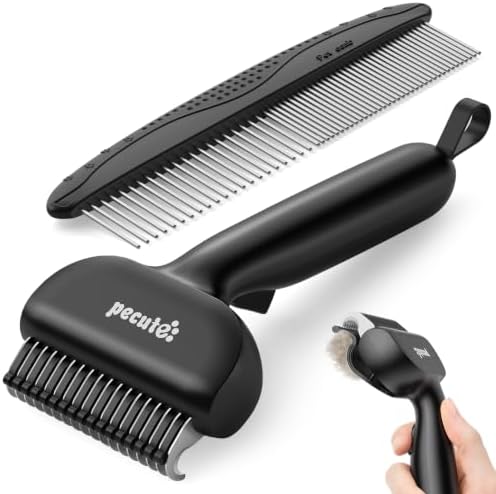
- 1-CLICK SELF-CLEANING — NO MORE MANUAL HAIR PULLING: This undercoat rake solves the grooming frustration. Just press the…
- REMOVES UP TO 95% OF LOOSE FUR — DESIGNED FOR THICK DOUBLE COATS: Engineered specifically for dense undercoats and heavy…
- GENTLE DEMATTING — ROUNDED TEETH GLIDE WITHOUT IRRITATING SKIN: Unlike sharp dematting rakes for dogs, our fine-polished…
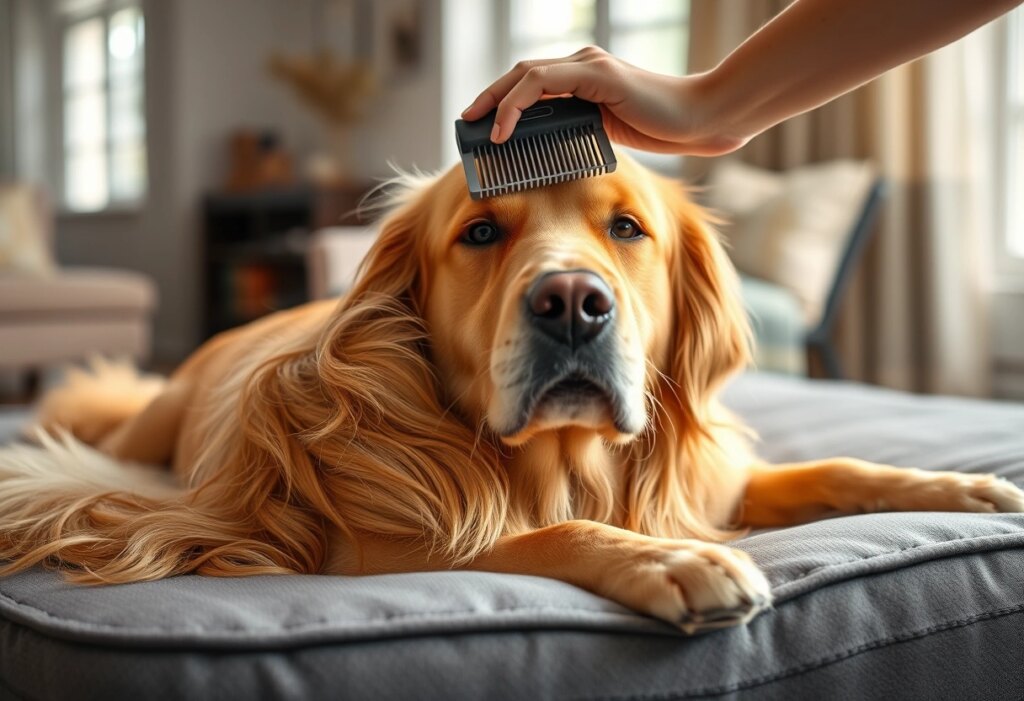
When mats have already formed, usually around the hips or behind the ears where a senior dog can no longer reach, a dedicated undercoat rake for dogs paired with a dematting comb becomes necessary before general brushing can even happen. Trying to force a slicker brush through an established mat pulls at the skin and can cause real pain in a dog with reduced skin elasticity. The 2 Pack Double Sided Dematting Comb for Dogs Cats allows you to work through tangles gradually with rounded teeth that reduce skin drag, which is the safer approach for a dog whose connective tissue is already less forgiving than it was at age three.
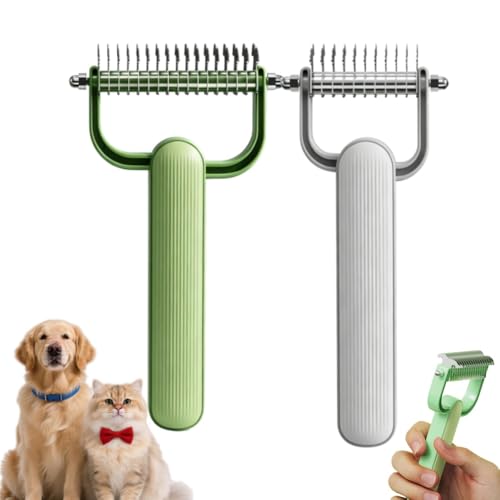
- ✨【Efficient Hair Removal Experience】The V-tooth pet grooming comb features efficient hair removal, designed for both cat…
- 🌀【Upgraded Material】This deshedding comb is crafted from upgraded material, providing durability, suitable for long term…
- 🖐【Ergonomic Handle for Comfort】The ergonomic handle of this pet comb offers comfortable design with a soft, fitted grip,…
Cooperative Care: A 3-Step Desensitization Protocol for Grooming Tolerance
One misconception I hear often is that a dog “just doesn’t like being brushed” as a fixed personality trait. In most cases, what’s actually happening is an unaddressed pain association combined with a total lack of agency in the process. The dog has no way to say “that spot hurts, slow down” except by pulling away, and owners frequently interpret that as stubbornness rather than communication. Teaching a structured stop signal changes the entire dynamic. Here’s the protocol I recommend for senior Labs and Goldens who have started resisting grooming:
- Establish a consent position. Teach the dog to rest in a specific spot, a mat or the edge of an orthopedic bed, and reward calm settling there with high-value treats before any tool touches the coat. This builds a positive antecedent, meaning the environment predicts safety before grooming even starts.
- Introduce a “pause” cue the dog can trigger. Chin rest or nose-to-target behaviors work well. If the dog lifts its head off the rest position, grooming stops immediately. This gives the dog functional control over session duration, which measurably reduces avoidance behavior in most cases because the dog learns discomfort has an exit rather than being unavoidable.
- Pair tool contact with continuous low-value reinforcement, not just start/end rewards. A steady trickle of small treats during brushing, rather than one treat at the end, keeps the dog’s arousal state lower throughout and prevents the anticipatory tension that builds when a dog is just waiting for the session to be over.
This isn’t about tricking the dog into tolerating pain. If a dog consistently signals to stop the moment a tool reaches a specific area, that’s diagnostic information, not a training failure, and it usually means a veterinary skin or joint check is warranted before continuing in that spot.

The goal of cooperative grooming isn’t compliance. It’s giving the dog a functional way to say “this is too much right now,” which in my experience produces far more consistent long-term tolerance than restraint-based approaches ever do.
Case Profile: A Happiness Plan for a 10-Year-Old Golden Retriever with Reduced Standing Tolerance
Consider a hypothetical but clinically representative case: a ten-year-old Golden Retriever, moderate hip dysplasia, tolerates standing for roughly five minutes before shifting weight and showing discomfort. Owner reports increased matting behind the ears and along the rear flanks over the past year. Here is the grooming-specific Happiness Plan I’d build for this profile.
- Session pacing: Two sessions of four to five minutes daily rather than one fifteen-minute weekly session. Shorter, frequent sessions match the dog’s standing tolerance and prevent the cumulative joint fatigue that comes from one long grooming marathon.
- Positioning: All sessions occur with the dog lying laterally on a supportive orthopedic surface, never standing, to remove weight-bearing stress entirely from the equation.
- Tool rotation: Start each session with a grooming glove for one to two minutes to lower arousal and check for tenderness, since the glove mimics petting and rarely triggers defensive responses. Follow with the True Touch Five Finger Deshedding Glove style tool before transitioning to a rake for denser areas once the dog is settled and showing no guarding.
- Skin-check schedule: Weekly visual and tactile checks of hip, flank, and ear-base regions for redness, flaking, or early mat formation, logged briefly so patterns are visible over time rather than relying on memory.

- MIMICS REAL HUMAN TOUCH Your pet will enjoy a relaxing massage while the over 180 soft silicone grooming tips reach deep…
- 5 FINGER DESIGN Easily contours to reach all the places hair hides like behind their legs, under their chest, in their t…
- PET THE HAIR AWAY Guaranteed to minimize shedding, keeping you and your house clean. Just think how much happier and hea…
This kind of consistent, low-pressure routine isn’t just about aesthetics. The American Veterinary Medical Association (AVMA, 2023) reports that regular deshedding reduces matting-related dermatitis incidence by approximately 40% in senior double-coated breeds, largely because trapped moisture and debris under mats create the exact conditions bacterial and fungal skin infections need to take hold. A consistent grooming schedule using the right senior dog grooming brush is functioning as preventive medicine, not just cosmetic maintenance.
Choosing the Right Shedding Tool for Labs Specifically
Labrador coats differ slightly from Golden coats in that the undercoat is denser but the guard hairs are shorter, which means a shedding tool for Labs needs strong undercoat penetration without excessive length in the tines. Owners frequently reach for whatever tool worked on a fluffier breed and find it doesn’t clear a Lab’s coat efficiently. If your senior Lab is also showing broader signs of slowing down, appetite changes, or altered sleep patterns alongside the shedding increase, it’s worth cross-referencing those symptoms against a general resource on early old age symptoms in senior dogs, since skin and coat changes rarely occur in total isolation from other systemic aging markers. According to the American Kennel Club, regular coat maintenance is also one of the more reliable ways owners catch early skin masses or lesions in senior dogs, simply because you’re putting hands on the entire body surface multiple times a week.
Building a Sustainable Routine
The dogs who tolerate grooming best long-term aren’t the ones who were forced through it consistently. They’re the ones whose owners paid attention to pacing, pain signals, and tool choice from the start. Investing in a few well-matched deshedding tools and a slower, more communicative approach pays off in both coat health and the overall trust relationship you maintain with a dog who is already navigating enough physical changes in this stage of life. Reassess your deshedding tools kit every few months as your dog’s mobility and skin condition shift, because what worked at age eight may need adjusting by age eleven.
Why does my senior Lab or Golden Retriever seem to shed more than when they were younger?
Aging slows the natural follicle cycling process, causing hair to remain in the resting (telogen) phase longer before shedding in larger amounts. Reduced skin elasticity and decreased self-grooming ability due to joint stiffness also contribute to visible buildup, particularly around the hips and flanks.
What deshedding tools are safest for a senior dog with arthritis?
Grooming gloves and self-cleaning deshedding brushes with light-pressure bristles are generally the safest starting point, since they don’t require the dog to stand unsupported and apply gentler, more even pressure than traditional slicker brushes or metal rakes.
How often should I use deshedding tools on a senior double-coated dog?
Short, frequent sessions of four to five minutes, several times per week, tend to work better than one long weekly session. This pacing respects reduced standing tolerance and prevents the joint fatigue that comes from extended grooming positions.
Can regular deshedding actually prevent skin problems in older dogs?
Yes. Regular deshedding reduces matting-related dermatitis incidence by approximately 40% in senior double-coated breeds according to AVMA reporting, largely by preventing trapped moisture and debris under mats that create conditions favorable to skin infections.