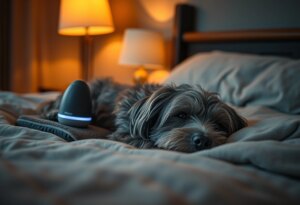
If you’ve been padding down the hallway at 2 a.m. for the third night in a row, trying to figure out why your old dog is barking at shadows, I want you to know something first: dog barking at night in a senior dog is almost never “just being difficult.” It’s information. Your dog is telling you something has shifted, in her body, her brain, or her sense of safety, and our job is to listen closely enough to know which one it is.
I’ve sat on plenty of dark porches with old dogs who couldn’t settle. Some nights it was a raccoon rustling the fence line. Some nights it was something deeper, something in an aging brain that couldn’t quite make sense of the world anymore. White noise machines get talked about a lot as the fix for dog barking at night. I want to give you the honest version of that conversation, not the version that sells you something and disappears.
Why Senior Dogs Bark More at Night
Older dogs experience the world differently than they did at two or three years old. Their hearing changes. Their vision often dims. And for a meaningful portion of them, their brains are genuinely aging in ways that mirror human cognitive decline.
There’s a real phenomenon in veterinary medicine called sundowning, borrowed straight from human dementia care, where confusion and restlessness intensify as daylight fades. A 2013 study published in the Journal of Veterinary Behavior found that up to 32% of dogs over age 11 show signs of canine cognitive dysfunction (CCD), and that number climbs the older they get. That’s not a small footnote. That’s a third of our senior dogs walking around with brains that are quietly rewiring in ways that make nighttime harder.
Add in some sensory decline, a dog who can’t see the mailbox shadow clearly or hear the neighbor’s car door the way she used to, and you get a dog who startles at sounds she used to sleep right through. That startle turns into a bark. The bark turns into pacing. The pacing turns into a 3 a.m. wake-up call for the whole house.
Old dogs aren’t losing their minds. Their minds are changing shape, and it’s on us to meet them there with patience instead of frustration.
How White Noise Machines Actually Work
The theory behind a white noise machine for dogs is pretty simple, and honestly, pretty sound. A consistent, even hum of sound masks the sudden, sharp noises that trigger a startle response, a creak in the floorboards, a possum in the yard, a car door three houses down. Instead of silence that gets broken by one jarring sound, the room has a steady blanket of noise that smooths those spikes out.

For a dog whose hearing or brain processing has started to decline, sudden sound changes can feel disorienting rather than just annoying. A steady background hum gives their nervous system less to react to. Think of it like dimming harsh lighting for someone with sensitive eyes. You’re not fixing the underlying issue, you’re softening the environment around it.
This is also where sound-related training tools come into the picture, though for a different purpose. Products like the Anti Barking Device for Dogs, Automatic Bark Box Ultrasonic Dog Deterrent are designed to interrupt barking through sound cues, which is a completely different mechanism than white noise. I mention it here because pet parents often lump these tools together, and they work in opposite directions. One masks triggering sound. The other introduces a sound to stop a behavior. For a senior dog with cognitive decline, I’d tread carefully with anything startling.
Do White Noise Machines for Dogs Actually Work? The Honest Answer
Here’s where I have to be straight with you, because that’s the whole point of this site. A white noise machine for dogs can genuinely help with sound-sensitivity barking. If your senior dog is waking up and barking because of outside noises, a consistent hum in the bedroom can smooth a lot of that out. I’ve seen it work. I’ve recommended it to plenty of sanctuary families. But a white noise machine will not fix pain. It will not fix a full bladder. And it will not fix true CCD-driven disorientation, the kind where a dog wakes up and genuinely doesn’t know where she is or who’s in the room with her.
The ASPCA and the American Veterinary Society of Animal Behavior (AVSAB) are both clear on this point: any sudden behavioral change in a senior dog, including new nighttime barking, warrants a vet visit before you assume it’s just a sound sensitivity issue. Arthritis pain, urinary tract infections, vision loss, and cognitive decline can all present as “barking at night,” and a white noise machine will do nothing for any of them. It might even mask the problem long enough that you miss the real cause.
So the honest answer is: yes, it works, for a specific slice of the problem. It is not a substitute for a veterinary exam. Please don’t let a gadget become a reason to delay that call.
What to Look for in a Machine for an Aging Dog’s Ears and Routine
Not all white noise machines are built with a senior dog’s sensory needs in mind. Some are made for babies, some for frequent travelers, and their tones don’t always translate well to a dog whose hearing has already started to shift. Here’s what actually matters when you’re choosing one for senior dog nighttime anxiety:
- Adjustable volume, so you can start low and increase gradually rather than shocking a sensitive dog with sudden sound
- Non-startling tones, favor gentle white or brown noise over anything with sharp beeps or musical chimes that could confuse a dog with CCD
- Auto-off timers, useful if your dog only struggles in the first few hours of the night rather than needing sound all night long
- Placement near the bed, close enough to mask outside noise, but not so close it becomes its own disruptive presence
- Simple, consistent operation, a machine that turns on the same way every night helps build predictability, which matters enormously for a cognitively declining brain
Interestingly, some pet parents have found unexpected comfort in audio designed for reflection and calm rather than pure noise masking. Something like Short Takes on Long Stories can offer a gentle, low-key auditory backdrop for quiet evenings when you’re sitting with your dog rather than rushing to sleep. It’s not a clinical tool, but the steady presence of a calm voice or soft narration in the background can be part of building a peaceful wind-down routine for both of you.

Comparing Nighttime Sound Solutions for Senior Dogs
| Product Type | Best For | Key Feature | Senior Dog Suitability | Price Tier |
|---|---|---|---|---|
| Standard White Noise Machine | Masking outside sounds during sleep | Continuous, even hum with volume control | High, gentle and non-startling when set low | $$ |
| Ultrasonic Bark Deterrent | Interrupting active barking behavior | Sound-triggered response device | Moderate, use cautiously with CCD dogs | $$ |
| Calming Audio/Story Playback | Wind-down routines and quiet companionship | Soft narration or ambient audio | High, especially for anxious or lonely seniors | $ |
| AI-Guided Sleep Sound Systems | Adaptive nighttime environments | Responsive audio adjustment | Moderate to High, depending on simplicity of use | $$$ |
Sound Sensitivity vs. Attention-Seeking: Knowing the Difference
Not every bark in the night is about sound sensitivity or cognitive decline. Some senior dogs, especially ones who’ve had a recent change in the household, a new baby, a returning adult child, another pet getting more attention, will bark out of something closer to jealousy or attention-seeking. That’s a different animal entirely, and it calls for a different kind of support. If that sounds like what’s going on with your dog, our guide on the dog anxiety vest for jealousy and attention-seeking behavior walks through how gentle pressure garments can help dogs who are barking out of emotional need rather than sensory overwhelm. It’s worth ruling out before you assume every nighttime bark is a hearing or brain issue.

Building a Full Nighttime Comfort Routine
A white noise machine is one piece of a much bigger picture, not the whole picture. If you want to actually reduce dog barking at night in a lasting way, it has to sit inside a routine built around your dog’s real, whole-body needs.
Here’s what I’d want you to build alongside the sound machine:
- Orthopedic bedding that keeps arthritic joints from aching in the middle of the night and waking your dog up
- A consistent potty schedule, including a late final bathroom trip, since a full bladder is one of the most common and most overlooked causes of nighttime barking in seniors
- Vet-checked pain management, because a dog in silent discomfort will often express it through restlessness and vocalization rather than obvious limping
- Predictable bedtime rituals, same time, same room, same steps every night, which genuinely helps a cognitively declining brain feel steadier
- Daytime mental engagement, since dogs who are understimulated during the day often become more restless at night
I’ll also say this gently: weather changes can quietly disrupt sleep too. A dog who got soaked on an evening walk and came inside cold and uncomfortable may bark more that night simply because she’s not settled in her body. If that’s part of your world, our piece on whether Golden Retrievers need a raincoat covers how weather protection ties into overall comfort, and the same logic applies across breeds.
For families curious about more adaptive, tech-forward options, some pet parents have experimented with While You Dream Artificial Intelligence style audio systems that adjust to nighttime patterns. I’d call this a mid-tier experiment rather than a guaranteed fix, but for households already comfortable with smart home tools, it can be a reasonable addition to a broader comfort routine.

When to Call the Vet Instead of Buying Another Gadget
I want to leave you with this, because I think it matters more than any product recommendation I could give you. If your dog’s dog barking at night is new, sudden, or getting worse despite a calm environment and a solid routine, please call your vet before you buy anything else. The ASPCA’s senior pet care guidance is clear that behavioral shifts in older dogs deserve a medical look first, not a gadget-first response. Pain, vision loss, hearing loss, and cognitive decline all deserve their own diagnosis and their own care plan. A white noise machine can absolutely be part of a good nighttime routine. It should never be the reason you delay a vet visit for a dog who’s trying to tell you something is wrong.
This is a sacred trust we take on when we bring an aging dog into our nights and our beds and our lives. They give us their whole lives, and the least we owe them in return is showing up for the moments they can’t explain to us in words.
Frequently Asked Questions
Can a white noise machine really stop my senior dog from barking at night?
It can help significantly if the barking is triggered by outside noises like wildlife, traffic, or household creaks. A white noise machine for dogs masks those sudden sounds so your dog isn’t startled awake repeatedly. It won’t resolve barking caused by pain, a full bladder, or true cognitive dysfunction, so it works best as one part of a broader nighttime comfort plan rather than a standalone fix.
How do I know if my dog’s nighttime barking is from cognitive dysfunction or just sound sensitivity?
Sound sensitivity barking is usually tied to a specific trigger, a car outside, a neighbor’s dog, a gust of wind. Cognitive dysfunction related barking tends to look more disoriented, with pacing, staring at walls, or seeming confused about where they are even in a familiar room. If you’re seeing the second pattern, please schedule a vet visit rather than assuming a white noise machine will solve it.
Is it safe to leave a white noise machine running all night for an old dog?
Yes, in most cases a low, steady volume is safe to run all night, and many senior dogs settle better with consistent sound rather than sound that starts and stops. Just keep the volume gentle and check that it’s not so loud it becomes its own disruption, especially for dogs with sensitive hearing or existing anxiety around noise.
What else should I try if white noise doesn’t stop my senior dog’s nighttime barking?
Start with a vet exam to rule out pain, urinary issues, or cognitive decline. From there, look at orthopedic bedding, a firm potty schedule with a late-night bathroom trip, and predictable bedtime rituals. Dog barking at night often improves once the whole routine, not just the sound environment, is addressed together.
If you’re up again tonight listening for that bark, know that you’re not failing your dog by not having it all figured out yet. You’re paying attention, and that’s the whole job. Give your old dog patience, give yourself grace, and trust that quiet, consistent care adds up to something real over time.
Tell your pup I said Hi! — Dawn