
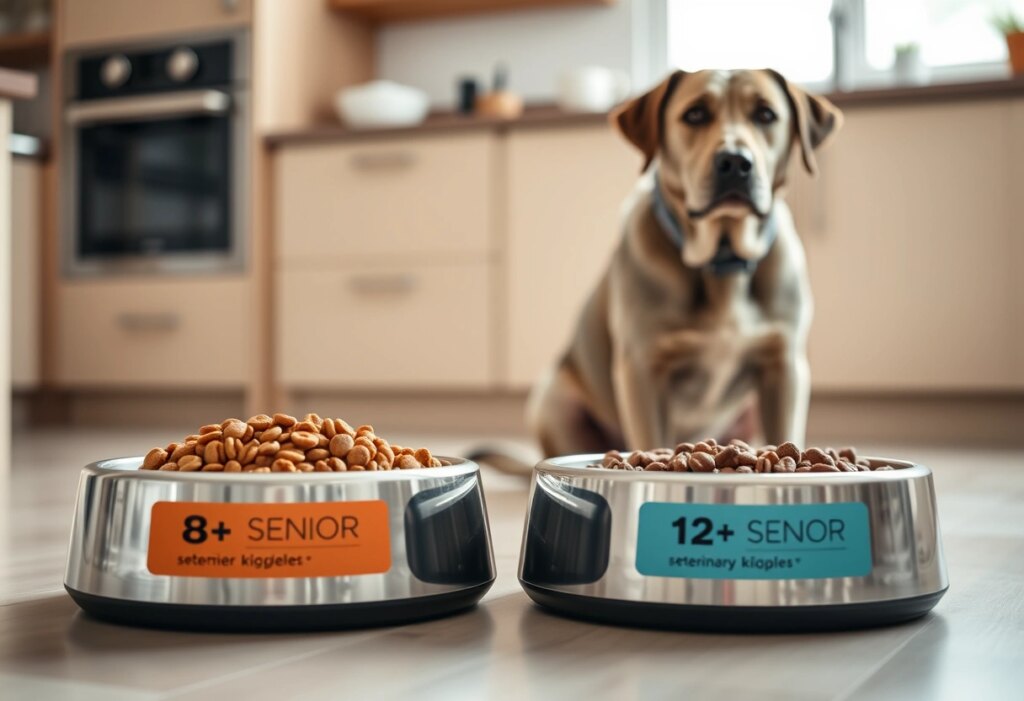

Royal Canin Senior food comes in two age-banded formulas, 8+ and 12+, and the difference between them is not marketing fluff. It reflects real, measurable shifts in a dog’s metabolic rate, kidney function, and muscle mass that occur across the second decade of life. If you’re standing in the aisle (or scrolling a product page) trying to decide which bag belongs in your dog’s bowl, the answer depends less on your dog’s birthday and more on what’s happening inside her body right now.
I get this question constantly from clients who assume “12+” just means “more senior” or “extra fancy.” It doesn’t. Age-banded senior formulas exist because the physiology of an 8-year-old Labrador and a 13-year-old Labrador can be genuinely different animals metabolically, even if they look similarly gray around the muzzle. Let’s get into what’s actually driving the formulation differences, because understanding the biology behind the label is what lets you make a decision based on data instead of a guess.
Why Age-Banded Senior Formulas Exist: The Metabolic Rationale
Resting energy requirement (RER) doesn’t stay flat across a dog’s lifespan. According to WSAVA nutritional guidelines, most breeds show roughly a 20% reduction in resting energy requirement by the time they reach 11 to 12 years old, driven by declining lean muscle mass and a slower basal metabolic rate. This isn’t a behavioral quirk or a matter of “getting lazy.” It’s a measurable shift in how many calories a dog’s body burns just existing, breathing, digesting, maintaining organ function, independent of exercise.
Layered on top of that metabolic slowdown is sarcopenia, the progressive, age-related loss of skeletal muscle mass that happens even in dogs who are not clinically ill. Sarcopenia reduces a dog’s functional strength, alters how she processes dietary protein, and increases her vulnerability to frailty if caloric intake isn’t matched to her actual energy needs. A Royal Canin Senior formula built for an 8-year-old dog assumes a moderate metabolic decline. A formula built for a 12-year-old dog assumes a much steeper one, plus a higher likelihood of subclinical organ changes. That’s the physiological line separating the two products, and it’s why simply feeding “the senior bag” regardless of specific age band misses the point of age-stratified nutrition entirely.
Royal Canin Senior 8+ vs 12+: A Side-by-Side Nutrient Breakdown
Below is a comparative snapshot of how the two formulas typically differ in macronutrient ratios and functional additives. Always check the current guaranteed analysis on your specific bag, as formulations are periodically updated, but the directional differences hold consistent.
| Attribute | Royal Canin Senior 8+ | Royal Canin Senior 12+ |
|---|---|---|
| Target Life Stage | Early-to-mid senior (mature adult decline) | Advanced senior (geriatric, higher comorbidity risk) |
| Protein Content | Moderate-to-high, supports lean mass retention | Adjusted for reduced renal workload, still muscle-sparing |
| Phosphorus Levels | Standard senior restriction | Further restricted to support subclinical kidney function |
| Calorie Density | Moderate reduction from adult formula | Lower density, matched to steeper RER decline |
| Joint-Support Additives | Glucosamine, chondroitin, EPA/DHA (moderate levels) | Glucosamine, chondroitin, EPA/DHA (often higher concentration) |
| Kibble Texture | Standard senior kibble | Often smaller/softer for dental and jaw comfort |
| Price Tier | $$$ | $$$$ |
Notice that both formulas include joint-support compounds like glucosamine and EPA/DHA, but the 12+ version typically leans harder into phosphorus restriction and calorie reduction. That’s a direct response to the renal and cardiac vulnerabilities that accumulate with advanced age, not just an arbitrary bump in “senior-ness.”

An Observational Exercise: Reading Your Dog’s Biological Markers Before You Switch
Rather than switching formulas purely by the calendar, I want you to run a short observational protocol over two to three weeks. This is the same kind of functional behavioral analysis I’d use to assess any change in an animal’s baseline, applied here to nutritional status.
- Appetite tracking: Log whether your dog finishes meals promptly, hesitates, or leaves food behind. A sudden drop in enthusiasm for a previously palatable food can signal that caloric density or kibble texture no longer matches her needs.
- Stool consistency scoring: Use a simple 1-to-5 scale (too loose to too firm) and log it daily. Persistent softening after introducing a new formula often points to a protein or fat ratio mismatch, not a food “intolerance” in the dramatic sense owners assume.
- Monthly body condition scoring (BCS): Using the standard 9-point BCS scale, physically palpate your dog’s ribs and assess waist definition from above. Weight loss despite stable food intake is one of the earliest observable markers of the metabolic shift the 12+ formula is designed to address.
- Water intake changes: Increased thirst can be an early behavioral marker of declining kidney function, and it’s worth logging alongside the other three metrics rather than dismissing it as “just hot weather.”
None of these markers alone confirms you need to switch formulas. But a pattern across two or three of them, especially unexplained weight loss combined with increased thirst, is a legitimate data-driven trigger for a vet conversation, not just a guess based on the number on the calendar.
The Misconception That “12+” Just Means “More Senior”
This is the myth I correct most often in consults, and the data on it is fairly unambiguous. Owners frequently assume the 12+ label is simply a marketing escalation, the pet food equivalent of “extra strength.” It isn’t. The 12+ formula is built around a distinct renal and cardiac support profile, not a generic intensification of the 8+ recipe.
According to the AAHA Senior Care Guidelines (2023), approximately 30% of dogs over age 10 show subclinical kidney function decline, meaning bloodwork may still fall within normal reference ranges even as functional renal reserve is measurably reduced. This is precisely why phosphorus restriction becomes a formulation priority in age-band-12+ diets, independent of whether a dog has been formally diagnosed with kidney disease.
Subclinical decline is a genuinely tricky category for owners to intuit, because “subclinical” by definition means there’s no obvious external sign yet. Your dog isn’t limping, isn’t vomiting, isn’t drinking abnormally more water in a way you’d notice without tracking it. That’s exactly why the phosphorus-restricted, calorie-adjusted 12+ formula exists as a preventive nutritional buffer rather than a reactive treatment. Waiting for overt clinical signs before adjusting diet means you’ve already missed the window where nutrition could have been doing protective work.
A Gradual Transition Protocol: Switching Formulas Without GI Upset
Any dog food transition, including moving between senior age bands, should be staged. Senior digestive tracts are generally less resilient to abrupt dietary shifts than younger dogs, partly due to changes in gut motility and microbiome stability that come with age.
- Days 1-2: 75% current food, 25% new formula
- Days 3-4: 50% current food, 50% new formula
- Days 5-7: 25% current food, 75% new formula
- Days 8-10: 100% new formula, monitoring stool and appetite closely
If loose stool or vomiting appears at any stage, hold at the current ratio for an extra two to three days before advancing rather than pushing forward on schedule. This isn’t a rigid countdown, it’s a responsive protocol that should bend to what your dog’s GI tract is actually telling you.

Some owners choose to work with a general senior maintenance diet during this transition window rather than jumping straight between age-banded specialty formulas. A food like NUTRO NATURAL CHOICE Adult Dry Dog Food, Farm-Raised can serve as a stable, moderate-protein baseline while you’re running the observational tracking described above, particularly if your dog is sitting right at that 8 to 10 year threshold and you’re not yet sure which age band fits.

- Supports Whole-Body Health: NUTRO NATURAL CHOICE Adult Dry Dog Food is made with essential nutrients and antioxidants to…
- Made With Real Lamb: Real lamb is the #1 ingredient in this protein-rich recipe
- Supports Healthy Skin & Coat: Made with high-quality protein, this delicious dry dog food also contains Omega 3 & 6 fatt…
Digestive Sensitivity and Formula Selection: Why Gut Health Matters in the Decision
Digestive tolerance is a variable that gets overlooked when owners focus purely on the age number on the bag. A dog with a history of sensitive digestion may do better on a formula with added probiotics and prebiotic fiber regardless of which senior age band she technically qualifies for. If your dog has shown a pattern of loose stool scores during the transition protocol above, a digestive-support formula like Purina ONE Plus Digestive Health Dry Dog Food, Chicken can be a reasonable bridge option while you and your vet sort out whether the 8+ or 12+ Royal Canin Senior formula is the better long-term fit.

- Complete and balanced digestive care dog food with digestive support for adult dogs with sensitive stomachs
- Highly digestible adult dog food formula enriched with probiotics for dog digestive support
- Real chicken is the first ingredient in our high protein dog food, which includes natural glucosamine sources for joint …
This is also a good moment to mention that hunger cues in senior dogs on prescription or restricted diets can behave differently than owners expect. If your dog seems persistently hungry after switching to a lower-calorie senior formula, it’s worth reading our breakdown on Prescription Diet vs OTC Food for Senior Dog Hunger, which walks through why calorie-restricted formulas can trigger begging behavior that isn’t actually true caloric deficiency.
When Comorbidities Override the Age Cutoff: A Vet-Consultation Checklist
Age is a useful proxy, but it is not the final word. A dog with diagnosed renal disease, arthritis, or cardiac disease may need a formula override regardless of whether she’s 9 or 13. Bring these points to your next vet visit:
- Recent bloodwork results, specifically BUN, creatinine, and SDMA values, which flag kidney function changes before symptoms appear
- Current body condition score and any weight trend over the past three to six months
- Mobility observations: stiffness after rest, reluctance on stairs, or slower rise-to-stand time, which may justify a higher-glucosamine formula sooner than the 12+ age cutoff would suggest
- Any existing diagnosis of arthritis, kidney disease, or cardiac disease that would call for a therapeutic prescription diet instead of an over-the-counter senior formula
- Current medication list, since some drugs interact with dietary sodium or phosphorus levels
Dogs managing joint pain sometimes benefit from formulas with elevated EPA/DHA regardless of their exact age band, since the anti-inflammatory omega-3 profile matters more than the calendar cutoff in these cases. And if your household is also navigating nighttime bathroom accidents alongside a senior nutrition transition, our guide on Crate vs Belly Band: Best Fix for Nighttime Accidents covers a related management issue that often surfaces around the same age.
Bringing It Together: Choosing Between Royal Canin Senior 8+ and 12+
The decision between Royal Canin Senior 8+ and Royal Canin Senior 12+ isn’t really about which birthday your dog has hit. It’s about whether her metabolic rate, kidney function, and muscle mass are tracking with typical early-senior physiology or with the steeper decline curve seen in advanced-age dogs. Royal Canin Senior formulas are engineered around those biological markers, and the AAHA data on subclinical kidney decline is a strong argument for erring toward the more phosphorus-restricted 12+ formula once your dog crosses into her low-to-mid teens, even if she still seems outwardly vigorous.
Run the observational tracking protocol, involve your veterinarian when the data suggests something’s shifting, and remember that a dog with existing arthritis or renal disease may need to override the age-based cutoff entirely. For general background on canine nutritional needs across the lifespan, the ASPCA maintains a solid overview of how nutrient requirements change as dogs age. Choosing the right Royal Canin Senior formula is ultimately about matching what’s on the label to what your dog’s body is actually doing, not just what her age suggests it should be doing.
Frequently Asked Questions
Can I switch my dog straight from Royal Canin Senior 8+ to 12+ without a transition period?
It’s not recommended. Even within the same Royal Canin Senior product line, the calorie density and phosphorus levels differ enough that an abrupt switch can cause loose stool or appetite changes in a senior digestive tract. A 7 to 10 day gradual transition, mixing increasing ratios of the new formula, gives the gut time to adjust.
My dog is 10 years old. Should I use the 8+ or 12+ formula?
Age 10 sits in a gray zone where either formula could be appropriate depending on your dog’s individual bloodwork and body condition. Run the observational tracking described above (appetite, stool consistency, monthly body condition scoring, water intake) for a few weeks and share the results with your veterinarian rather than defaulting to age alone.
Does the Royal Canin Senior 12+ formula help with kidney disease?
The Royal Canin Senior 12+ formula’s reduced phosphorus content is designed to support dogs with subclinical, age-related kidney function decline, not to treat diagnosed kidney disease. Dogs with confirmed renal disease typically need a therapeutic prescription renal diet, which is a different product category entirely and should be discussed directly with your veterinarian.
What if my dog loses weight on the 12+ formula?
Unexplained weight loss on a lower-calorie senior formula warrants a veterinary visit before you simply increase portion size. It could reflect a genuine mismatch between the formula’s calorie density and your dog’s actual energy needs, or it could signal an underlying medical issue that needs to be ruled out through bloodwork and a physical exam.