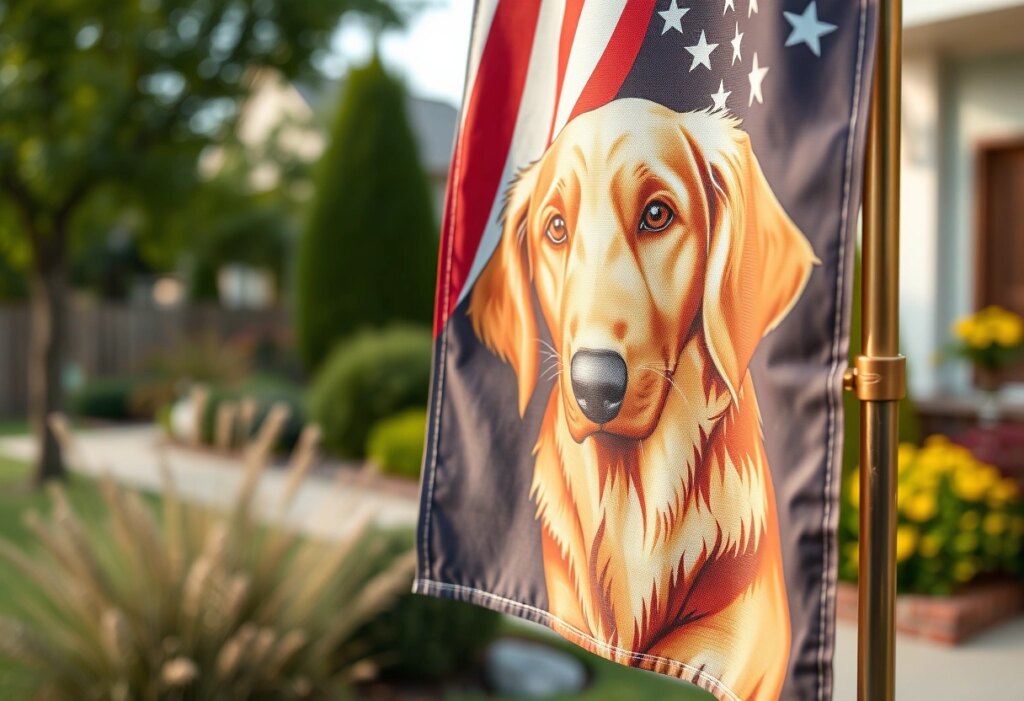

A weather-resistant flag has to survive sun, rain, and wind without turning into a faded, frayed rag within a single season, and that is the standard every outdoor golden retriever flag should be held to before it earns a spot on your porch pole. As a behaviorist, I spend most of my time studying stress physiology and sensory processing in dogs, not textile engineering. But porch and garden flags sit at an odd intersection of both worlds: they are decorative objects that also flap, snap, and rattle in the wind right next to the yard where your dog naps, patrols, and reacts to every new stimulus that crosses the property line. A flag that degrades quickly does not just look shabby. It becomes a noisier, more erratic visual and auditory trigger the longer it goes unreplaced.
This piece breaks down what “weather-resistant” actually means in fabric-industry terms, how nylon and polyester perform differently under sustained UV exposure, which hardware choices hold up in humid or coastal climates, and how to build a simple maintenance routine so your flag (and your dog’s nervous system) both have an easier time with the seasons ahead.
Key Takeaways
- Look for 300D or heavier polyester with UV-stabilized, solution-dyed color, not just a printed design.
- Double-stitched or triple-stitched edges resist fraying in sustained wind above 15 mph far better than single-stitched hems.
- Brass grommets outlast plastic grommets in humid, coastal, or freeze-thaw climates by a wide margin.
- Match flag weight and size to your typical local wind conditions rather than buying the biggest option available.
- Rotate and store flags seasonally to slow fading, mildew, and hardware corrosion.
What a Weather-Resistant Flag Actually Requires
“Weather-resistant” is a marketing phrase, not a regulated standard, so it helps to know what it should mean before you take a seller’s word for it. A genuinely weather-resistant flag is built from three components working together: a UV-stabilized dye process that resists photodegradation, a fabric weight dense enough to resist tearing and stretching, and construction details (stitching, hemming, grommet placement) engineered for repeated flexing in wind rather than a single decorative display indoors.
UV-stabilized dyes matter because ordinary pigment breaks down at the molecular level when exposed to continuous ultraviolet radiation. Cheaper flags printed with standard dye-sublimation on lightweight nylon will show visible fading within a matter of weeks in full sun exposure, especially in southern states with high UV indices. Fabric weight is usually expressed in denier (the “D” you see in product listings), and 300D polyester is the baseline most outdoor gear manufacturers treat as genuinely durable for continuous outdoor use, as opposed to the 75D or 100D nylon common in cheaper seasonal flags.
Nylon vs. Polyester: What the Durability Data Actually Shows
Owners frequently assume nylon and polyester are interchangeable because both show up constantly in outdoor flag listings. The data says otherwise. Industry fabric testing conducted under protocols similar to ASTM D4966 (an abrasion resistance standard used across outdoor textile manufacturing) consistently shows that solution-dyed polyester, where color is embedded into the fiber itself before weaving, retains color fastness roughly two to three times longer than sublimation-printed nylon under continuous ultraviolet exposure. Nylon is lighter and often drapes more attractively in light wind, which is why it dominates seasonal and decorative flags, but that same lightness means it degrades faster under sun and moisture cycling.
This is where seasonal decor flags reveal the trade-off clearly. A piece like the Fall Green White Pumpkin Decorative Garden Flag, Watercolor Style is designed for a short display window of a few months, so lighter nylon and sublimation printing make practical sense there. A flag meant to stay up year-round, through summer heat and winter storms, needs the heavier, solution-dyed polyester construction instead. Matching material to intended display duration is one of the simplest ways to avoid disappointment.

- Premium Quality: Our Friendsgiving garden flags feature vivid patterns, crafted with premium colorfast permanent dye. Th…
- Durable Vertical Flag: Made of 100% burlap blended with machine-washable polyester, this vertical garden flag is built t…
- Double-Sided Design: This garden flag has a full double-sided print, images are clear on both sides, and text reads corr…
For a true UV-resistant flag intended for permanent outdoor display, prioritize listings that explicitly state solution-dyed or “fade-resistant” polyester construction over ones that only describe the print method.
Grommets vs. Sleeve Pockets: The Hardware That Determines Lifespan
Fabric quality gets most of the attention, but hardware failure is the more common reason flags end up torn or spinning uselessly on their pole within a year. Two mounting styles dominate the market: brass or stainless grommets (metal-reinforced holes at the top of the flag) and sleeve or pole-pocket designs (a fabric tube the pole slides through).
Brass grommets consistently outperform plastic ones in humid, coastal, or freeze-thaw climates because plastic becomes brittle with repeated UV and temperature cycling, then cracks under the stress of wind gusts. Brass resists corrosion far longer, though it should still be checked periodically for green oxidation (verdigris), which signals it is time for a rinse or eventual hardware replacement. Sleeve designs distribute wind stress more evenly across the fabric and tend to reduce the tearing that happens around grommet holes in gusty conditions, but they also spin less freely, which some owners find visually less dynamic.
A well-constructed example worth studying for its stitching approach is the Dyrenson Welcome Boston Terrier Dog Decorative Garden Flag, which uses reinforced double-stitched edges around its grommet holes, the exact detail that prevents the small tears that eventually turn into a flag that separates from its pole entirely in strong wind.

- Durable Flag — Material: 100% burlap. Weatherproof and non-fray durability, Dyrenson home garden’s durable indoor, outd…
- Garden Flag Size — This vertical garden flag is the small, mini garden size (12-12.5 x 18″). Flag pole not included
- Produced in Higher Quality — The garden flags with puppy patterns are printed in premium colorfast permanent dye to cre…
Whichever hardware you choose, a durable garden flag should list its grommet material explicitly. If a listing is silent on that detail, treat it as a signal to look elsewhere.
Comparing Construction Quality at a Glance
The table below lines up construction details across a few reference products so you can see how material, hardware, and price tier tend to move together. None of these categories are absolute rules, but they reflect the general pattern seen across outdoor flag manufacturing when you are shopping for a weather-resistant flag rather than a short-season decoration.

| Product | Primary Material | Hardware | Best Use Case | Price Tier |
|---|---|---|---|---|
| Personalized Grandma Garden Flag | Solution-dyed polyester | Reinforced grommet holes | Year-round personalized display | $$ |
| Fall Pumpkin Watercolor Flag | Lightweight sublimation nylon | Standard grommets | Seasonal, short-term display | $ |
| Dyrenson Boston Terrier Flag | Heavier double-stitched polyester blend | Brass-compatible grommets | High-wind, humid climates | $$ |
The Buying Checklist Before You Order an Outdoor Golden Retriever Flag
Before adding any outdoor golden retriever flag to your cart, run it through the same checklist I use when evaluating any piece of recurring environmental equipment for a client’s dog: what is it actually rated to withstand, versus what does the listing photo imply?
- Fade-resistance rating: Look for explicit mentions of UV-stabilized or solution-dyed fabric rather than generic “fade-resistant” claims with no detail behind them.
- Water-repellency treatment: A treated finish sheds rain rather than absorbing it, which prevents the mildew smell and color bleed that show up after just a few soaked weekends.
- Reinforced stitching count: Double or triple stitching along the top and side hems is the detail that prevents small rips from turning into full tears in gusty conditions.
- Weight-to-wind matching: Heavier fabric holds up better in consistently windy regions, while lighter fabric moves more freely in calmer coastal or suburban settings; match the flag to your actual local conditions, not the display photo.
A piece like the Personalized Grandma Garden Flag Custom Grandkids Names demonstrates several of these boxes checked at once: solution-dyed polyester with reinforced grommet stitching, which is the combination that tends to survive an entire year of exposure rather than a single season.
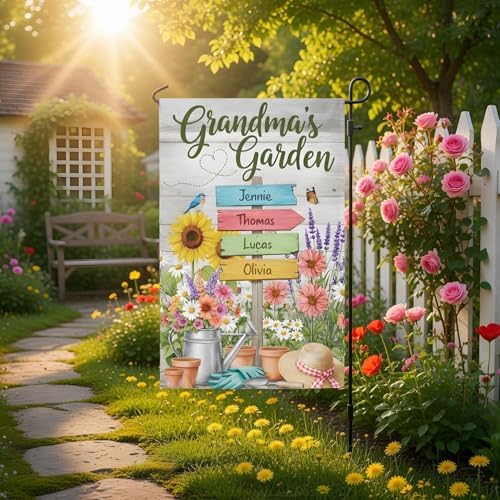
- HEARTFELT FAMILY BLOOMS: This personalized garden flag features a vibrant floral design and custom grandchildren’s names…
- Premium Material: Constructed with 2 layers of premium materials, including high-quality polyester fabric and coated sil…
If you are adding a new dog to the household soon, whether a purebred or a mix like those covered in our guide to finding a reputable Golden Dox breeder, it is worth choosing flag hardware and placement with an eye toward how a curious young dog might interact with a low-hanging pole or spinning fabric near a play area.
Dogs do not process a snapping flag as decoration. They process it as movement, sound, and novelty in their territory, all at once. A degraded flag that flaps unevenly or rattles against a loose grommet is a more erratic stimulus than an intact one, and erratic, unpredictable stimuli are exactly what tend to elevate baseline arousal in alert-sensitive dogs.
Maintenance Protocol: Rotation, Storage, and Degradation Signs
Even the best weather-resistant flag benefits from a maintenance routine, the same way any piece of recurring environmental equipment does. I recommend a simple three-part protocol:
- Rotation schedule: If you own more than one flag, rotate them every four to six weeks rather than leaving a single flag exposed continuously. This halves the cumulative UV exposure any one flag absorbs across a year.
- Seasonal storage: Bring flags indoors or into a garage during severe weather events (high wind advisories, ice storms) and during the coldest winter months if your region sees repeated freeze-thaw cycling, which accelerates grommet and fabric fatigue.
- Degradation checkpoints: Inspect monthly for fraying along the edges, visible color bleed or chalking on the surface (a sign the dye layer is breaking down), and rust or green oxidation forming around the grommets. Any one of these signs means the flag is on a declining trajectory, not a stable one.
On the behavioral side, it is also worth noting that a flag flapping loudly during a wind advisory can act as an unexpected trigger for dogs with noise sensitivity or territorial alert behavior, particularly older dogs whose hearing and stress thresholds have shifted with age. If your dog reacts to visitors, delivery workers, or ambient yard movement with persistent barking, our review of the best training tool to stop senior dog barking at visitors covers evidence-based options that pair well with simple antecedent management steps like relocating a noisy flag away from a dog’s primary sightline.
According to the National Weather Service, sustained winds above 15 mph are common across much of the country for extended stretches of the year, which is precisely the threshold outdoor flag manufacturers use when rating fabric weight and stitching durability. Choosing a weather-resistant flag rated for that baseline, rather than one tested only in calm showroom conditions, is what separates a flag that lasts one season from one that lasts several.
Frequently Asked Questions
What fabric weight should I look for in a weather-resistant flag?
Aim for 300D polyester or heavier. Anything lighter than that, especially unlisted denier weights, tends to be built for short seasonal display rather than continuous year-round exposure to sun and wind.
Are brass grommets really worth paying more for over plastic ones?
In humid, coastal, or freeze-thaw climates, yes. Plastic grommets become brittle with repeated UV and temperature cycling and tend to crack within a year or two, while brass resists corrosion and holds up considerably longer under the same conditions.
How often should I replace an outdoor flag?
A quality outdoor golden retriever flag built from solution-dyed polyester with reinforced stitching typically lasts twelve to eighteen months of continuous display before fading or fraying becomes noticeable. Lighter nylon flags often need replacement within a single season.
Can a flapping flag actually affect my dog’s behavior?
Yes. Sudden or erratic movement and noise near a dog’s territory can raise baseline arousal, particularly in dogs already sensitive to visitors or unfamiliar stimuli. A damaged, unevenly flapping flag tends to produce a more unpredictable stimulus than an intact one, which is one more reason to replace a degrading flag promptly.